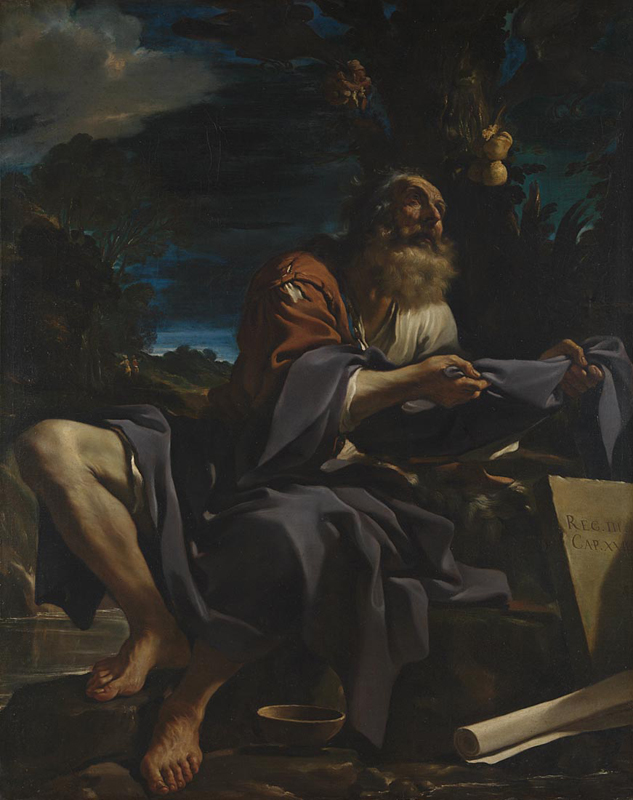
Elijah and the Widow
"The barrel of meal shall not waste, neither shall the cruse of oil fail"
"And Elijah the Tishbite, who was of the inhabitants of Gilead, said unto Ahab, As the LORD God of Israel liveth, before whom I stand, there shall not be dew nor rain these years, but according to my word." He hides by the brook Cherith, "and the ravens brought him bread and flesh in the morning, and bread and flesh in the evening."
"Arise, get thee to Zarephath, which belongeth to Zidon… I have commanded a widow woman there to sustain thee." She has "but an handful of meal in a barrel, and a little oil in a cruse: and, behold, I am gathering two sticks, that I may go in and dress it for me and my son, that we may eat it, and die." "Fear not… make me thereof a little cake first… For thus saith the LORD God of Israel, The barrel of meal shall not waste, neither shall the cruse of oil fail, until the day that the LORD sendeth rain."
Her son falls sick and stops breathing. "What have I to do with thee, O thou man of God? art thou come unto me to call my sin to remembrance, and to slay my son?" Elijah carries him to the upper room, stretches himself on the child three times and cries, "O LORD my God, I pray thee, let this child's soul come into him again." The child revives. "Now by this I know that thou art a man of God, and that the word of the LORD in thy mouth is truth."
Zarephath
Zarephath is identified with Sarafand on the Lebanese coast between Sidon and Tyre. James Pritchard's excavations (1969–74) found a Phoenician town with pottery kilns, olive presses and a small shrine with an inscription to Tanit-Ashtart. Tishbe and the brook Cherith have not been securely located.
Drought in Phoenicia
Josephus quotes the Tyrian historian Menander that in the reign of Ithobaal (Ethbaal, Jezebel's father) there was a year-long drought, ended when the king prayed. This is a later quotation of a lost source; it is suggestive, not confirmation of Elijah's drought. Climate studies of the region show droughts in the Iron Age but cannot date a particular one this precisely.
Widows
A widow with a son and no land had almost no security. Jesus cites this story in Nazareth: "many widows were in Israel in the days of Elias… But unto none of them was Elias sent, save unto Sarepta, a city of Sidon" (Luke 4:25–26).
The Case for the Biblical Account
Scripture's account
Elijah, the ravens and the widow of Zarephath (1 Kings 17).
What evidence would we expect?
A Phoenician town at Zarephath; droughts in the 9th century BC.
The discoveries
Excavated Phoenician Sarepta; Menander's reported drought under Ithobaal (via Josephus).
Testing the discoveries
The setting is real; the miracles are matters of faith.
The strongest reconstruction
Prophetic stories about Elijah set in the real conflict between YHWH worship and Phoenician Baal worship under Ahab.
What remains possible
The locations of Tishbe and Cherith.
What the evidence shows
- Sarafand is ancient Zarephath (Sarepta).
- Josephus reports a drought under Ithobaal of Tyre, citing Menander. Antiquities 8.324.
- Menander's drought is Elijah's drought.
- "The word of the LORD in thy mouth is truth."
Continue the journey
Ancient MysteriesBaal, Rain and Mount CarmelWho was Baal, and why is the contest about fire and rain?More from this lesson
Investigations
Optional deep dives: the ancient sources, the physical evidence, and every interpretation side by side, including unconventional ones, each labeled for what it is.
Baal, Rain and Mount CarmelBaal religion: documented · Site of the contest: tradition · The miracle: faith
Who was Baal, and why is the contest about fire and rain?
Ugaritic texts (13th century BC) portray Baal as the storm god who brings rain, fights Death, and whose absence dries the land. The Carmel story challenges Baal on exactly these powers. The Phoenician Baal of Jezebel's Tyre was probably Baal Shamem or Melqart. The contest itself is known only from Kings.
Open the full investigation →Echoes Across Civilizations
Optional: how other ancient peoples told similar stories. Open one to compare, then come back to the lesson.
Storm gods, drought and rainUgaritic · Hittite
How did Israel's neighbors explain drought and rain?
- Ugaritic: The Baal Cycle Shared literary world
- Hittite: The vanishing god (Telipinu) Resemblance only
Why this matters to the rest of Scripture
- Jesus on the widow of Zarephath.
- Elijah prayed, and it rained not.
- Elisha raises the Shunammite's son.
- The widow of Nain's son.