Jeroboam, Rehoboam and Shishak
"Shishak king of Egypt came up against Jerusalem"
"Arise, I pray thee, and disguise thyself, that thou be not known to be the wife of Jeroboam; and get thee to Shiloh." Ahijah cannot see, "for his eyes were set by reason of his age," but the LORD tells him. "Come in, thou wife of Jeroboam; why feignest thou thyself to be another?… I am sent to thee with heavy tidings." Because Jeroboam made other gods and cast God "behind thy back," his house will be swept away; "and when thy feet enter into the city, the child shall die." The child alone will be mourned and buried, "because in him there is found some good thing."
Rehoboam, son of an Ammonite mother, Naamah, reigns seventeen years in Jerusalem. Judah builds "high places, and images, and groves, on every high hill," and there are cult prostitutes in the land.
"And it came to pass in the fifth year of king Rehoboam, that Shishak king of Egypt came up against Jerusalem: And he took away the treasures of the house of the LORD, and the treasures of the king's house; he even took away all: and he took away all the shields of gold which Solomon had made." Rehoboam makes bronze shields instead, and the guards carry them out and back whenever the king enters the temple. "And there was war between Rehoboam and Jeroboam all their days."
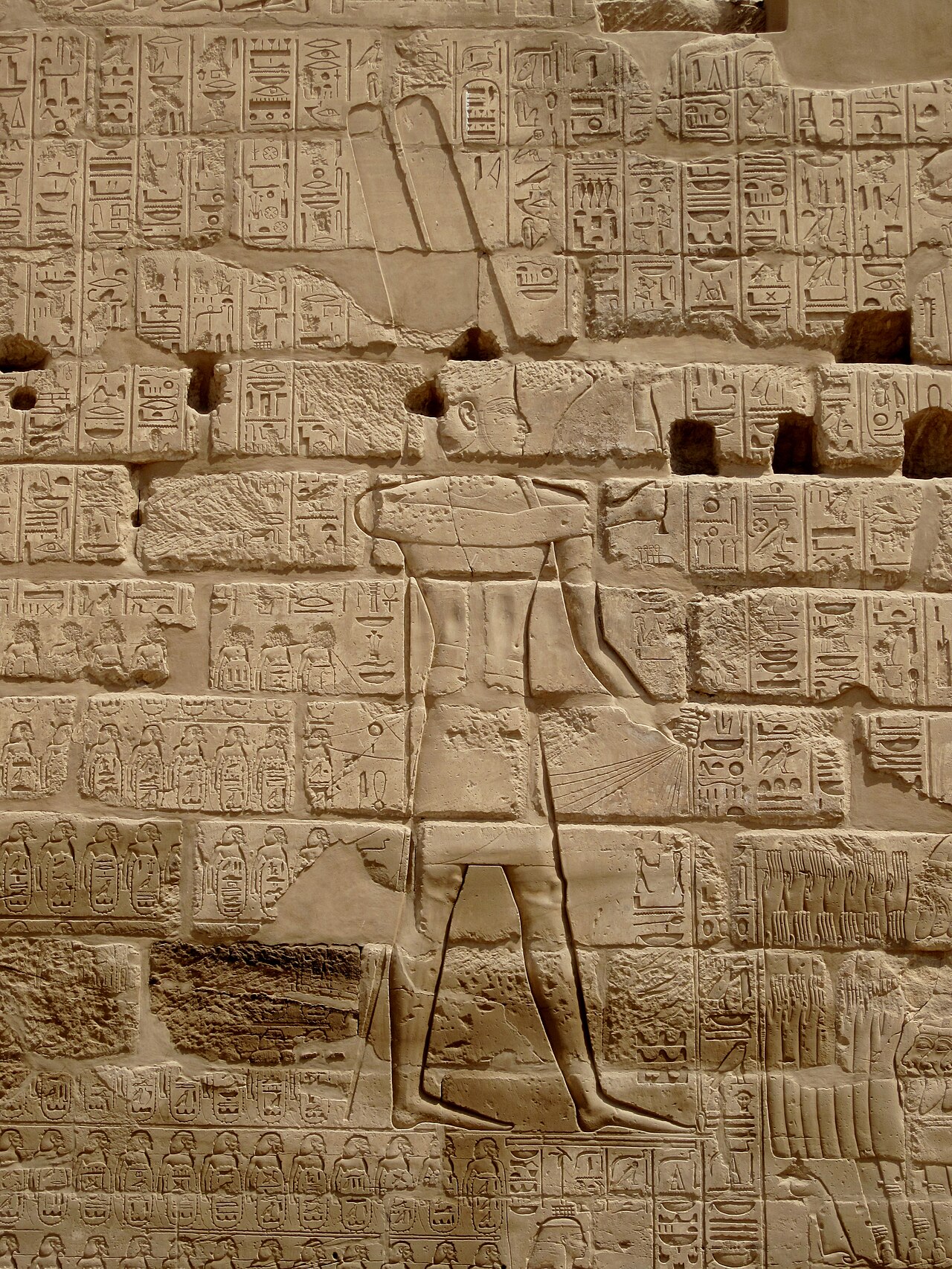
Shoshenq I at Karnak
On the Bubastite Portal of the temple of Amun at Karnak, Shoshenq I (founder of the 22nd Dynasty, c. 945–924 BC) is shown smiting enemies, with rows of name-rings listing more than 150 places in the southern Levant: among them Megiddo, Taanach, Rehov, Beth-shean, Gibeon, Mahanaim and many sites in the Negev. A fragment of a Shoshenq stele was found at Megiddo. Most scholars identify him with Shishak and date the campaign around 925 BC.
Jerusalem is not clearly in the surviving list (some rings are destroyed), and most named places are in the north and the Negev, not Judah's heartland. Kings says Shishak took tribute from Jerusalem; the relief shows a campaign through Israel. Whether Jerusalem paid without a siege, appeared in a lost ring, or was not involved is debated. The list is royal propaganda, not a map of every town conquered.
The Greek here
In the library's Greek, chapter 14 has only the Rehoboam material (14:21–31); the story of Jeroboam's sick son belongs, in this Greek tradition, to the additional Jeroboam account after 12:24, which is not in the library's digital text.
The Case for the Biblical Account
Scripture's account
Shishak's campaign (1 Kings 14:25–26).
What evidence would we expect?
An Egyptian record of a campaign into Canaan in the late 10th century BC.
The discoveries
Shoshenq I's Karnak relief and name list; his stele fragment at Megiddo; destruction layers at several sites (dates debated).
Testing the discoveries
A campaign is documented; its route and Jerusalem's role are reconstructed.
The strongest reconstruction
Shoshenq I campaigned in Israel and the Negev c. 925 BC; Judah may have paid tribute.
What remains possible
Whether Jerusalem was named on the relief; the campaign's exact year.
What the evidence shows
- Shoshenq I recorded a campaign into the southern Levant at Karnak.Source: Ancient Israel and Ancient Egypt (Cambridge Elements), on Shoshenq I ↗; K. Jansen-Winkeln, "Egypt and the North" (2015), on Shoshenq's campaign ↗
- Shishak is Shoshenq I.
- Jerusalem appears in Shoshenq's list.
- Shoshenq plundered the Jerusalem temple. Known only from Kings and Chronicles.
Continue the journey
Journey of a Passage1 Kings 14:25–26: Shishak and Shoshenq: a text and an inscriptionThis is not a manuscript variant: all the witnesses checked agree that Shishak king of Egypt came up against Jerusalem in Rehoboam's fifth year.More from this lesson
On the map
Location securely identified Probable identification Proposed or debated location Biblical route (roads schematic) Scholarly proposal
- Shoshenq I's campaign (schematic). A schematic model only, using a few names from the Karnak list. The real route is reconstructed differently by different scholars, and the list is not a proven itinerary.
Investigations
Optional deep dives: the ancient sources, the physical evidence, and every interpretation side by side, including unconventional ones, each labeled for what it is.
Shoshenq I at KarnakCampaign: documented · Identification with Shishak: widely accepted · Jerusalem in the list: disputed
Does Egypt record Shishak's campaign?
Shoshenq I, founder of Egypt's 22nd Dynasty, recorded a campaign into the southern Levant on the Bubastite Portal at Karnak, with more than 150 place names. A fragment of his stele was found at Megiddo. Most scholars identify him with the biblical Shishak and date the campaign c. 925 BC. Jerusalem is not clearly named in the surviving list.
Open the full investigation →Why this matters to the rest of Scripture
- Jeroboam's refuge with Shishak.
- The Chronicler's longer account.
- Solomon's gold shields.
- The end of Jeroboam's house.