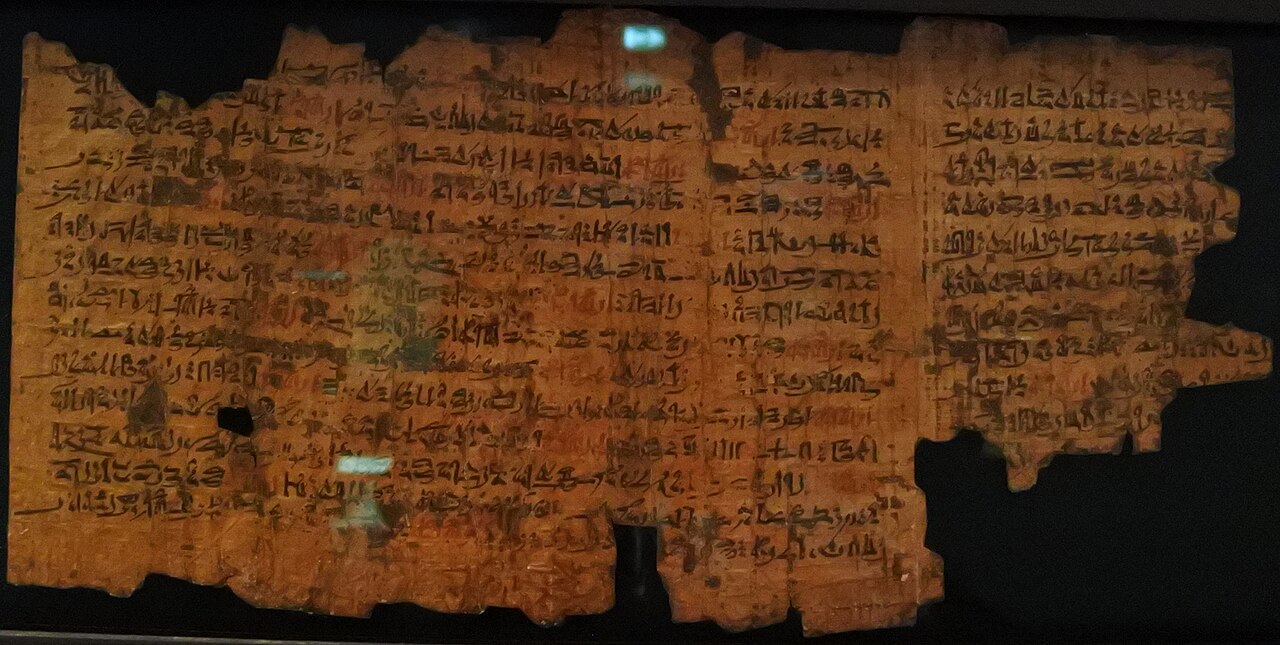
The Ipuwer Papyrus: An Egyptian Record of the Plagues?
Papyrus Leiden I 344 preserves a long Egyptian lament, the Admonitions of Ipuwer, describing a land in chaos: "the river is blood," plague throughout the land, servants wearing their masters' gold. Some writers identify it as an Egyptian account of the plagues. The papyrus is real and the parallels are striking; but its date and its literary genre make a direct identification unlikely.
Papyrus: authentic · Parallels: real · Eyewitness record of the Exodus: unlikely
Historical manuscriptPapyrus Leiden I 344, the Admonitions of Ipuwer, copied in the New Kingdom. National Museum of Antiquities, Leiden.Image credit
1 What Scripture says
"All the waters that were in the river were turned to blood. And the fish that was in the river died; and the river stank, and the Egyptians could not drink of the water of the river" (Exodus 7:20–21). "There was a great cry in Egypt; for there was not a house where there was not one dead" (12:30). "They borrowed of the Egyptians jewels of silver, and jewels of gold, and raiment… and they spoiled the Egyptians" (12:35–36).
2 What evidence we might expect
If Ipuwer records the plagues, a text composed at or after the Exodus, describing specific events.
Details that match Exodus beyond what any disaster would produce.
No signs of a fixed literary genre that used the same images for other purposes.
3 What ancient sources survive
The Admonitions of Ipuwer (The Dialogue of Ipuwer and the Lord of All)
Language
Middle Egyptian, hieratic script
Composed
Debated: late Middle Kingdom (c. 1850–1650 BC) is the common view; some argue for the First Intermediate Period (c. 2150 BC) or the Second Intermediate Period
Oldest surviving copy
Papyrus Leiden I 344 recto, a single copy made in the 19th Dynasty (13th century BC); the beginning and end are lost
Status
Egyptian literature; never part of any scripture
The text was acquired by the Leiden museum in 1828 from the collection of Giovanni Anastasi; its find spot, reported as Memphis (Saqqara), is not documented.
Source: A. H. Gardiner, The Admonitions of an Egyptian Sage from a Hieratic Papyrus in Leiden (1909); R. Enmarch, A World Upturned: Commentary on and Analysis of The Dialogue of Ipuwer and the Lord of All (2008)
4 What discoveries exist
The parallels people cite
Ipuwer (Lichtheim / Gardiner)
Exodus
"Lo, the river is blood… men shrink from tasting… and thirst for water" (2:10)
The Nile turned to blood; the Egyptians could not drink (7:20–21)
"Plague is throughout the land, blood is everywhere" (2:5–6)
Plagues throughout Egypt
"Lo, cattle are left to stray"; "all animals, their hearts weep" (5:5; 9:2–3)
Pestilence on the livestock (9:3)
"Lo, trees are felled, branches stripped"; "grain has perished on every side" (4:14; 6:3)
Hail and locusts destroy crops and trees (9:25; 10:15)
"The land is not light" (9:11, as sometimes translated)
Three days of darkness (10:22)
"He who buries his brother is everywhere" (2:13)
"Not a house where there was not one dead" (12:30)
"Gold and lapis lazuli, silver and turquoise… are hung about the necks of maidservants" (3:2–3)
Israel asks the Egyptians for silver, gold and clothing (12:35)
"Foreigners have come to Egypt"; "the desert is throughout the land" (3:1)
Israel, a foreign people, in Egypt
Listed this way, the parallels are memorable. Read in full, the text tells a different kind of story: Egypt's social order is overturned, the poor become rich and the rich poor, officials are murdered, records destroyed, the royal residence plundered, foreigners from Asia have entered the Delta, and the sage reproaches "the Lord of All" for allowing it. It does not describe an oppressed people leaving Egypt; if anything, foreigners are arriving and taking over.
Dating the composition
The surviving copy was made about the 13th century BC, but its language is classic Middle Egyptian. Most Egyptologists date the composition to the late Middle Kingdom, centuries before either proposed Exodus date. Some date it to the First Intermediate Period, an era of real breakdown after the Old Kingdom; John Van Seters argued for the Second Intermediate Period, when Asiatic Hyksos rulers held the Delta.
A known Egyptian genre
Ipuwer belongs with other Egyptian "lament" or "chaos" texts, such as the Prophecy of Neferti, which describe the land in disorder (often with the same images: the Nile failing, foreigners invading, social reversal) so that a king's restoration of order can be praised. The images are conventions for chaos, not a chronicle of a particular year. "The river is blood" may be a vivid image of violence and death in the water rather than discoloration.
5 How interpretations compare
Scholarly reconstruction
A literary lament
A Middle Kingdom poem about cosmic and social disorder, using conventional images, written long before the Exodus. Its resemblance to Exodus reflects shared Egyptian realities, the Nile, cattle, crops, and the common language of catastrophe.
Source: M. Lichtheim, Ancient Egyptian Literature, vol. 1: The Old and Middle Kingdoms (1973), pp. 149–163; R. Enmarch, A World Upturned: Commentary on and Analysis of The Dialogue of Ipuwer and the Lord of All (2008)
Alternative explanation
An Egyptian memory of the Exodus
Immanuel Velikovsky (1952) proposed that Ipuwer describes the same catastrophe as Exodus, as part of a radical revision of ancient chronology. Some revisionists, such as David Rohl's New Chronology, also place the Exodus near the end of the Middle Kingdom and see Ipuwer as relevant.
Assessment: This requires moving the Exodus, or Egyptian chronology, by centuries. Velikovsky's chronology is rejected by Egyptologists; Rohl's has not won acceptance either. Within the standard chronology, Ipuwer is too early.
Source: I. Velikovsky, Ages in Chaos (1952); D. Rohl, A Test of Time (1995)
Traditional reading
Shared tradition
Some believers read Ipuwer not as an eyewitness record but as evidence that Egyptians knew catastrophes like those of Exodus, so that the biblical plagues are described in terms that fit Egypt.
Assessment: Fair as far as it goes: the plagues strike recognizably Egyptian targets. It does not make Ipuwer a record of the Exodus.
6 The strongest supported reconstruction
The Ipuwer Papyrus is a genuine and important Egyptian literary text. Its images overlap with the plagues because both describe disaster in Egypt. But it was most likely composed centuries before either Exodus date, it belongs to a recognizable literary genre, and its overall story does not match Exodus. It is best used to show how Egyptians imagined catastrophe, not as independent confirmation of the plagues.
7 What remains possible or unknown
The exact date of composition, which is still argued among Egyptologists.
Whether its images were inspired by any particular historical crisis, such as a period of low Niles or the Hyksos takeover.
8 How this material came to us
One copy survives, on the front (recto) of Papyrus Leiden I 344; the back carries a hymn to Amun. Alan Gardiner published the standard edition in 1909; Miriam Lichtheim's 1973 translation is widely quoted; Roland Enmarch's 2005 edition and 2008 commentary are the current scholarly standard. Popular books and websites often quote older translations selectively and in a different order from the papyrus.
What the evidence shows
Independently documentedPapyrus Leiden I 344 contains the Admonitions of Ipuwer, including the line "the river is blood."
Source: A. H. Gardiner, The Admonitions of an Egyptian Sage from a Hieratic Papyrus in Leiden (1909); M. Lichtheim, Ancient Egyptian Literature, vol. 1: The Old and Middle Kingdoms (1973), pp. 149–163
Independently documentedThe surviving copy dates to about the 13th century BC.
Plausible, not confirmedThe text was composed before the 15th century BC. The majority view, based on its language.
Source: R. Enmarch, A World Upturned: Commentary on and Analysis of The Dialogue of Ipuwer and the Lord of All (2008)
DisputedIpuwer is an eyewitness account of the Exodus plagues. Requires a revised chronology rejected by most specialists.