Era 4 · Covenant and WildernessDeuteronomy
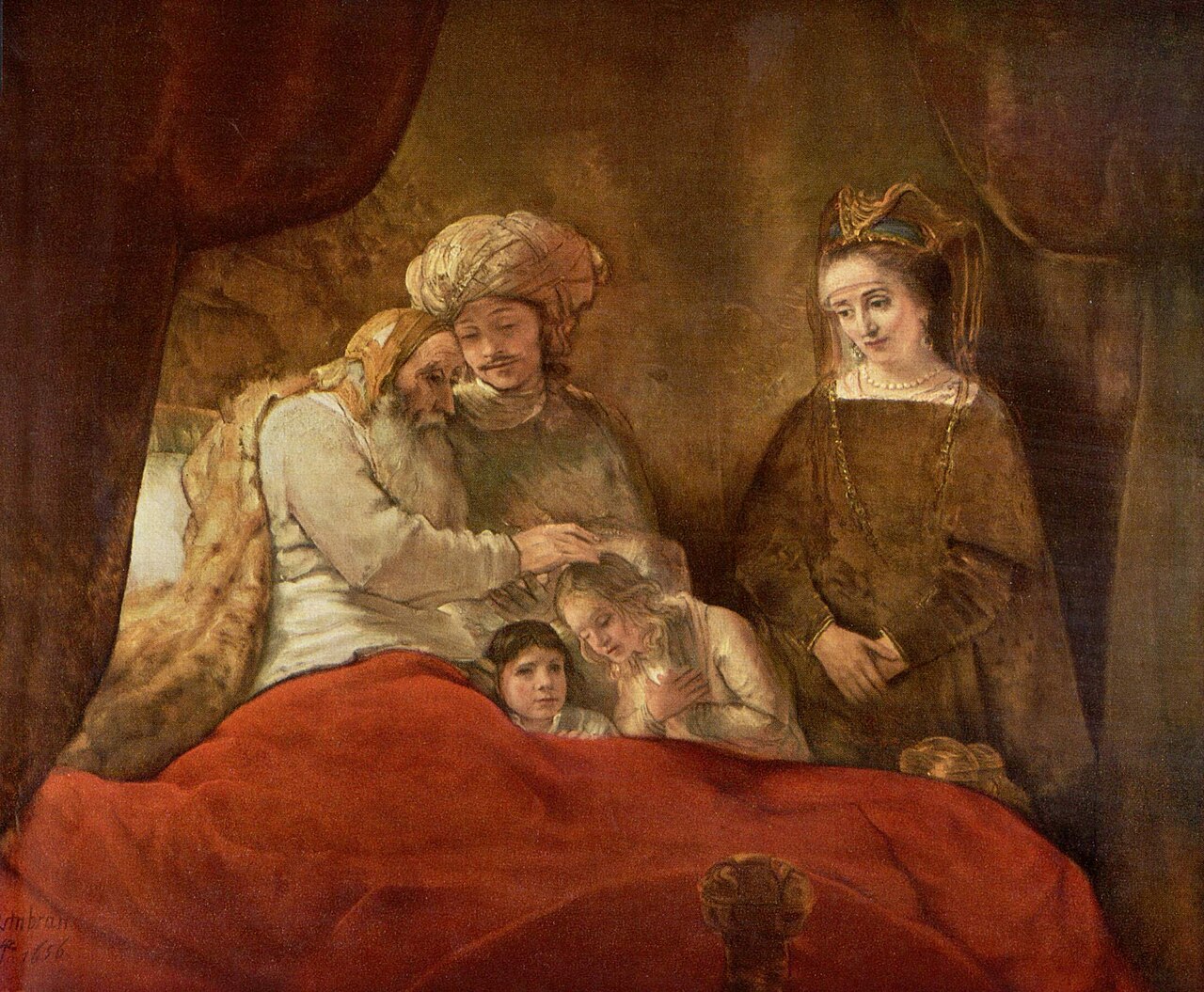
The Blessing of Moses
"The eternal God is thy refuge, and underneath are the everlasting arms"
"The LORD came from Sinai, and rose up from Seir unto them; he shined forth from mount Paran, and he came with ten thousands of saints: from his right hand went a fiery law for them."
"Let Reuben live, and not die." Judah: "Hear, LORD, the voice of Judah." Levi: "Let thy Thummim and thy Urim be with thy holy one… They shall teach Jacob thy judgments." Benjamin: "The beloved of the LORD shall dwell in safety by him." Joseph: blessed with "the precious things of heaven… and for the good will of him that dwelt in the bush." Zebulun and Issachar, Gad, Dan ("a lion's whelp"), Naphtali and Asher each receive a line.
"There is none like unto the God of Jeshurun, who rideth upon the heaven in thy help… The eternal God is thy refuge, and underneath are the everlasting arms… Happy art thou, O Israel: who is like unto thee, O people saved by the LORD."
Genesis 49 and Deuteronomy 33
| Tribe | Jacob (Genesis 49) | Moses (Deuteronomy 33) |
|---|---|---|
| Reuben | Loses preeminence | "Let Reuben live, and not die" |
| Simeon | Scattered with Levi for violence | Not mentioned |
| Levi | Scattered for violence | Priests with Urim and Thummim, teachers of the law |
| Judah | The scepter; a lion | "Hear… the voice of Judah": help against enemies |
| Joseph | A fruitful bough | The longest blessing; "the firstling of his bullock" |
| Dan | A serpent by the way | "A lion's whelp" |
Simeon's absence fits its later absorption into Judah (Joshua 19:1–9). Some Greek manuscripts add Simeon to Reuben's line. Levi's transformation from Genesis 49's curse to Deuteronomy's blessing reflects its role after the golden calf (Exodus 32:26–29).
God from the south
Sinai, Seir and Paran are all southern places. Judges 5:4–5 ("LORD, when thou wentest out of Seir") and Habakkuk 3:3 ("God came from Teman, and the Holy One from mount Paran") use the same picture. The Kuntillet Ajrud inscriptions (c. 800 BC) mention "YHWH of Teman." Many scholars see an old tradition associating Israel's God with the southern deserts. This is imagery of a divine warrior's coming, not a route map.
"A fiery law"
The Hebrew of 33:2 is written as one word, eshdat, but read as two, esh dat, "fire of law." Dat is a Persian loanword elsewhere, which complicates the reading. The Samaritan text in our library lacks "esh" ("fire") here, and the Greek reads "his angels with him at his right hand." Translators remain unsure of the original meaning.
The Case for the Biblical Account
Scripture's account
Moses blesses the tribes (Deuteronomy 33).
What evidence would we expect?
Archaic poetic features; tribal history consistent with the blessings; parallel theophany texts.
The discoveries
Parallels with Judges 5 and Habakkuk 3; "YHWH of Teman" at Kuntillet Ajrud; the absence of Simeon; textual difficulties in 33:2.
Testing the discoveries
Archaic-seeming language is suggestive but does not by itself date the poem.
The strongest reconstruction
Deuteronomy 33 preserves old poetic traditions of the tribes and of God coming from the south.
What remains possible
The poem's date; the meaning of 33:2.
What the evidence shows
- Kuntillet Ajrud inscriptions mention "YHWH of Teman."Source: Z. Meshel, Kuntillet ʿAjrud (Ḥorvat Teman): An Iron Age II Religious Site (2012)
- Simeon is not named in Moses' blessing in the Hebrew text.
- Deuteronomy 33 is among the oldest Hebrew poems.
- "The eternal God is thy refuge."
Continue the journey
Journey of a PassageDeuteronomy 33:2: A fiery law, or angels at His right hand?The last line of 33:2 is one of the hardest in the Torah.More from this lesson
Why this matters to the rest of Scripture
- Jacob blesses his sons.
- "When thou wentest out of Seir."
- "The Holy One from mount Paran."
- "Received the law by the disposition of angels."
- "Ordained by angels."