Era 4 · Covenant and WildernessDeuteronomy
The Song of Moses: The Nations and Heavenly Beings
"When the most High divided to the nations their inheritance"
"Give ear, O ye heavens, and I will speak; and hear, O earth, the words of my mouth." "He is the Rock, his work is perfect: for all his ways are judgment: a God of truth and without iniquity."
"Remember the days of old… When the most High divided to the nations their inheritance, when he separated the sons of Adam, he set the bounds of the people according to the number of the children of Israel. For the LORD's portion is his people; Jacob is the lot of his inheritance." God found Israel "in a desert land… he kept him as the apple of his eye. As an eagle stirreth up her nest, fluttereth over her young."
"But Jeshurun waxed fat, and kicked… then he forsook God which made him." "They sacrificed unto devils, not to God; to gods whom they knew not." Judgment comes, but God stops short: "See now that I, even I, am he, and there is no god with me: I kill, and I make alive; I wound, and I heal." The song ends: "Rejoice, O ye nations, with his people: for he will avenge the blood of his servants… and will be merciful unto his land, and to his people."
God tells Moses to climb Mount Nebo, see Canaan, and die there, "as Aaron thy brother died in mount Hor," "because ye trespassed against me… at the waters of Meribah."
"Sons of Israel" or "sons of God"? (32:8)
| Witness | Reading in 32:8 | Status |
|---|---|---|
| Masoretic Text (Leningrad Codex) | bene yisra'el, "sons of Israel" | Extant; checked in the library |
| Samaritan Pentateuch | "sons of Israel" | Extant; checked in the library |
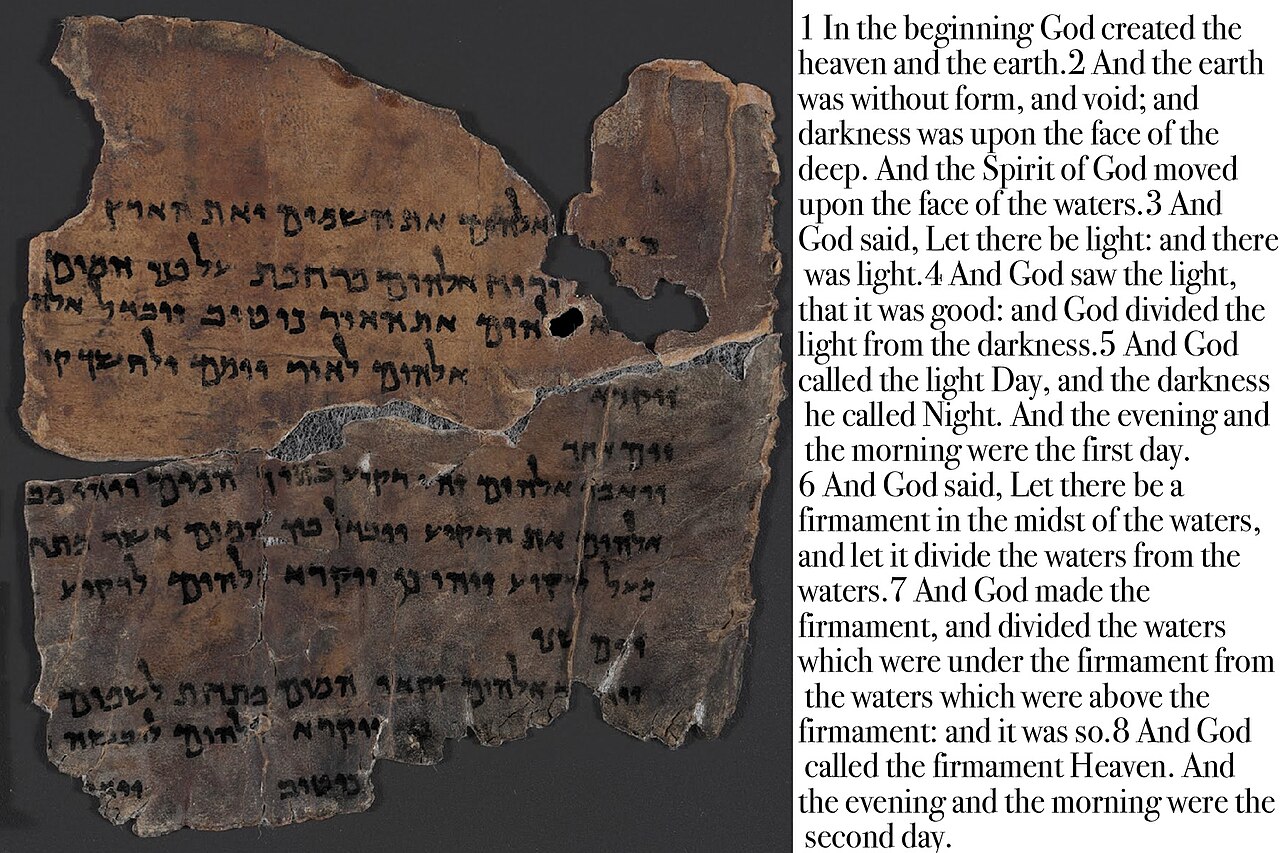
| 4QDeut-j (4Q37), Qumran | bny 'lwhym, "sons of God" | As published in DJD XIV; letter-level status not checked here |
| Septuagint | "angels of God" (some manuscripts "sons of God") | Giguet's French translation in the library reads "ses anges" |
| Vulgate | filiorum Israel, "sons of Israel" | Checked in the library |
Many text critics think "sons of God" is earlier. The verse places the dividing of the nations at the time of Genesis 10–11, before Israel existed, and its pairing with 32:9 ("the LORD's portion is his people") and with 4:19 suggests the nations were assigned to heavenly beings while Israel belonged to the LORD. A later scribe may have changed it to avoid any suggestion of other divine beings. Others think the variation arose differently. The reason for the change is a scholarly reconstruction; the difference itself is real.
A heavenly council
At Ugarit, the high god El presides over "the sons of El," and texts speak of seventy sons of Athirat. Psalm 82 pictures God judging in "the congregation of the mighty… among the gods," and Job 1–2 has "the sons of God" presenting themselves before the LORD. Genesis 10 lists seventy nations. These are ancient ideas about the heavenly world, shared and adapted. They are related to Genesis 6:1–4 and 1 Enoch's Watchers, which the Genesis lessons explore. Some modern writers read the "sons of God" as extraterrestrial visitors; that is a modern interpretation, and the texts do not describe spacecraft or physical visitors.
The longer ending (32:43)
| Witness | 32:43 |
|---|---|
| Masoretic Text | Four lines: "Rejoice, O ye nations, with his people…" |
| 4QDeut-q (4Q44) | Six lines; begins "Rejoice, O heavens, with him, and bow down to him, all you gods" (as published in DJD XIV) |
| Septuagint | Eight lines: "Rejoice, ye heavens, with him, and let all the angels of God worship him; rejoice, ye nations, with his people, and let all the sons of God strengthen themselves in him…" |
| Samaritan Pentateuch | Shorter, like the Masoretic; the library's text marks gaps in this verse |
The Qumran and Greek longer forms are related but not identical; the Greek has more than the Qumran fragment can confirm. Hebrews 1:6, "And let all the angels of God worship him," quotes the Greek form of this line (or Psalm 97:7) of Christ.
The Case for the Biblical Account
Scripture's account
The Song of Moses (Deuteronomy 32).
What evidence would we expect?
Early copies of the song; ancient Near Eastern divine-council imagery.
The discoveries
4QDeut-j and 4QDeut-q from Qumran; the Septuagint's "angels of God"; Ugaritic texts on the sons of El; Psalm 82; Hebrews 1:6.
Testing the discoveries
The textual differences are among the most significant in the Torah and are attested in manuscripts over 2,000 years old. Their explanation is debated.
The strongest reconstruction
An early form of 32:8 and 32:43 spoke of divine beings; later Hebrew tradition read them differently.
What remains possible
That the Masoretic readings are original; that both developed from another text; the exact relation of the Qumran and Greek endings.
What the evidence shows
- 4QDeut-j reads "sons of God" in 32:8, as published in DJD XIV.Source: E. Ulrich et al., Qumran Cave 4.IX: Deuteronomy, Joshua, Judges, Kings, DJD XIV (Oxford, 1995); Leon Levy Dead Sea Scrolls Digital Library (Israel Antiquities Authority) ↗
- The Masoretic and Samaritan texts read "sons of Israel" in 32:8. Checked in the site's library.
- "Sons of God" is the original reading. Favored by many text critics; disputed by others.Source: E. Tov, Textual Criticism of the Hebrew Bible, 3rd ed. (2012)
- The Greek ending of 32:43 is fully confirmed by Qumran. 4Q44 is shorter than the Greek.
- The "sons of God" were extraterrestrial beings. A modern interpretation; no ancient text describes this.
- "I kill, and I make alive; I wound, and I heal."
Continue the journey
Journey of a PassageDeuteronomy 32:8–9: Sons of Israel, or sons of God?When the Most High divided the nations, He set their bounds "according to the number of the sons of Israel" in the Masoretic Text, but "the sons of God" in a Dead Sea Scroll, and "the angels of God" in the Greek.More from this lesson
Echoes Across Civilizations
Optional: how other ancient peoples told similar stories. Open one to compare, then come back to the lesson.
The heavenly council and the nationsUgarit · Mesopotamia · Second Temple Judaism
Did other ancient peoples picture a high god ruling a council of divine beings who were assigned to the nations?
- Ugarit: El and "the sons of El" (bn ilm) Possible historical contact
- Mesopotamia: The assembly of the gods (Enuma Elish, Atrahasis) Resemblance only
- Second Temple Judaism: Angels over the nations (Daniel, Jubilees, 1 Enoch) Shared literary world
Why this matters to the rest of Scripture
- The table of nations.
- The sons of God.
- God in the divine council.
- "The sons of God came to present themselves."
- "Rejoice, ye Gentiles, with his people."
- "Let all the angels of God worship him."