Era 4 · Covenant and WildernessDeuteronomy
How Deuteronomy Came to Us
Four kinds of date: the story's setting, the traditions, the book's composition, and the oldest copies
Deuteronomy presents itself as Moses' speeches, given in the land of Moab in the fortieth year (1:1–5), and says twice that Moses wrote "this law" and gave it to the priests (31:9, 24). Jewish and Christian tradition received it as the fifth book of Moses. Its final chapter describes his death, and tradition has long credited those verses to Joshua or to prophetic continuation.
In 1805 Wilhelm de Wette proposed that Deuteronomy, or its core, was the "book of the law" found in the Temple under King Josiah in 622 BC (2 Kings 22–23). That idea shaped two centuries of scholarship. Today it is a major scholarly hypothesis, not a settled identification.
The witnesses, by kind
| Witness | Kind | Date | Notes |
|---|---|---|---|
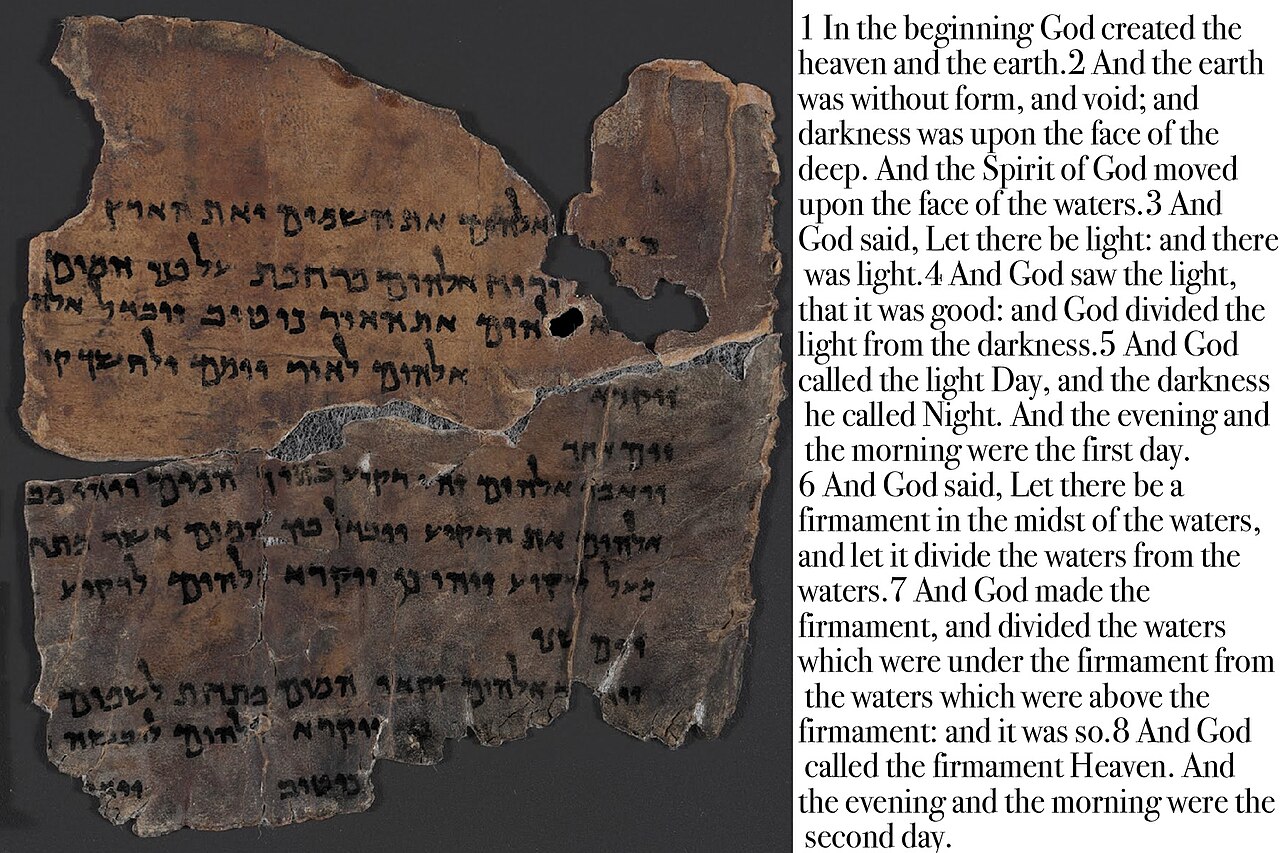
| Dead Sea Scrolls (about 30–35 manuscripts, depending on how counted) | A find collection of Hebrew manuscripts, not one line of copying | 2nd c. BC – 1st c. AD | Mostly fragments; some excerpt scrolls and tefillin; 4QDeut-j and 4QDeut-q have the major Song variants |
| Nash Papyrus | A single sheet for teaching or worship | 2nd–1st c. BC | Decalogue and Shema |
| Samaritan Pentateuch | A separate Hebrew tradition | Ancient tradition; medieval manuscripts (edition: Florentin and Tal 2025) | Gerizim in 5:21 addition and 27:4; "has chosen" in Deut 12–26 |
| Septuagint | Greek translation tradition with its own manuscripts | Translated c. 3rd century BC; great codices 4th–5th c. AD | "Angels of God" (32:8); longer 32:43; "they buried him" (34:6) |
| Vulgate, Old Latin, Syriac, Coptic | Later translations | 2nd–5th c. AD | Mostly follow Hebrew or Greek; the Old Latin is reported to read Gerizim in 27:4 |
| Leningrad Codex | Masoretic Hebrew manuscript | AD 1008 | The oldest complete Hebrew Deuteronomy |
None of these is known to have been copied from another surviving witness. The family tree on the passage pages shows shared traditions and translations, not direct copies.
The landmark differences
| Passage | What differs | Kind of difference |
|---|---|---|
| 5:6–21 | Decalogue wording vs Exodus 20; Samaritan Gerizim commandment | Parallel passages; sectarian addition |
| 12:5 and about twenty more | "Will choose" (MT) or "has chosen" (SP) | Manuscript variant |
| 17:18 | "A copy of this law" becomes "Deuteronomy" in Greek | Translation, source of the book's name |
| 22:28–29 | Verbs for seizing; the woman's status | Interpretation of the Hebrew, not a variant |
| Chapter 13, 23 and 29 numbering | Hebrew and English verse numbers differ by one | Versification, not a textual difference |
| 26:5 | "Wandering Aramean" or "an Aramean sought to destroy" | Interpretation and translation |
| 27:4 | Ebal (MT, LXX) or Gerizim (SP, Old Latin) | Manuscript variant at the heart of the Samaritan–Jewish divide |
| 32:8 | "Sons of Israel" (MT, SP) or "sons of God" (4Q37), "angels of God" (LXX) | Manuscript variant |
| 32:43 | Four lines (MT) or longer (4Q44, LXX) | Manuscript variant |
| 33:2 | "Fiery law" and the angels | Difficult text; translation |
| 34:6 | "He buried" or "they buried" | Manuscript variant or vocalization |
The Shapira strips
In 1883 the Jerusalem antiquities dealer Moses Wilhelm Shapira offered the British Museum fifteen leather strips with a version of Deuteronomy in old Hebrew script. Experts declared them forgeries; Shapira took his own life in 1884, and the strips were sold and later disappeared. In 2021 Idan Dershowitz argued they were genuine ancient manuscripts, perhaps preserving an early form of Deuteronomy; Benjamin Suchard replied the same year with linguistic evidence of 19th-century forgery. Without the strips no physical test is possible. They are not counted as a witness here.
Composition: how scholars have explained it
Moses delivered and wrote the speeches and laws; later hands added the account of his death and small notes. Supporters point to the book's own claims, its treaty structure resembling Hittite treaties of the Late Bronze Age, and its consistent setting before the conquest.
A substantial Mosaic core of law and teaching was transmitted, expanded and edited over centuries, reaching its present form in the monarchy or exile.
Following de Wette, a core of Deuteronomy (chapters 12–26 and some framing) was written in the late 7th century BC, possibly with northern roots, to support Josiah's centralization. Close links with Esarhaddon's 672 BC treaty are seen as supporting a 7th-century date.
The framing chapters (1–4, 29–34), with their exile and return, are often dated to the exile or later. Ernest Nicholson and others challenge the identification with Josiah's book, and some place more of the book in the Persian period.
Deuteronomy's language and ideas continue in Joshua through Kings, which many scholars call the "Deuteronomistic History"; its date and unity are also debated. These are interpretive models, not physical evidence.
How Deuteronomy became Scripture
Deuteronomy is Torah for Jews and Samaritans (whose canon is the Torah alone) and part of every Christian Old Testament. Its acceptance is not the main question; its wording and formation are. It is among the books most quoted in the New Testament: Jesus' answers in the wilderness (8:3; 6:16; 6:13), the first commandment (6:4–5), the prophet like Moses (18:15), and Paul on the word near you (30:12–14) and the Song (32:21, 35, 43).
Research status for Deuteronomy
| Area | Status | What remains |
|---|---|---|
| Chapter coverage 1–34 | Research complete | All chapters in 31 lessons plus this one |
| 32:8 and 32:43 witnesses | Evidence unresolved | 4Q37 and 4Q44 letters marked extant or restored against DJD XIV; Greek against the Göttingen edition |
| 27:4 witnesses | Evidence unresolved | Old Latin and Greek papyrus readings to be checked in editions; Segal 2025 to be summarized in full |
| Samaritan readings | Evidence unresolved | Checked in the library text; collation with Florentin and Tal (2025) outstanding; library text has gaps in 32:43 |
| Esarhaddon parallels | Evidence unresolved | Line-by-line comparison with a published translation of the treaty |
| Images | Research outstanding | Tayinat tablet, Gerizim, Ebal and tefillin photographs still to be identified and checked |
| Claim-level citations | Research outstanding | Several law lessons cite primary texts without page-level references |
What the evidence shows
- Deuteronomy says Moses wrote "this law" (31:9, 24).
- Deuteronomy is the book found in Josiah's Temple.Source: M. A. Sweeney, "Deuteronomy and the Reigns of Kings Hezekiah and Josiah of Judah," Oxford Handbook of Deuteronomy (2020) ↗; E. Nicholson, Deuteronomy and the Judaean Diaspora (Oxford, 2014) ↗
- Deuteronomy is among the most frequently copied books at Qumran.Source: E. Ulrich et al., Qumran Cave 4.IX: Deuteronomy, Joshua, Judges, Kings, DJD XIV (Oxford, 1995)
- The Shapira strips were genuine ancient manuscripts.Source: I. Dershowitz, "The Valediction of Moses," ZAW (2021) ↗; B. D. Suchard, "A Valediction to Moses W. Shapira's Deuteronomy Document," Bibliotheca Orientalis 78 (2021) ↗
- Deuteronomy's structure resembles ancient treaties.
- Deuteronomy is inspired Scripture.
Toward Joshua
Deuteronomy ends with Moses dead on the edge of the land and Joshua "full of the spirit of wisdom." The book of Joshua begins: "Now after the death of Moses." It brings the conquest narratives, Jericho, Ai and Hazor, the Amarna letters and the Merneptah Stele, and some of the most debated archaeology in the Bible.
Continue the journey
Journey of a PassageExodus 20:8–17: The Ten Commandments: order, Sabbath, and a Samaritan commandmentThe Decalogue is one of the best-attested passages in the Bible, yet its witnesses differ in three ways: the order of "murder, adultery, theft," the reason given for the Sabbath (Exodus 20 versus Deuteronomy 5), and an extra commandment about Mount Gerizim in the Samaritan Pentateuch.More from this lesson
Investigations
Optional deep dives: the ancient sources, the physical evidence, and every interpretation side by side, including unconventional ones, each labeled for what it is.
Esarhaddon's Succession Treaty and DeuteronomyTreaty: authentic, excavated · Specific parallels: real · Direct translation: disputed
Did Deuteronomy borrow its loyalty laws and curses from an Assyrian oath of 672 BC?
In 672 BC the Assyrian king Esarhaddon made his officials and vassals swear loyalty to his son Ashurbanipal. A complete copy of the oath was found at Tell Tayinat in Turkey in 2009. Its demands to report disloyal prophets and relatives, and some of its curses, closely resemble Deuteronomy 13 and 28. How close, and what that means, is debated.
Open the full investigation →Josiah and the Book Found in the TempleJosiah: historical king · Book found: biblical report · Identification with Deuteronomy: a major hypothesis
Was the scroll found in Josiah's Temple an early form of Deuteronomy?
In about 622 BC, during Temple repairs, the high priest Hilkiah reported finding "the book of the law." King Josiah tore his clothes, read it to the people, removed the high places and held a great Passover in Jerusalem. Since 1805, many scholars have identified that book with Deuteronomy or its core. Others disagree.
Open the full investigation →Gerizim and Ebal: Altars, Temples and a Lead TabletGerizim sanctuary: real, first date debated · Ebal structure: real, function disputed · Ebal "curse tablet" reading: disputed
What has archaeology found on the mountains of blessing and curse?
Mount Gerizim has a large sacred precinct of the Samaritans, excavated by Yitzhak Magen. Mount Ebal has an Iron Age structure that Adam Zertal identified as Joshua's altar, and a small lead object announced in 2023 as an early curse tablet naming YHW. Each claim needs careful sorting.
Open the full investigation →The Shapira Strips: A Lost "Deuteronomy"Strips: lost · Authenticity: disputed · Status on this site: not a witness
Were the leather strips Moses Shapira sold in 1883 ancient manuscripts or forgeries?
In 1883 the antiquities dealer Moses Wilhelm Shapira offered the British Museum leather strips written in old Hebrew letters with a version of Deuteronomy's speeches. Scholars declared them forgeries; Shapira died in 1884 and the strips vanished. In 2021 the case was reopened.
Open the full investigation →Why this matters to the rest of Scripture
- The book of the law found in the Temple.
- "This book of the law shall not depart out of thy mouth."
- Ezra reads the law.
- Jesus answers from Deuteronomy.
- The prophet like Moses.
Sources to explore
- University of Toronto Tayinat Archaeological Project: the Esarhaddon Succession Treaty ↗
- I. Hjelm, "The Samaritan and Jewish Versions of the Pentateuch: A Survey," Religions 11 (2020) ↗
- M. Florentin and A. Tal, The Samaritan Pentateuch: An English Translation with a Parallel Annotated Hebrew Text (2025) ↗
- Leon Levy Dead Sea Scrolls Digital Library (Israel Antiquities Authority) ↗
- M. A. Sweeney, "Deuteronomy and the Reigns of Kings Hezekiah and Josiah of Judah," Oxford Handbook of Deuteronomy (2020) ↗
- E. Nicholson, Deuteronomy and the Judaean Diaspora (Oxford, 2014) ↗
Overviews are a starting point. Each links onward to the primary sources and specialist studies behind it.