Era 4 · Covenant and WildernessDeuteronomy
Blessing and Curse Across the Land
"Behold, I set before you this day a blessing and a curse"
"For the land, whither thou goest in to possess it, is not as the land of Egypt, from whence ye came out, where thou sowedst thy seed, and wateredst it with thy foot, as a garden of herbs: But the land… is a land of hills and valleys, and drinketh water of the rain of heaven: A land which the LORD thy God careth for: the eyes of the LORD thy God are always upon it."
If Israel loves God, "I will give you the rain of your land in his due season, the first rain and the latter rain." If it turns to other gods, "he shut up the heaven, that there be no rain." Therefore "lay up these my words in your heart and in your soul," bind them, teach them, write them on doorposts.
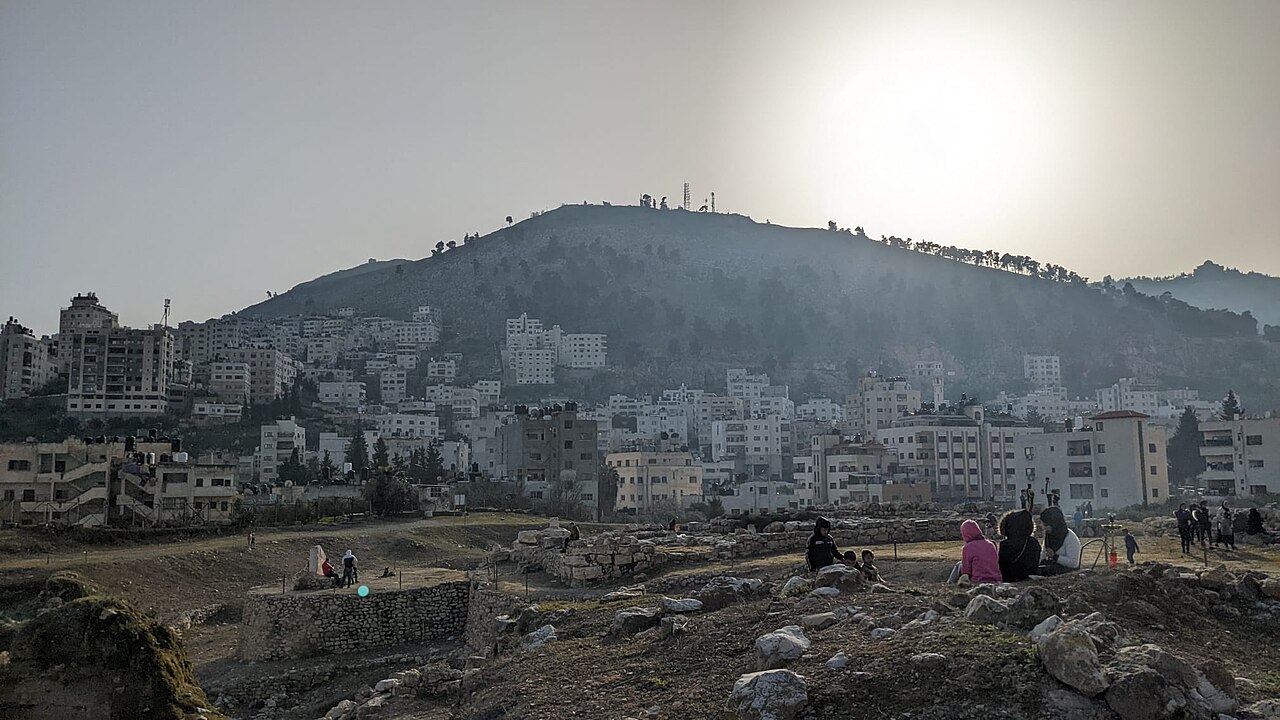
"Behold, I set before you this day a blessing and a curse." When Israel enters the land, "thou shalt put the blessing upon mount Gerizim, and the curse upon mount Ebal," the two mountains "beside the plains of Moreh."
Rain and river
Egyptian farming depended on the annual Nile flood and canal irrigation ("watered it with thy foot" may refer to opening channels with the foot or to treadmills). The hill country of Canaan depended on rainfall: the "former rain" in autumn for plowing and the "latter rain" in spring for ripening grain. Climate in the region has varied over millennia, but the basic contrast between river and rain agriculture holds.
Gerizim and Ebal
The two mountains stand on either side of the pass at ancient Shechem (Tell Balata, by modern Nablus): Gerizim to the south (about 881 m) and Ebal to the north (about 940 m). They are among the most securely identified places in the Bible. Whether the ceremony described in Deuteronomy 11 and 27 and Joshua 8 took place is not independently attested. Which mountain was to receive the altar is the subject of a famous textual difference, examined in the lesson on Deuteronomy 27.
The Samaritan Pentateuch reads 11:30 with an addition, placing the site "opposite Shechem." It also uses 11:29–30 as part of its Gerizim commandment in the Ten Commandments.
The Case for the Biblical Account
Scripture's account
The land depends on rain; blessing and curse are set before Israel, to be proclaimed at Gerizim and Ebal (Deuteronomy 11).
What evidence would we expect?
Rain-fed agriculture in the hill country; the two mountains at Shechem; cultic remains on them.
The discoveries
The hydrology and agriculture of the Levant; Shechem (Tell Balata) as a major Bronze and Iron Age city; a sanctuary on Gerizim (Persian–Hellenistic periods); a disputed Iron Age installation on Ebal.
Testing the discoveries
The geography is exact. The excavated sanctuaries are later or disputed and do not date the ceremony.
The strongest reconstruction
Deuteronomy ties covenant blessing to a real landscape at the heart of the hill country.
What remains possible
Whether a covenant ceremony was held at Shechem in Israel's early history, as Joshua 8 and 24 describe.
What the evidence shows
- Gerizim and Ebal flank the pass at Shechem.
- Rain-fed farming in Canaan depended on autumn and spring rains.
- A blessing-and-curse ceremony took place there under Joshua. Recorded in Joshua 8; not independently attested.
- "The eyes of the LORD thy God are always upon it."
Continue the journey
Journey of a PassageDeuteronomy 27:4: Ebal or Gerizim?Where were the stones and the altar to be set up?More from this lesson
Investigations
Optional deep dives: the ancient sources, the physical evidence, and every interpretation side by side, including unconventional ones, each labeled for what it is.
Gerizim and Ebal: Altars, Temples and a Lead TabletGerizim sanctuary: real, first date debated · Ebal structure: real, function disputed · Ebal "curse tablet" reading: disputed
What has archaeology found on the mountains of blessing and curse?
Mount Gerizim has a large sacred precinct of the Samaritans, excavated by Yitzhak Magen. Mount Ebal has an Iron Age structure that Adam Zertal identified as Joshua's altar, and a small lead object announced in 2023 as an early curse tablet naming YHW. Each claim needs careful sorting.
Open the full investigation →Why this matters to the rest of Scripture
- The ceremony on the two mountains.
- Joshua reads the law at Ebal and Gerizim.
- Abram at the oak of Moreh, Shechem.
- "Our fathers worshipped in this mountain."
- "The early and latter rain."