Era 4 · Covenant and WildernessDeuteronomy
Nations, Wanderings, and the Eastern Battles
"I will not give you of their land"
"Ye have compassed this mountain long enough: turn you northward." Israel passes the descendants of Esau in Seir: "meddle not with them; for I will not give you of their land… because I have given mount Seir unto Esau for a possession." The same is said of Moab and of Ammon, the sons of Lot. Thirty-eight years pass between Kadesh and the brook Zered, "until all the generation of the men of war were wasted out from among the host."
Sihon king of Heshbon refuses passage, and Israel takes his land from the Arnon to the Jabbok. Og king of Bashan comes out at Edrei, and his sixty fortified cities, "fenced with high walls, gates, and bars," fall too. "For only Og king of Bashan remained of the remnant of giants; behold, his bedstead was a bedstead of iron… nine cubits was the length thereof, and four cubits the breadth of it."
Moses gives the land east of the Jordan to Reuben, Gad and half of Manasseh, on condition that their warriors cross with their brothers. Then he prays: "O Lord GOD, thou hast begun to shew thy servant thy greatness… I pray thee, let me go over, and see the good land." The answer: "Let it suffice thee; speak no more unto me of this matter. Get thee up into the top of Pisgah… and charge Joshua."
Lands given to other nations
Deuteronomy 2 says God dispossessed earlier peoples for Edom, Moab and Ammon as He would for Israel: the Horites before Esau, the Emim before Moab, the Zamzummim before Ammon, and the Avim before the Caphtorim (2:10–12, 20–23). These "antiquarian notes" read like a scribe's commentary. The names Emim ("terrors"), Zamzummim and Rephaim are presented as tall peoples "as the Anakim," but the text describes traditions, not skeletons; no remains of such giants have been found.
Og's bed and the Rephaim
Og's "bedstead of iron" at Rabbah (modern Amman) was about 4 by 1.8 meters. The Hebrew 'eres can mean a bed or couch; "iron" may describe black basalt. Some scholars connect it with the large stone dolmens of the Golan and northern Jordan, others with a royal funerary couch. No object at Rabbah has been identified as Og's bed. A Ugaritic text (KTU 1.108, 13th century BC) places Rapiʾu, "king of eternity," at ʿAshtaroth and Edreʿi, the same pair of towns Deuteronomy gives for Og (1:4). At Ugarit the rpum are honored royal ancestors, not necessarily giants.
Moab and Gad, centuries later
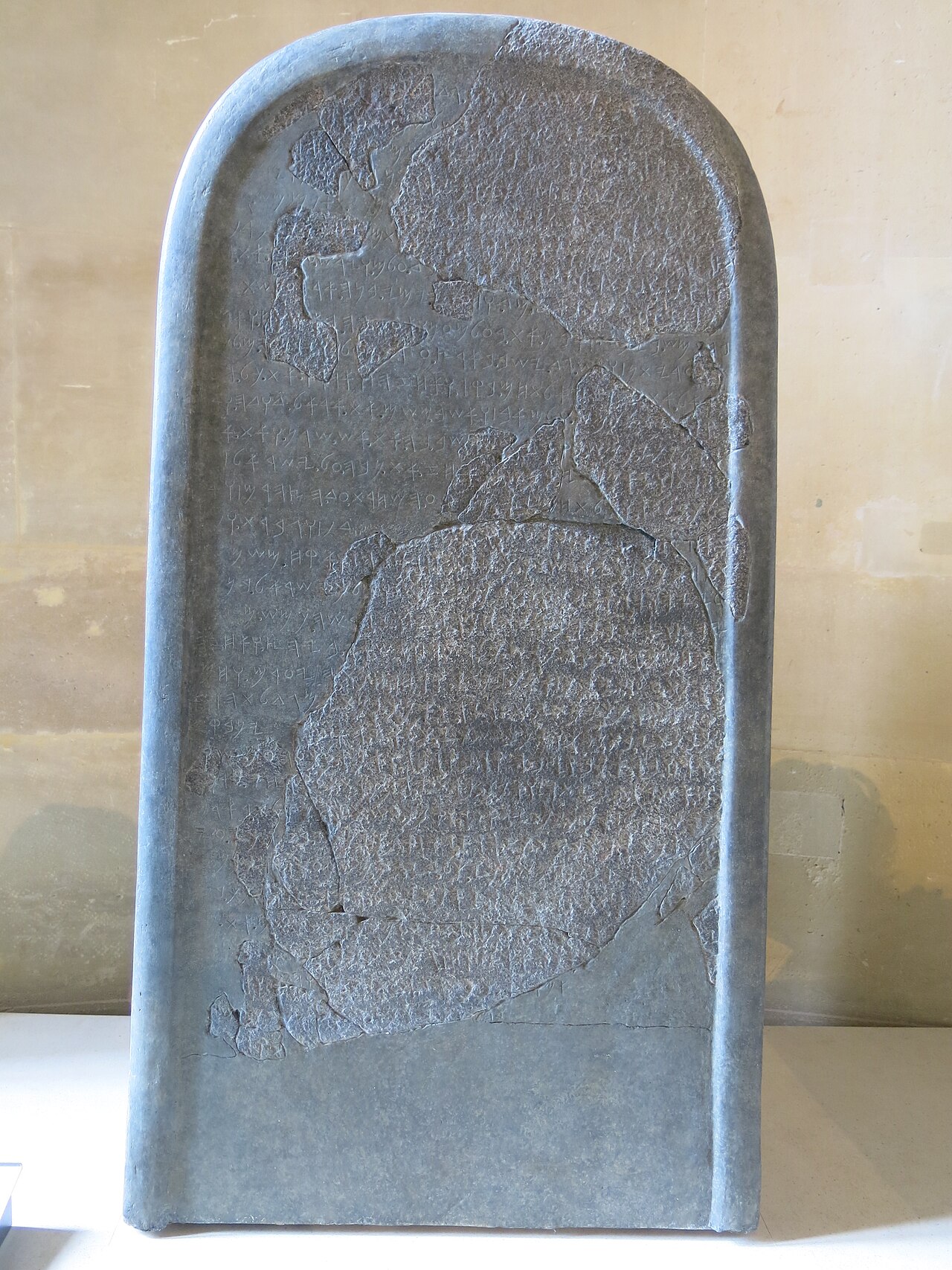
The Mesha Stele (Louvre AO 5066), carved by a Moabite king in the 9th century BC, names Dibon, Ataroth, Nebo and "the men of Gad" who had lived in Ataroth "from of old." It shows the same Israel–Moab border region contested centuries later. It is later context, not a record of Moses' time.
The Case for the Biblical Account
Scripture's account
Israel avoids Edom, Moab and Ammon, defeats Sihon and Og, and settles two and a half tribes east of the Jordan (Deuteronomy 2–3).
What evidence would we expect?
Peoples and kingdoms of Edom, Moab and Ammon; towns of Heshbon, Dibon and Bashan; memories of Og and the Rephaim.
The discoveries
Edom and Moab in Egyptian texts of the 13th century BC; the 9th-century Mesha Stele; Ugaritic Rephaim traditions linked to Ashtaroth and Edrei; no Late Bronze Age city at Tell Hesban or Dhiban; Iron Age kingdoms in Transjordan.
Testing the discoveries
The names and traditions are old and real, but the political borders shown in Deuteronomy cannot be assumed unchanged across centuries, and Heshbon's archaeology does not fit a Late Bronze city.
The strongest reconstruction
Deuteronomy 2–3 preserves real place names and regional traditions, shaped into a theology of land given by God to many peoples.
What remains possible
Different identifications of Heshbon and Bashan's cities; a later setting for some geographical notes.
The same chapters inside Numbers
The Samaritan Pentateuch copies several passages of Deuteronomy 2–3 into Numbers 20–21 (for example 2:2–6, 2:9, 2:24–25, 3:24–28), so that the earlier story contains the words Moses later quotes. The Numbers lessons show each addition.
What the evidence shows
- Deuteronomy says God gave land to Edom, Moab and Ammon as well as to Israel.
- A Ugaritic text pairs Ashtaroth and Edrei as seats of a Rephaite king.Source: KTU 1.108 (Ugarit): Rapiʾu, king of eternity, in ʿAshtaroth and Edreʿi
- Og's bed has been found. No identified object.
- The Rephaim were a race of giants. At Ugarit the rpum are royal ancestors; Deuteronomy describes tall peoples.
- The Mesha Stele shows Israel and Moab contesting this region in the 9th century BC.Source: Mesha Stele, Louvre AO 5066 ↗
Continue the journey
Echoes Across CivilizationsGiants, Watchers, and heavenly beingsWhat did other cultures say about beings between heaven and earth?More from this lesson
Echoes Across Civilizations
Optional: how other ancient peoples told similar stories. Open one to compare, then come back to the lesson.
Giants, Watchers, and heavenly beingsJewish (Second Temple) · Mesopotamia · Greece
What did other cultures say about beings between heaven and earth?
- Jewish (Second Temple): 1 Enoch, the Book of the Watchers Shared literary world
- Mesopotamia: The Apkallu (the seven sages) Shared literary world
- Greece: Titans, Giants, and demigod heroes Resemblance only
Also covered: Ancient-astronaut interpretations, clearly labeled as a modern theory.
Compare side by side →Why this matters to the rest of Scripture
- Edom refuses passage.
- Sihon and Og.
- Reuben, Gad and the eastern lands.
- Moab and Ammon, sons of Lot.
- "The Philistines from Caphtor, and the Syrians from Kir."