Era 4 · Covenant and WildernessDeuteronomy
An Altar on Ebal, or Gerizim?
"Thou shalt build there an altar unto the LORD thy God"
"On the day when ye shall pass over Jordan… thou shalt set thee up great stones, and plaister them with plaister: And thou shalt write upon them all the words of this law." "Therefore it shall be when ye be gone over Jordan, that ye shall set up these stones… in mount Ebal… And there shalt thou build an altar unto the LORD thy God, an altar of stones: thou shalt not lift up any iron tool upon them."
Simeon, Levi, Judah, Issachar, Joseph and Benjamin stand on Mount Gerizim "to bless the people"; Reuben, Gad, Asher, Zebulun, Dan and Naphtali on Mount Ebal "to curse." The Levites cry out twelve curses, and all the people answer "Amen":
- "Cursed be the man that maketh any graven or molten image… and putteth it in a secret place."
- "Cursed be he that setteth light by his father or his mother."
- "Cursed be he that removeth his neighbour's landmark."
- "Cursed be he that maketh the blind to wander out of the way."
- "Cursed be he that perverteth the judgment of the stranger, fatherless, and widow."
- Four curses for sexual sins within the family and with animals.
- "Cursed be he that smiteth his neighbour secretly."
- "Cursed be he that taketh reward to slay an innocent person."
- "Cursed be he that confirmeth not all the words of this law to do them."
Ebal or Gerizim?
| Witness | 27:4 reads | Notes |
|---|---|---|
| Masoretic Text | Ebal | Checked in the library |
| Samaritan Pentateuch | Gerizim (הר גריזים) | Checked in the library; Gerizim is the Samaritans' holy mountain |
| Septuagint (most manuscripts) | Ebal | The library's French translation reads "Hébal" |
| Old Latin (Vetus Latina, Lyon manuscript) | Gerizim (Garizim) | Reported in scholarship; not checked here |
| A small Hebrew fragment of Deuteronomy 27 that appeared on the antiquities market in the 2000s | Gerizim | Unprovenanced and of disputed authenticity; not from a controlled excavation, so it is not counted as evidence here |
| Vulgate | Ebal (Hebal) | Checked in the library |
Many text critics think "Gerizim" is the older reading and that "Ebal" was introduced in the Jewish tradition as a polemic against the Samaritan temple: Ebal is the mountain of the curse, an odd place for an altar. Others think the Samaritan text changed "Ebal" to "Gerizim" to support its sanctuary, or that the original named no mountain. Michael Segal (2025) traces how the passage and Joshua 8:30–35 developed together. Neither reading should be called a simple copying slip, and no winner is declared here.
What archaeology has found
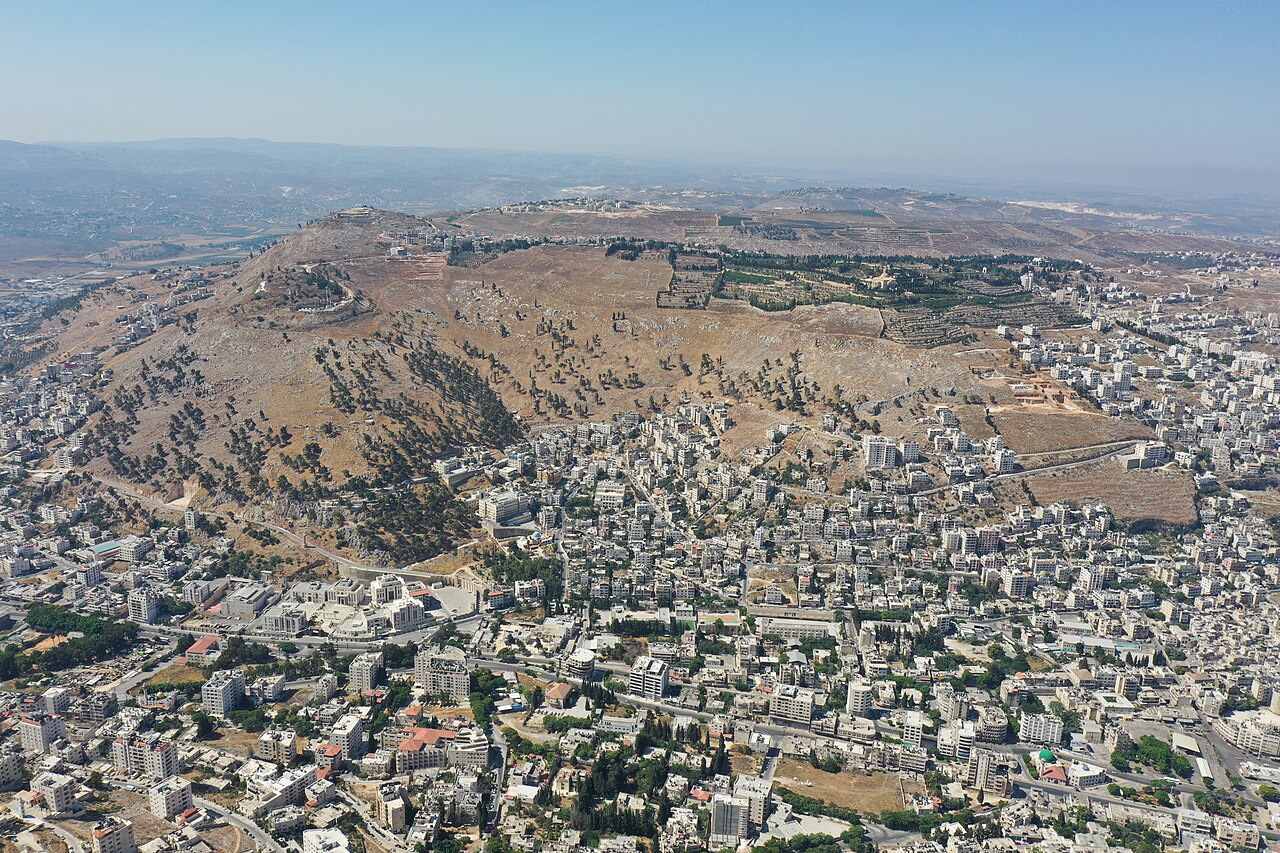
- Mount Gerizim: Yitzhak Magen excavated a large sacred precinct with thousands of inscriptions (Aramaic, Hebrew and Greek) and burnt animal bones. He dated its first phase to the mid-5th century BC; Jodi Magness (2025) questions whether the evidence securely establishes a 5th-century temple. The sanctuary was destroyed by John Hyrcanus around 110 BC.
- Mount Ebal: Adam Zertal (1980s) excavated an Iron Age I structure he identified as Joshua's altar. Others interpret it as a watchtower, farmhouse or a cultic site of a different kind; the identification remains contested.
- The Ebal "curse tablet": a small folded lead object found in 2019 by sifting debris dumped from Zertal's excavation. In 2023 Scott Stripling, Gershon Galil and colleagues announced that scans showed an early Hebrew curse naming YHW. A peer-reviewed response published in Heritage Science (2024) argued that the claimed letters cannot be demonstrated in the scans. The object's context is a secondary dump, and its inscription is unconfirmed.
The Case for the Biblical Account
Scripture's account
Plastered stones, an altar, and a blessing-and-curse ceremony at Gerizim and Ebal (Deuteronomy 27).
What evidence would we expect?
An altar or sanctuary on one of the mountains; ancient witnesses to the reading of 27:4; plastered inscriptions.
The discoveries
The Samaritan "Gerizim" and the Old Latin; the Gerizim sanctuary (Persian–Hellenistic); Zertal's Iron I structure on Ebal; the disputed lead object; plastered-wall inscriptions elsewhere (Deir Alla, Kuntillet Ajrud) show that writing on plaster was practiced.
Testing the discoveries
The textual question is real and unresolved. The Gerizim sanctuary is real but later than Joshua's time, and its first date is debated. The Ebal structure's function and the lead object's inscription are disputed.
The strongest reconstruction
Deuteronomy 27 locates a covenant ceremony at Shechem's mountains; which mountain held the altar became a dividing line between Jews and Samaritans.
What remains possible
That Gerizim is original; that Ebal is original; that both developed from an earlier text; that Zertal's structure was an early altar.
What the evidence shows
- The Masoretic Text reads Ebal and the Samaritan Pentateuch Gerizim in 27:4. Checked in the site's library.
- Gerizim is the original reading.Source: M. Segal, "From the Jordan to Mt. Ebal and Back," Vetus Testamentum 75 (2025) ↗
- A sacred precinct on Mount Gerizim was in use in the Persian and Hellenistic periods.Source: Mount Gerizim National Park (Israel Nature and Parks Authority) ↗
- The first Gerizim temple was built in the 5th century BC.Source: J. Magness, "When Was the First Samaritan Temple on Mount Gerizim Built?" (2025) ↗
- Zertal's Ebal structure is Joshua's altar.
- The Ebal lead object bears the earliest Hebrew inscription naming YHWH. Claimed in 2023; challenged in a 2024 peer-reviewed study.Source: Heritage Science (2024): critique of the Mount Ebal lead tablet reading ↗
Continue the journey
Journey of a PassageDeuteronomy 27:4: Ebal or Gerizim?Where were the stones and the altar to be set up?More from this lesson
Investigations
Optional deep dives: the ancient sources, the physical evidence, and every interpretation side by side, including unconventional ones, each labeled for what it is.
Gerizim and Ebal: Altars, Temples and a Lead TabletGerizim sanctuary: real, first date debated · Ebal structure: real, function disputed · Ebal "curse tablet" reading: disputed
What has archaeology found on the mountains of blessing and curse?
Mount Gerizim has a large sacred precinct of the Samaritans, excavated by Yitzhak Magen. Mount Ebal has an Iron Age structure that Adam Zertal identified as Joshua's altar, and a small lead object announced in 2023 as an early curse tablet naming YHW. Each claim needs careful sorting.
Open the full investigation →Why this matters to the rest of Scripture
- Blessing on Gerizim, curse on Ebal.
- Joshua builds the altar on Ebal (in the Hebrew).
- Joshua 24:1, 25–27Covenant at Shechem.
- An altar of unhewn stone.
- The Samaritan woman: "Our fathers worshipped in this mountain."