Era 4 · Covenant and WildernessDeuteronomy
The Place God Chooses
"Unto the place which the LORD your God shall choose… thither thou shalt come"
"Ye shall utterly destroy all the places, wherein the nations which ye shall possess served their gods, upon the high mountains, and upon the hills, and under every green tree." "Ye shall not do so unto the LORD your God. But unto the place which the LORD your God shall choose out of all your tribes to put his name there, even unto his habitation shall ye seek, and thither thou shalt come."
There Israel will bring burnt offerings, sacrifices, tithes, vows and firstlings, "and there ye shall eat before the LORD your God, and ye shall rejoice… ye and your households." "Take heed to thyself that thou offer not thy burnt offerings in every place that thou seest."
Because the chosen place may be far away, "thou mayest kill and eat flesh in all thy gates, whatsoever thy soul lusteth after," like gazelle or deer, clean and unclean alike. "Only be sure that thou eat not the blood: for the blood is the life." And never worship as the nations did: "even their sons and their daughters they have burnt in the fire to their gods."
Local shrines in the archaeology
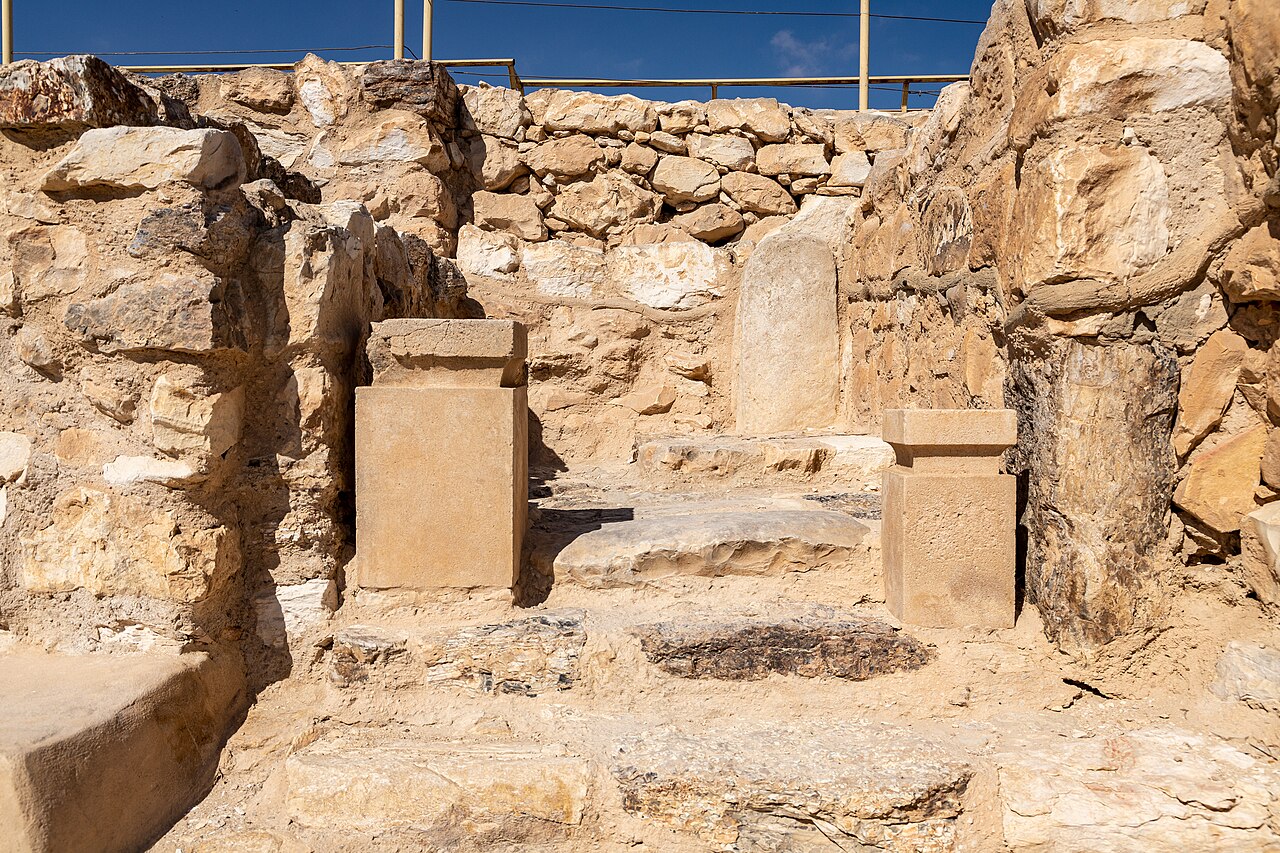
Excavations have found sanctuaries of Judah away from Jerusalem. At the Arad fortress, a shrine with an altar, two incense altars and standing stones was in use in the 8th century BC; residue analysis published in 2020 identified frankincense on one incense altar and cannabis on the other. At Tel Motza, near Jerusalem, a temple was in use in the 9th–8th centuries BC. A large horned altar from Beersheba was found dismantled, its stones reused in a later wall. When and why these shrines went out of use is debated in the excavation reports, and not every abandonment can be credited to a king's reform.
"Shall choose" or "has chosen"?
| Witness | Deuteronomy 12:5 | What it implies |
|---|---|---|
| Masoretic Text | yivchar, "[the LORD] will choose" | A place not yet named: later understood as Jerusalem |
| Samaritan Pentateuch | bachar, "has chosen" | A place already chosen: for Samaritans, Mount Gerizim |
| Greek (Giguet's translation in our library) | "choisira", will choose | Agrees with the Masoretic here |
| Vulgate | elegerit, "shall have chosen" | Future |
The difference recurs about twenty times in Deuteronomy 12–26. Some scholars note that a past-tense reading appears in some Greek, Latin and Coptic witnesses at certain verses, and argue that "has chosen" may be old rather than a Samaritan invention; others regard it as a Samaritan adaptation. The question is open. The passage page lays out the witnesses.
The Case for the Biblical Account
Scripture's account
Sacrifice only at the chosen place; local slaughter for food; no blood; no Canaanite worship (Deuteronomy 12).
What evidence would we expect?
If centralization was enforced, local sanctuaries would go out of use; texts reporting a reform.
The discoveries
Shrines at Arad, Motza and Beersheba in use and later abandoned or dismantled; 2 Kings 18:4 (Hezekiah) and 23 (Josiah) report the removal of high places; the Samaritan "has chosen" reading.
Testing the discoveries
The dates and causes of the shrines' abandonment are debated (for Arad, the excavators' phases have been revised more than once). The reforms are reported only in Kings and Chronicles.
The strongest reconstruction
Deuteronomy 12 sets out a program of worship at one place, which Kings links to Hezekiah's and Josiah's reforms.
What remains possible
That the law is older than the reforms; or that it was written to support them; and that the chosen place was first understood differently in north and south.
What the evidence shows
- Residue analysis found frankincense and cannabis on the Arad incense altars.Source: E. Arie, B. Rosen and D. Namdar, "Cannabis and Frankincense at the Judahite Shrine of Arad," Tel Aviv 47 (2020)
- The Masoretic Text reads "will choose" and the Samaritan "has chosen" in 12:5. Checked in the site's library texts.Source: Posen Library: Samaritan Pentateuch (Deut 12:5, "has chosen") ↗
- "Has chosen" is the original reading.
- Josiah's reform caused the end of the Arad shrine.
- "The blood is the life."
Continue the journey
Journey of a PassageDeuteronomy 12:5: "Will choose" or "has chosen"?The Masoretic Text speaks of the place God "will choose"; the Samaritan Pentateuch of the place God "has chosen." One letter changes a promise about an unnamed future place into a reference to one already chosen.More from this lesson
Investigations
Optional deep dives: the ancient sources, the physical evidence, and every interpretation side by side, including unconventional ones, each labeled for what it is.
Josiah and the Book Found in the TempleJosiah: historical king · Book found: biblical report · Identification with Deuteronomy: a major hypothesis
Was the scroll found in Josiah's Temple an early form of Deuteronomy?
In about 622 BC, during Temple repairs, the high priest Hilkiah reported finding "the book of the law." King Josiah tore his clothes, read it to the people, removed the high places and held a great Passover in Jerusalem. Since 1805, many scholars have identified that book with Deuteronomy or its core. Others disagree.
Open the full investigation →Why this matters to the rest of Scripture
- Slaughter at the tent of meeting.
- Josiah removes the high places.
- "My name shall be there."
- "Neither in this mountain, nor yet at Jerusalem."
- "Abstain… from blood."