Era 4 · Covenant and WildernessDeuteronomy
The Covenant Spoken Again
"The LORD made not this covenant with our fathers, but with us"
"Hear, O Israel, the statutes and judgments which I speak in your ears this day." Moses insists the covenant is theirs, not only their parents': "The LORD made not this covenant with our fathers, but with us, even us, who are all of us here alive this day."
He repeats the words spoken from the fire: "I am the LORD thy God, which brought thee out of the land of Egypt, from the house of bondage. Thou shalt have none other gods before me." The Sabbath is commanded again, but its reason is new: "remember that thou wast a servant in the land of Egypt, and that the LORD thy God brought thee out thence… therefore the LORD thy God commanded thee to keep the sabbath day," so that "thy manservant and thy maidservant may rest as well as thou."
The people had been afraid: "this great fire will consume us… Go thou near, and hear all that the LORD our God shall say." God approved: "O that there were such an heart in them, that they would fear me, and keep all my commandments always." So Moses became the mediator of the rest of the law.
Exodus 20 and Deuteronomy 5 side by side
| Exodus 20 | Deuteronomy 5 | |
|---|---|---|
| Sabbath verb | "Remember" | "Keep" (observe) |
| Sabbath reason | God rested on the seventh day of creation | Israel was a slave in Egypt; servants must rest too |
| Honor parents | "That thy days may be long" | Adds "as the LORD thy God hath commanded thee… and that it may go well with thee" |
| Coveting | House first, then wife | Wife first; then "desire" (a different verb) the house and adds "his field" |
| Joining | Separate commands | Joined by "and" ("Neither shalt thou…") |
Jewish tradition explained the two Sabbath verbs by saying God spoke "remember" and "keep" in a single utterance, which is why the Sabbath hymn Lekha Dodi begins "Keep and remember, in one word." These are differences between two passages of the Bible, not between manuscripts.
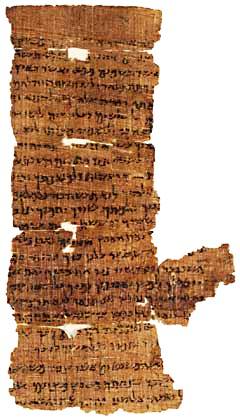
The Nash Papyrus
A single sheet bought in Egypt in 1902, dated to the 2nd–1st century BC, contains a form of the Ten Commandments followed by the Shema. Its Decalogue mixes features of Exodus 20 and Deuteronomy 5, and it was probably used for teaching or worship rather than as a copy of either book. Before the Dead Sea Scrolls it was the oldest known Hebrew biblical text.
The Samaritan commandment
In the Samaritan Pentateuch, after the commandment against coveting (in both Exodus 20 and Deuteronomy 5), a further command is added: set up great plastered stones, write the law on them, and build an altar "in Mount Gerizim." It is assembled from Deuteronomy 11:29–30 and 27:2–7. The Samaritan text also puts "house" before "wife" in Deuteronomy 5:21, as in Exodus. The Ten Commandments passage page shows every witness.
The Case for the Biblical Account
Scripture's account
Moses repeats the Ten Commandments at Moab (Deuteronomy 5).
What evidence would we expect?
Ancient copies of both forms; signs of how the Decalogue was used and remembered.
The discoveries
The Nash Papyrus; Decalogue texts in Qumran tefillin and excerpt scrolls (such as 4QDeut-n) that sometimes blend the Exodus and Deuteronomy wording; the Samaritan Gerizim commandment; the Greek, which follows Deuteronomy's order of wife then house.
Testing the discoveries
The two biblical forms are stable in all major witnesses; mixed forms occur in texts made for teaching and prayer.
The strongest reconstruction
The Decalogue circulated in two biblical forms and was memorized and blended in daily use.
What remains possible
Which form is earlier, or whether both develop from a shorter original set of commands.
What the evidence shows
- Deuteronomy 5 grounds the Sabbath in the release from Egypt; Exodus 20 in creation.
- The Nash Papyrus combines features of both Decalogues and adds the Shema.Source: Nash Papyrus (Cambridge University Library, MS Or. 233), 2nd–1st century BC
- The Samaritan Pentateuch adds a Gerizim commandment and reads "house" before "wife" in 5:21. Read in the site's Samaritan text.
- The Samaritan commandment shows that Joshua built an altar on Gerizim. It is a textual tradition, not historical evidence of an altar.
- "The LORD talked with you face to face in the mount out of the midst of the fire."
Continue the journey
Journey of a PassageExodus 20:8–17: The Ten Commandments: order, Sabbath, and a Samaritan commandmentThe Decalogue is one of the best-attested passages in the Bible, yet its witnesses differ in three ways: the order of "murder, adultery, theft," the reason given for the Sabbath (Exodus 20 versus Deuteronomy 5), and an extra commandment about Mount Gerizim in the Samaritan Pentateuch.More from this lesson
Echoes Across Civilizations
Optional: how other ancient peoples told similar stories. Open one to compare, then come back to the lesson.
Covenants shaped like treatiesHittite · Assyrian
Did ancient kings make treaties in the same shape as God's covenant at Sinai?
- Hittite: Hittite vassal treaties (e.g. Mursili II with Duppi-Teshub of Amurru; Suppiluliuma I with Shattiwaza) Possible historical contact
- Assyrian: The Succession Treaty of Esarhaddon (Vassal Treaties of Esarhaddon) Possible historical contact
Why this matters to the rest of Scripture
- The first giving of the Ten Commandments.
- "The ten commandments."
- Jesus lists commandments.
- "The sabbath was made for man."
- The commandments summed up in love.