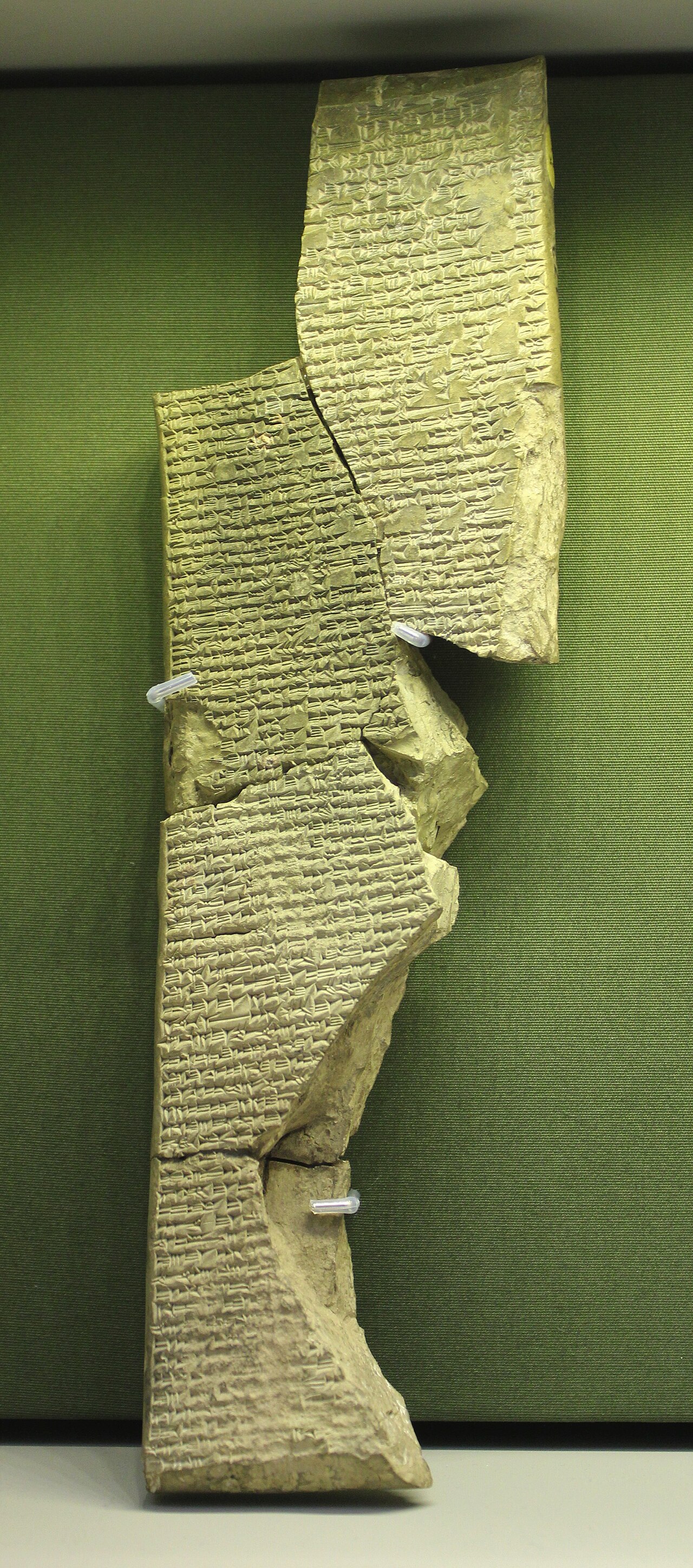
Did other ancient peoples picture a high god ruling a council of divine beings who were assigned to the nations?
What the relationship labels mean
Possible historical contact: The cultures were in contact, so one tradition could have known the other.
Shared literary world: The stories appear to share older roots or a common cultural setting.
Similar human experience: Different peoples responding to similar realities, such as river floods.
Resemblance only: A real similarity worth noticing; no historical connection has been established.
Modern speculative theory: A modern interpretation, not an ancient source. Not supported by authenticated evidence.
Ugarit · Ras Shamra, Syrian coast
El and "the sons of El" (bn ilm)
Possible historical contact
Composed
Texts written down c. 1300–1200 BC
Earliest surviving copy
Clay tablets from Ugarit
The high god El, "father of years," presides over the assembly of the gods; the goddess Athirat is said to have seventy sons. Lesser gods have their own domains.
Similar
A high god presiding over "sons of God"
Seventy divine sons, compare seventy nations in Genesis 10
"Elyon" and "El" as divine titles
Different
The council's members are worshiped as gods
No single people as El's own portion
Read it: M. S. Smith, The Origins of Biblical Monotheism (2001); E. T. Mullen, The Divine Council in Canaanite and Early Hebrew Literature (1980)
The gods meet in assembly to decide the fate of the world; Marduk is made king of the gods and assigns the gods their places in heaven and earth.
Similar
A council of divine beings deciding the world's order
Domains assigned to gods
Different
Many gods of equal kind; the king of the gods is chosen by them
Second Temple Judaism · Judea
Angels over the nations (Daniel, Jubilees, 1 Enoch)
Shared literary world
Composed
3rd–2nd centuries BC
Earliest surviving copy
Dead Sea Scroll fragments
Daniel speaks of "the prince of Persia" and "Michael your prince" (10:13–21); Jubilees 15:31–32 says God set spirits over the nations but ruled Israel Himself; 1 Enoch tells of the fallen Watchers.
Similar
Nations assigned to heavenly beings
Israel as God's own portion
Different
The beings are angels under God, not gods
Full investigations
Psalm 82: Who Are the "Gods"? →When God "judgeth among the gods," who is on trial: heavenly beings, the gods of the nations, human judges, or Israel?
Back to the story
The Song of Moses: The Nations and Heavenly Beings →Moses' great poem calls heaven and earth to listen, tells how the Most High divided the nations and chose Jacob, how Israel grew fat and forgot the Rock, and how God will judge and then have mercy. Two of its verses read very differently in the oldest manuscripts: who received the nations, and who is called to worship at the end.
Remember Horeb: No Images and No Other Gods →Moses reminds Israel that at Horeb they heard a voice from the fire but saw no form, so they must make no image of God or worship the sun, moon and stars. He foresees exile and return, and sets apart three cities of refuge east of the Jordan.
A Man in the Land of Uz →Job of Uz is blameless and upright, rich in children and flocks, and offers sacrifices in case his children have sinned. In the heavenly council the accuser (ha-satan) asks whether Job's piety is only payment for his blessings. God allows him to take everything but Job's body. In one day raiders, fire and wind destroy Job's flocks, servants and all ten children. Job tears his robe, shaves his head, falls to the ground and worships: "The LORD gave, and the LORD hath taken away; blessed be the name of the LORD."
Eliphaz Hardens →The second round of speeches begins. Eliphaz, no longer gentle, says Job's own mouth condemns him: his words are wind and undermine reverence. Was Job the first man born, made before the hills? Did he listen in God's council? The grey-haired and aged are on the friends' side. Then he paints the wicked man's life: dread in his ears, waiting for the sword, darkness, a bloom that falls like an unripe grape.
Where Wast Thou? →"Then the LORD answered Job out of the whirlwind." God does not explain the heavenly test. He asks questions: where was Job when the earth was founded and the morning stars sang? Who shut in the sea with doors? Has Job commanded the dawn, walked in the depths, seen the gates of death? Where do light and darkness live? Who made the storehouses of snow and hail, the channels for rain on land where no one lives? Can Job bind the Pleiades or loose Orion, hunt prey for the lion, feed the raven's young?
Investigation: Who Is the Accuser? →In Job 1–2 the figure who challenges Job's piety is ha-satan, "the adversary," a member of the heavenly court who acts only with God's permission. The Hebrew word satan is used of human opponents, of the angel of the LORD blocking Balaam, and of a court accuser in Zechariah 3. Only 1 Chronicles 21:1 may use it as a name. The Greek translators wrote diabolos, "slanderer." Later Jewish writings (Jubilees, the Dead Sea Scrolls) and the New Testament developed a personal Satan, the devil, opposed to God. Job stands early in that history.
Isaiah 6: Holy, Holy, Holy →"In the year that king Uzziah died I saw also the Lord sitting upon a throne, high and lifted up, and his train filled the temple" (6:1). Seraphim with six wings call to one another, "Holy, holy, holy, is the LORD of hosts: the whole earth is full of his glory" (vv. 2–3); the threshold shakes and the house fills with smoke (v. 4). Isaiah cries, "Woe is me! for I am undone; because I am a man of unclean lips" (v. 5). A seraph touches his mouth with a live coal from the altar: "thine iniquity is taken away" (vv. 6–7). God asks, "Whom shall I send?"; Isaiah answers, "Here am I; send me" (v. 8). His message: "Hear ye indeed, but understand not… Make the heart of this people fat… lest they… understand… and be healed" (vv. 9–10). "How long?" Until cities lie waste; a tenth will remain and be burned again, like a felled oak whose stump remains: "the holy seed shall be the substance thereof" (vv. 11–13).
Isaiah 40: Comfort Ye My People →A new voice: "Comfort ye, comfort ye my people… her warfare is accomplished" (40:1–2). A voice cries: prepare the LORD's way in the wilderness; every valley raised, every mountain lowered; all flesh shall see his glory (vv. 3–5). Another voice: "All flesh is grass… but the word of our God shall stand for ever" (vv. 6–8). Zion, herald of good news, announces: "Behold your God!", who comes with power and feeds his flock like a shepherd (vv. 9–11). Who measured the waters in his hand? The nations are a drop in a bucket; to whom will you liken God? An idol has to be made so that it will not totter (vv. 12–20). He sits above the circle of the earth, names every star, gives strength to the weary: "they that wait upon the Lord shall renew their strength; they shall mount up with wings as eagles" (vv. 21–31).
Investigation: The Holy One and the Sea Monsters →Isaiah's God is "the Holy One of Israel," enthroned above seraphim (6), presiding over a heavenly court (6:8; 40:1–8), creator of everything including light and darkness (45:7), who once struck the sea dragon Rahab (51:9) and will slay Leviathan, "the piercing serpent… the crooked serpent" (27:1). Many of these images have close parallels in the literature and art of Israel's neighbors: winged serpents in Egyptian and Judahite art, divine assemblies at Ugarit, the Babylonian creation epic, and the Ugaritic Lotan, "the fleeing serpent, the twisting serpent." This investigation sets each Isaiah text beside its closest ancient comparison and asks what the comparison shows, and what it does not.