"There was a man in the land of Uz, whose name was Job; and that man was perfect and upright, and one that feared God, and eschewed evil." The book opens like a story told at a gate: a place no one can find on a map, a man of no named tribe, seven sons and three daughters, seven thousand sheep, three thousand camels, five hundred yoke of oxen and five hundred she-asses, "so that this man was the greatest of all the men of the east."
His children feast in turn in one another's houses. When the round of feasts ends, Job rises early and offers a burnt offering for each of them: "It may be that my sons have sinned, and cursed God in their hearts." The narrator has told us twice, before anything happens, that Job is upright. Whatever comes next, we are not to think he deserved it.
Then the scene shifts where Job cannot follow. "Now there was a day when the sons of God came to present themselves before the LORD, and Satan came also among them." The Hebrew says ha-satan, "the accuser" or "the adversary," with the article, like a title. The LORD points to Job: "Hast thou considered my servant Job?" The accuser answers with the question that drives the whole book: "Doth Job fear God for nought? Hast not thou made an hedge about him?… But put forth thine hand now, and touch all that he hath, and he will curse thee to thy face." The LORD allows it, but not against Job himself.
The disasters arrive as four messengers, each still speaking when the next comes. Sabeans take the oxen and asses and kill the servants. "The fire of God" falls on the sheep. Chaldeans in three bands take the camels. A great wind from the wilderness strikes the house where the children are eating, and they die. Each messenger ends the same way: "and I only am escaped alone to tell thee."
Job rises, tears his mantle, shaves his head, falls on the ground and worships: "Naked came I out of my mother's womb, and naked shall I return thither: the LORD gave, and the LORD hath taken away; blessed be the name of the LORD." The narrator adds: "In all this Job sinned not, nor charged God foolishly."
Where was Uz?
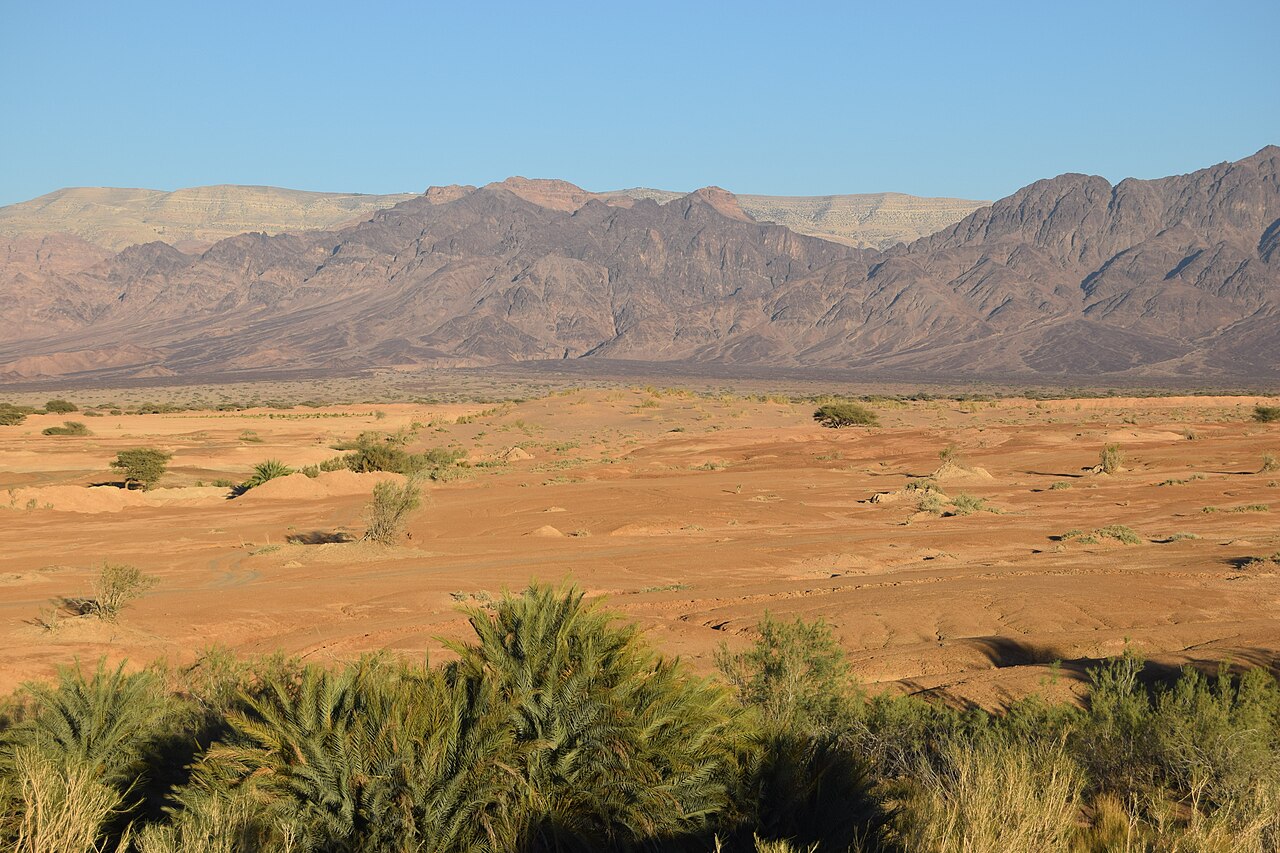
Nobody knows. Genesis lists an Uz among the sons of Aram (10:23), a son of Nahor (22:21) and a Horite descendant in Edom (36:28). Lamentations 4:21 speaks of "daughter of Edom, that dwellest in the land of Uz," and Jeremiah 25:20 lists "the kings of the land of Uz" among peoples east and south of Judah. So Uz is most likely somewhere in Edom or the north Arabian desert fringe, but no inscription names it and no site can be pointed to. The atlas shows it as an uncertain region, not a dot.
A man of the east
"The men of the east" (bene qedem) are the desert and steppe peoples east of Israel, proverbial for wisdom (1 Kings 4:30). Job is not an Israelite, offers sacrifices himself as head of the household like Abraham, and lives outside any temple or kingdom. That outsider setting is part of the story's power: its question belongs to anyone.
Wealth counted in animals
Job's wealth is pastoral: sheep and goats for wool and milk, camels for caravans, oxen to plough, she-asses prized for milk and breeding. Five hundred yoke of oxen means great farmland as well as flocks. The numbers are round and symbolic (seven and three, five hundred and five hundred), the way storytellers count.
Raiders from two directions
The Sabeans (people of Sheba, in south Arabia, or Arab traders of the north) strike from the south, the Chaldeans from the north-east. Chaldeans (Kaldu) appear in Assyrian records from the 9th century BC as tribes in southern Babylonia. Their mention fits a storyteller of the first millennium, though it cannot by itself date the book.
Mourning gestures
Tearing the outer robe, shaving the head and lying on the ground are mourning rites known across the ancient Near East and the Bible (Genesis 37:34; Jeremiah 7:29; Micah 1:16). Job does every one, and then worships.
Who is "the satan"?
In Job 1–2 the word has the article: ha-satan, "the adversary," a role in God's court rather than a personal name. He comes "among the sons of God," answers the LORD's questions and acts only with permission. Zechariah 3:1–2 has the same figure accusing the high priest; Numbers 22:22 uses the word for the angel of the LORD standing "for an adversary" against Balaam. Later Jewish and Christian writings developed a personal Satan, the devil, opposed to God; the Greek translators already wrote ho diabolos, "the slanderer," here, and the library's Greek (Giguet) has "le diable." Readers can hold both: what the Hebrew of Job says, and how the figure was later understood. See the investigation "Who Is the Accuser?"
"For nought" and "without cause"
The accuser's question is: "Doth Job fear God for nought (hinnam)?" In 2:3 the LORD says the accuser moved him against Job "without cause" (hinnam). The same word frames the test: is there piety for nothing, and can there be suffering for nothing?
"Bless" meaning "curse"
In 1:5, 1:11 and 2:5, 9 the Hebrew verb is barak, "bless," where the sense is clearly "curse." Most scholars see a scribal or authorial euphemism avoiding writing "curse God" (compare 1 Kings 21:10, 13). English translations render the sense; the Hebrew keeps the word "bless." In 1:21 Job "blesses" in the ordinary sense: "blessed be the name of the LORD." The book plays on the double edge of one word.
Story, not report
The messengers' reports are literary: four disasters in one day, each messenger interrupting the last, each ending with the same line. That shape tells us we are reading a crafted story. Whether a historical Job stood behind it is a separate question (see "How Job Came to Us"); no ancient record outside the Bible names him or his losses.
What the evidence shows
- The narrator states Job's uprightness before his losses (1:1, 8).
- Uz can be located on a map. Edom or north Arabia are reasonable candidates; no inscription identifies it.
- Ha-satan in Job 1–2 is a title ("the adversary") within God's court. The article shows a role; later identification with the devil is a development in interpretation.
- Barak ("bless") stands for "curse" in 1:5, 11; 2:5, 9.
Continue the journey
Journey of a PassageJob 1:1: A man in the land of UzAll the library's versions agree on the opening: a man in the land of Uz named Job, blameless and upright.More from this lesson
Echoes Across Civilizations
Optional: how other ancient peoples told similar stories. Open one to compare, then come back to the lesson.
The heavenly council and the nationsUgarit · Mesopotamia · Second Temple Judaism
Did other ancient peoples picture a high god ruling a council of divine beings who were assigned to the nations?
- Ugarit: El and "the sons of El" (bn ilm) Possible historical contact
- Mesopotamia: The assembly of the gods (Enuma Elish, Atrahasis) Resemblance only
- Second Temple Judaism: Angels over the nations (Daniel, Jubilees, 1 Enoch) Shared literary world
The assembly of heavenUgaritic · Babylonian
Did other peoples imagine a council of gods around a supreme god?
- Ugaritic: The assembly of El Shared literary world
- Babylonian: The assembly of the gods in Enuma Elish and Atrahasis Shared literary world
Why this matters to the rest of Scripture
- The accuser in the heavenly court again.
- Uz linked with Edom.
- "Ye have heard of the patience of Job."