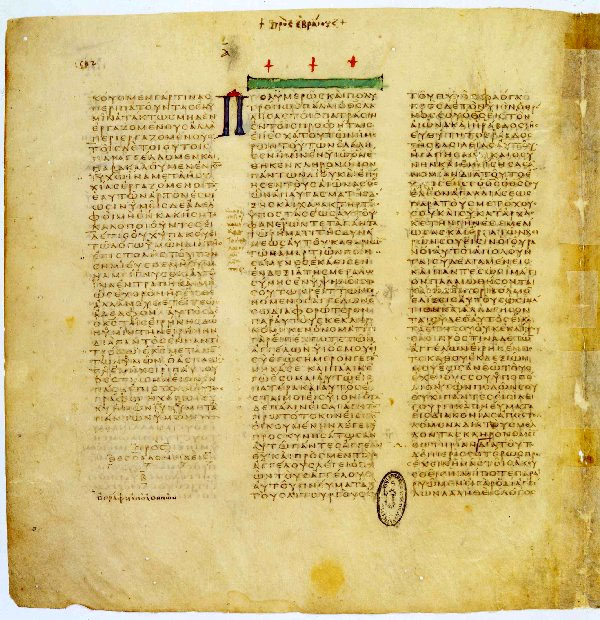
Investigation: Why Ancient Jobs Differ
Qumran, the Aramaic Targum, the shorter Greek and Origen's asterisks
Imagine three ancient readers in about AD 200. One, in Judea, reads Job in Hebrew from a scroll, perhaps one of the copies like those left in the Qumran caves. Another, in a synagogue in Galilee, hears an Aramaic translation. A third, in Alexandria, reads Job in Greek. The third reader has a much shorter book: whole lines and passages, especially in the later chapters, simply are not there.
Around AD 240 the Christian scholar Origen noticed. In his great six-column Bible, the Hexapla, he compared the Greek with the Hebrew and filled in the missing lines from another Greek translation, by Theodotion, marking each addition with an asterisk (※). He wrote to Julius Africanus that "in Job there are many passages, sometimes three or four verses, sometimes fourteen or nineteen," missing from the Greek. Jerome later said the Greek lacked "seven or eight hundred lines."
Over time copyists dropped the asterisks. Most later Greek manuscripts, and the printed Septuagints that modern translations like Giguet's are based on, contain the filled-out text. The shorter Old Greek survives in a few manuscripts, in Origen's marked text as reconstructed by scholars, and in translations made before Origen, notably the Sahidic Coptic.
| Witness | Date | Language | Extent | In the site's library? |
|---|---|---|---|---|
| 4Q99, 4Q100, 4Q101, 2Q15 | 1st century BC – 1st century AD (4Q101 perhaps earlier) | Hebrew (4Q101 in paleo-Hebrew script) | Small fragments (e.g. parts of chs. 8–9, 13–14, 31–37) | No (reports only) |
| 4Q157 (4QtgJob) | 1st century BC / AD | Aramaic | Job 3:5–9; 4:16–5:4 | No |
| 11Q10 (11QtgJob) | 1st century BC / AD | Aramaic | Large parts of 17:14–42:11 | No (IAA photographs exist) |
| Old Greek | Translated c. 2nd–1st century BC | Greek | About one-sixth shorter than the Hebrew | Partly, via Sahidic Coptic |
| Origen's Hexapla | c. AD 240 | Greek | Filled to Hebrew length, additions asterisked | No |
| Later Greek / printed LXX | 4th century onward | Greek | Filled-out text, marks usually lost | Yes: Giguet's French, Church Slavonic |
| Leningrad Codex | AD 1008 | Hebrew (Masoretic) | Complete | Yes (WLC) |
| Vulgate | c. AD 390s | Latin from Hebrew | Complete | Yes |
What you can check yourself
Open Job in the reader and compare the Hebrew (WLC), the Sahidic Coptic and the French of the Greek (Giguet). Giguet's Job has 1,068 verses filled, almost the full Hebrew count (1,070): it follows the filled-out Greek. The Coptic copy has 906, with gaps concentrated in chapters 21–42, especially the Elihu speeches. That pattern matches the scholarly description of the Old Greek. Some gaps may be damage in the Coptic manuscripts or in our digital copy; the reader marks them as missing, never as a proven Old Greek omission.
Why was the Greek shorter?
Two explanations. (1) The translator worked from a shorter Hebrew text. (2) The translator abridged a Hebrew text much like ours, condensing repetitive or obscure poetry, especially in the later chapters where the Hebrew is hardest. The NETS translator (C. Cox) and Maria Gorea (2021) describe the omissions as unevenly distributed and often consistent with deliberate condensing; most scholars favour abridgement, while evaluating each passage separately. The Qumran Hebrew fragments are close to the Masoretic text and include Elihu, which supports the existence of a full-length Hebrew Job before the Christian era.
The Aramaic Targum
11Q10 is one of the earliest translations of any biblical book. It ends at 42:11, and scholars debate whether that is due to damage or a shorter ending. Its reading of 42:6 is reported as "I am poured out and dissolved, and I shall become dust and ashes," very different from "I repent." Rabbinic tradition remembers that Rabban Gamaliel the Elder ordered an Aramaic Job to be hidden in a wall of the Temple Mount (Tosefta Shabbat 13:2), showing early unease about written Targums. The Targum is evidence of interpretation and, cautiously, of the Hebrew it translated.
Expansions as well as gaps
The Greek is shorter overall but adds some passages: the long speech of Job's wife (2:9) and the ending about resurrection and Jobab (42:17a–e). It also interprets: "the devil" (1:6), "angels" (38:7), "the dragon" (40:20). A difference between versions can be (a) a different Hebrew text, (b) a translator's choice, (c) a later scholarly supplement (Origen), or (d) a copyist's error. The site never labels all four as "scribal changes."
Still to verify
Exact Qumran verse ranges and readings (DJD; JOB-C04); the asterisked lines in Ziegler's edition and Gentry's study (JOB-C03); whether each Coptic gap is an Old Greek minus or damage.
What the evidence shows
- The Old Greek of Job was substantially shorter than the Hebrew.Source: M. Gorea, "The Book of Job," in The Oxford Handbook of the Septuagint (2021) (abstract) ↗; NETS, "Iob," translator's introduction and translation (after Ziegler's Göttingen edition, 1982) ↗; P. J. Gentry, The Asterisked Materials in the Greek Job (SBLSCS 38, 1995)
- Origen supplied missing lines from Theodotion and marked them with asterisks.Source: Origen, Letter to Africanus 3–4 (on passages of Job missing from the Greek); P. J. Gentry, The Asterisked Materials in the Greek Job (SBLSCS 38, 1995)
- The library's Giguet text follows the filled-out Greek. 1,068 of 1,070 verse slots filled.Source: The site's library: Westminster Leningrad Codex (Hebrew), Giguet's French of the Greek, Clementine Vulgate, KJV, Church Slavonic, Sahidic Coptic
- The Sahidic Coptic version preserves the shorter Greek form. Our copy's 168 gaps fit this pattern; some may be damage.Source: P. J. Gentry, The Asterisked Materials in the Greek Job (SBLSCS 38, 1995)
- 11Q10 preserves large parts of Job 17–42 in Aramaic.Source: Israel Antiquities Authority, Leon Levy Dead Sea Scrolls Digital Library, 11Q10 (11QtgJob), image B-285219 ↗; F. García Martínez and E. J. C. Tigchelaar, The Dead Sea Scrolls Study Edition (Brill, 1997–98)
Continue the journey
Journey of a PassageJob 2:9: The speech of Job's wifeIn Hebrew, Job's wife speaks one line: "Dost thou still retain thine integrity?More from this lesson
Investigations
Optional deep dives: the ancient sources, the physical evidence, and every interpretation side by side, including unconventional ones, each labeled for what it is.
Who Is Elihu?Present in all manuscripts · Origin: debated
Were Elihu's speeches part of the original book of Job?
Elihu son of Barachel the Buzite speaks for six chapters and is never mentioned before or after. Arguments for a later addition: his absence from the prologue, epilogue and God's verdict; differences of style; his quoting of earlier speeches; the interruption between Job's challenge and God's answer. Arguments for integration: he prepares for the storm theophany; his absence from the verdict may be deliberate. Elihu material is present in Qumran Hebrew fragments.
Open the full investigation →The Shorter Greek JobShorter Old Greek: documented · Cause: debated (abridgement favoured)
Why was the earliest Greek translation of Job about a sixth shorter than the Hebrew?
The Old Greek of Job lacked roughly 390 of the Hebrew's poetic lines, mostly in the later chapters. Origen (c. AD 240) supplied them from Theodotion and marked them with asterisks; later copies kept the additions and lost the marks. Most scholars think the translator abridged a Hebrew text much like ours; some propose a shorter Hebrew original. The Sahidic Coptic preserves the shorter form; the library's Coptic copy lacks 168 verses, concentrated in chapters 21–42.
Open the full investigation →Why this matters to the rest of Scripture
- The Greek wife's speech.
- Four ancient ways to read one line.
- The Greek ending.