"Hear diligently my speech… Suffer me that I may speak; and after that I have spoken, mock on… Wherefore do the wicked live, become old, yea, are mighty in power? Their seed is established in their sight with them… Their houses are safe from fear, neither is the rod of God upon them. Their bull gendereth, and faileth not… They send forth their little ones like a flock, and their children dance. They take the timbrel and harp… They spend their days in wealth, and in a moment go down to the grave."
"Therefore they say unto God, Depart from us; for we desire not the knowledge of thy ways. What is the Almighty, that we should serve him?… How oft is the candle of the wicked put out!"
"One dieth in his full strength, being wholly at ease and quiet… And another dieth in the bitterness of his soul… They shall lie down alike in the dust, and the worms shall cover them."
"Have ye not asked them that go by the way?… That the wicked is reserved to the day of destruction?… Yet shall he be brought to the grave, and shall remain in the tomb. The clods of the valley shall be sweet unto him… How then comfort ye me in vain, seeing in your answers there remaineth falsehood?"
An honoured tomb
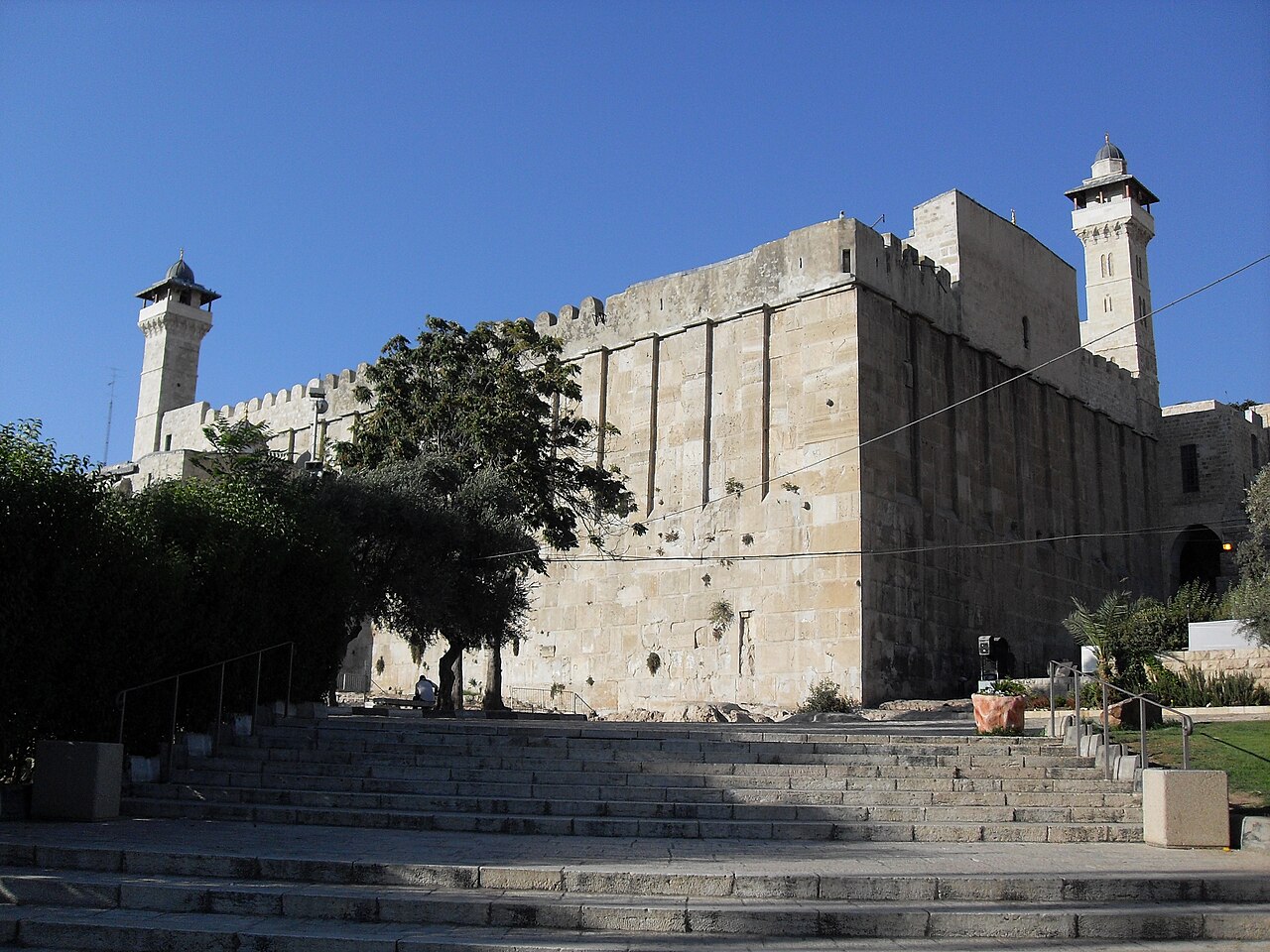
"He shall be brought to the grave, and shall remain in the tomb": the wicked man gets a grand funeral and a guarded tomb. Monumental tombs marked status, like the great enclosure over the Cave of Machpelah in Hebron pictured above (built in Herod's time over the patriarchs' traditional burial place).
Ask the travellers
Travellers and caravan merchants knew the world beyond the village. Job appeals to their broad experience against the friends' narrow tradition.
Pails full of milk
21:24, "His breasts are full of milk" (KJV), translates an uncertain word ('atinim): perhaps "pails" (his pails full of milk) or "thighs" (his thighs full of fat). The library's Greek and the Vulgate both read "his entrails full of fat," a picture of well-fed prosperity.
Empirical wisdom
Job's argument is observational: look at the world. Ecclesiastes makes the same point (7:15; 8:14), and Psalm 73 begins with it before finding a resolution in the sanctuary. Job does not insert an unseen later punishment to remove the sting; the site keeps it.
"Their children are punished"
In 21:19 Job quotes the friends' answer, that God stores up punishment for the wicked's children, and rejects it: let the wicked himself feel it. Ezekiel 18 and Deuteronomy 24:16 also reject punishing children for parents' sins.
Greek gaps
21:28–33 is among the passages missing from the library's Sahidic Coptic copy, which follows the shorter Old Greek. Whether these lines were absent from the earliest Greek translation should be checked against Ziegler's edition (JOB-C03).
The versions
The library's Greek and the Vulgate read 21:24 as "his entrails full of fat" where the KJV has "breasts full of milk." The library's Sahidic Coptic copy, which follows the shorter pre-Origen Greek, lacks 21:15, 21:23–24 and 21:28–33. Whether each missing line was absent from the Old Greek itself, or is damage in the Coptic manuscripts or our digital copy, is to be checked against Ziegler's edition (JOB-C03).
What the evidence shows
- Job 21 argues from observation that the wicked often prosper and die in peace.
- The Sahidic Coptic copy in the library lacks 21:28–33. Old Greek status to be confirmed against Ziegler.Source: The site's library: Westminster Leningrad Codex (Hebrew), Giguet's French of the Greek, Clementine Vulgate, KJV, Church Slavonic, Sahidic Coptic
Continue the journey
Echoes Across CivilizationsThe righteous suffererDid other ancient peoples write about a good person who suffers without knowing why?More from this lesson
Echoes Across Civilizations
Optional: how other ancient peoples told similar stories. Open one to compare, then come back to the lesson.
The righteous suffererBabylonian · Sumerian · Egyptian
Did other ancient peoples write about a good person who suffers without knowing why?
- Babylonian: Ludlul bēl nēmeqi ("I will praise the lord of wisdom") Shared literary world
- Babylonian: The Babylonian Theodicy Shared literary world
- Sumerian: "A Man and His God" Resemblance only
- Egyptian: The Dispute between a Man and his Ba Resemblance only
Why this matters to the rest of Scripture
- "I was envious at the foolish, when I saw the prosperity of the wicked."
- Righteous treated as wicked, wicked as righteous.
- "Wherefore doth the way of the wicked prosper?"