"Can a man be profitable unto God…? Is it any pleasure to the Almighty, that thou art righteous?… Is not thy wickedness great? and thine iniquities infinite? For thou hast taken a pledge from thy brother for nought, and stripped the naked of their clothing. Thou hast not given water to the weary to drink, and thou hast withholden bread from the hungry… Thou hast sent widows away empty, and the arms of the fatherless have been broken. Therefore snares are round about thee."
"Acquaint now thyself with him, and be at peace: thereby good shall come unto thee… If thou return to the Almighty, thou shalt be built up… Then shalt thou lay up gold as dust, and the gold of Ophir as the stones of the brooks. Yea, the Almighty shall be thy defence… He shall deliver the island of the innocent: and it is delivered by the pureness of thine hands."
A garment taken in pledge
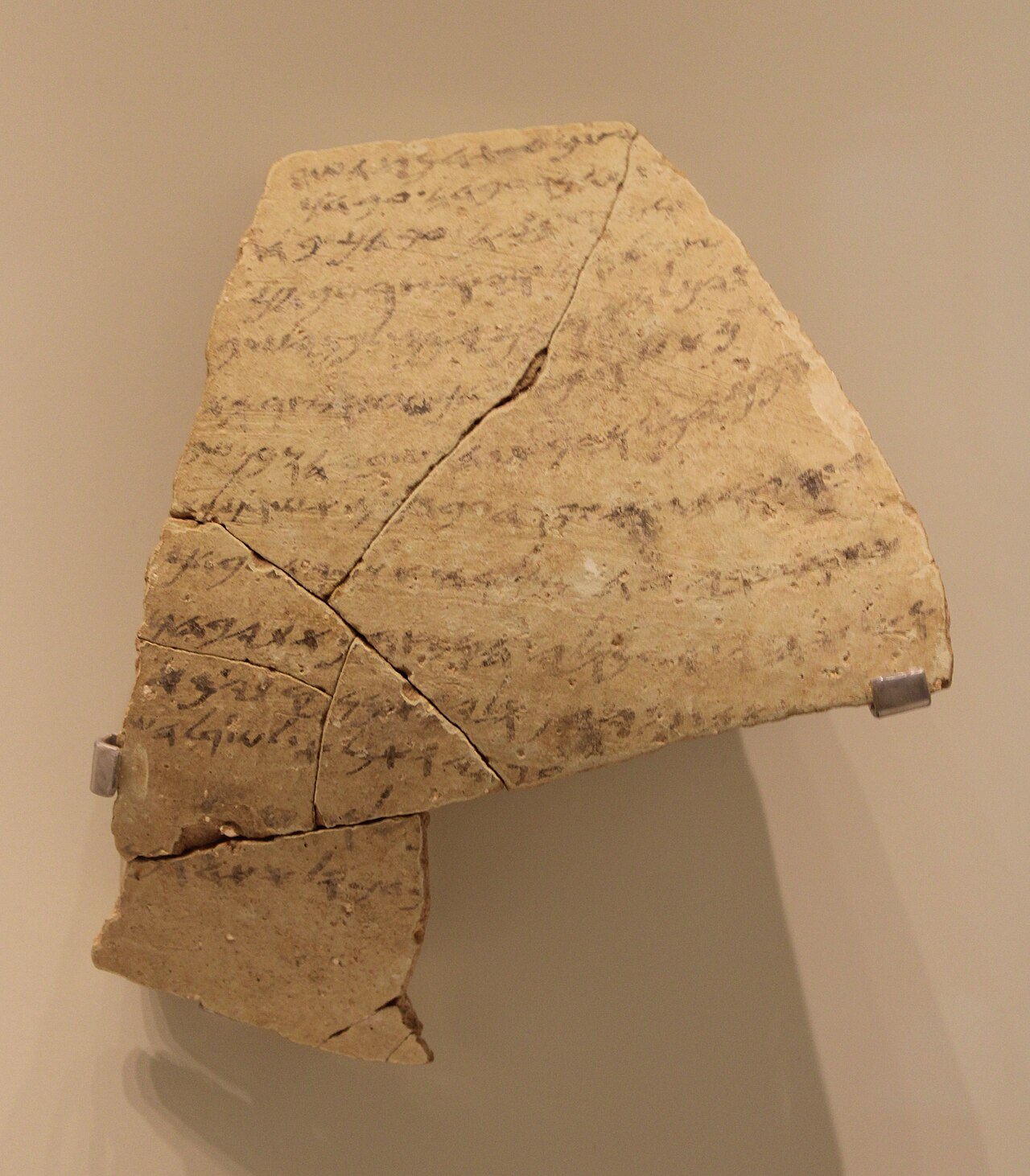
Biblical law forbade keeping a poor man's cloak overnight as a pledge (Exodus 22:26–27; Deuteronomy 24:12–13, 17). The Yavneh-Yam ostracon, pictured above, is a real labourer's appeal to an official to return his garment, seized at harvest. Eliphaz accuses Job of exactly this oppression.
Gold of Ophir
Ophir was a source of fine gold reached by ship from the Red Sea (1 Kings 9:28); its location (Arabia, East Africa, India) is unknown. A Tell Qasile ostracon (8th century BC) reads "gold of Ophir to Beth-Horon, 30 shekels."
The old way of the wicked
22:15–16 asks if Job will follow "the old way which wicked men have trodden, which were cut down out of time, whose foundation was overflown with a flood." Many interpreters, ancient and modern, see an allusion to the generation of the Flood. The library's Greek has "their dwelling became an overflowing river" and the Vulgate "a river overturned their foundation."
Compare Job 29 and 31
Job will answer point by point: he rescued the poor and fatherless (29:12), was a father to the needy (29:16), shared his bread (31:17), clothed the naked (31:19–20), never raised his hand against the fatherless (31:21). The narrator confirms Job's uprightness (1:1). The reader has no reason to believe Eliphaz's charges.
An ironic ending
Eliphaz promises that a restored Job will deliver the guilty by his intercession (22:30). In 42:8 that happens: God tells Eliphaz to ask Job to pray for him and his friends. Eliphaz's prophecy comes true against himself.
The versions
The library's Sahidic Coptic copy, which follows the shorter pre-Origen Greek, lacks 22:13–16, 22:20, 22:24 and 22:29–30. Whether each missing line was absent from the Old Greek itself, or is damage in the Coptic manuscripts or our digital copy, is to be checked against Ziegler's edition (JOB-C03).
What the evidence shows
- Eliphaz's charges against Job are confirmed by the narrator. The narrator says Job was upright (1:1, 8; 2:3).
- Biblical law forbade keeping a poor person's cloak overnight as a pledge.
- The Tell Qasile ostracon mentions "gold of Ophir."
Continue the journey
Echoes Across CivilizationsDebt release and libertyDid other ancient peoples cancel debts and free debt-slaves, like the Jubilee?More from this lesson
Echoes Across Civilizations
Optional: how other ancient peoples told similar stories. Open one to compare, then come back to the lesson.
Debt release and libertySumerian · Babylonian · Assyrian and Nuzi
Did other ancient peoples cancel debts and free debt-slaves, like the Jubilee?
- Sumerian: Reforms of Uruinimgina (Urukagina) Shared literary world
- Babylonian: The Edict of Ammi-saduqa (a misharum decree) Possible historical contact
- Assyrian and Nuzi: Andurarum proclamations Possible historical contact
Why this matters to the rest of Scripture
- Return the pledged cloak by sunset.
- Job's answer.
- Job prays for Eliphaz.