"Then the LORD answered Job out of the whirlwind, and said, Who is this that darkeneth counsel by words without knowledge? Gird up now thy loins like a man; for I will demand of thee, and answer thou me."
"Where wast thou when I laid the foundations of the earth? declare, if thou hast understanding. Who hath laid the measures thereof, if thou knowest? or who hath stretched the line upon it? Whereupon are the foundations thereof fastened? or who laid the corner stone thereof; When the morning stars sang together, and all the sons of God shouted for joy?"
"Or who shut up the sea with doors, when it brake forth, as if it had issued out of the womb? When I made the cloud the garment thereof… And said, Hitherto shalt thou come, but no further: and here shall thy proud waves be stayed?"
"Hast thou commanded the morning since thy days…? Have the gates of death been opened unto thee?… Hast thou entered into the treasures of the snow?… To cause it to rain on the earth, where no man is; on the wilderness, wherein there is no man… Canst thou bind the sweet influences of Pleiades, or loose the bands of Orion?… Wilt thou hunt the prey for the lion?… Who provideth for the raven his food? when his young ones cry unto God."
Building the world
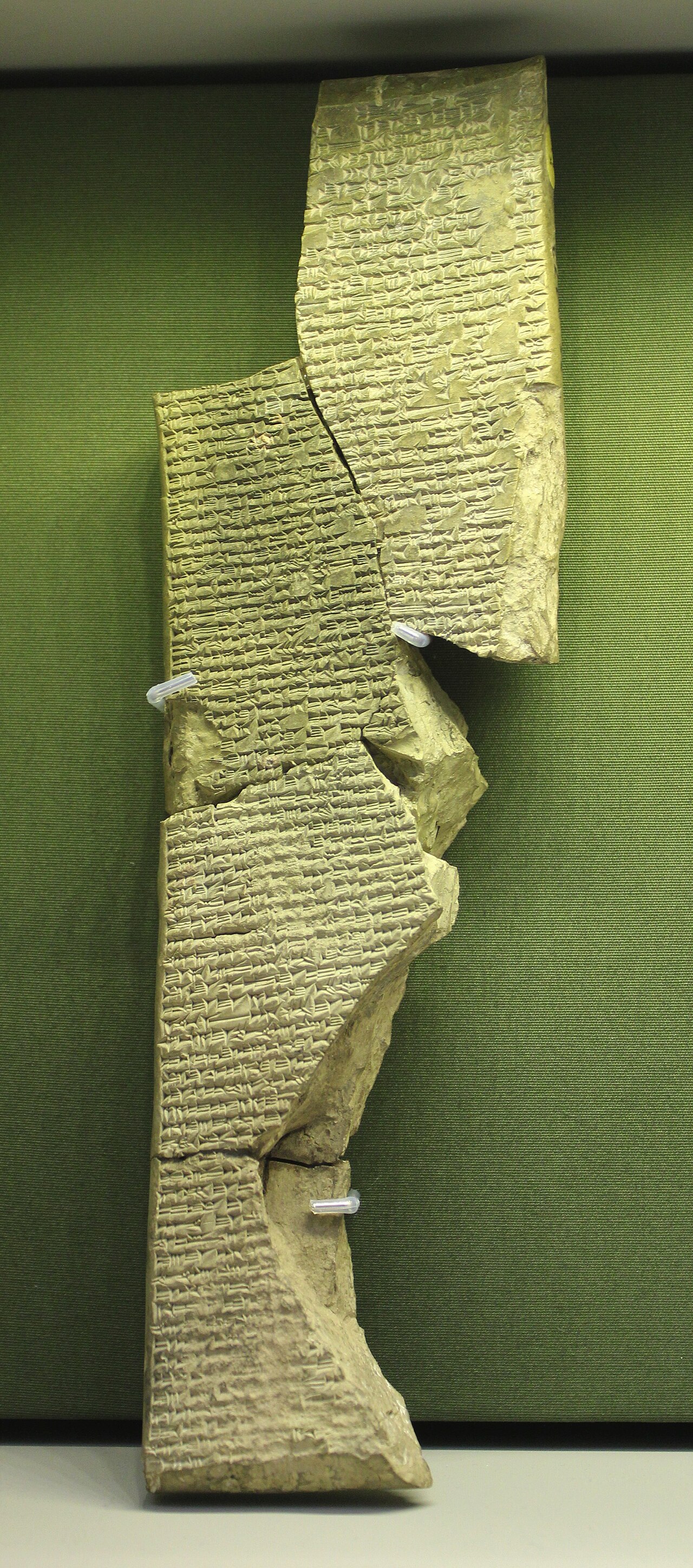
God describes creation as building a house: foundations, measurements, a line stretched, a cornerstone laid, with a song at the laying. Ancient temple-building texts describe similar ceremonies. The Babylonian Enuma Elish (above) also has the world built after the defeat of the sea, Tiamat; in Job the sea is not slain but swaddled like a newborn and given a boundary.
Rain where no one lives
38:26 is striking: God sends rain on the desert "where no man is." Creation is not centred on human use. The rest of the speech will show wild animals cared for by God alone.
The stars again
Kimah and Kesil (Pleiades and Orion?) return from 9:9, with Mazzaroth (constellations or a particular star group) and 'Ayish (the Bear?) "with her sons" (38:31–32). Babylonian astronomers mapped and named constellations in the same period; the Hebrew identifications remain uncertain.
Morning stars and sons of God
38:7 pairs "morning stars" with "sons of God" (bene elohim), the divine council of the prologue (1:6; 2:1). At creation the heavenly beings rejoice. The library's Greek reads "when the stars were made, all my angels praised me with a loud voice." The verse links the whirlwind speech to the court scene Job never saw, without telling Job what happened there.
Questions without accusation
God does not repeat the friends' charges. He does not say Job sinned and was punished. His rebuke is that Job "darkeneth counsel by words without knowledge": Job spoke about what he could not know. The answer moves Job from courtroom to cosmos.
No science claimed
Foundations, pillars, storehouses of snow and gates of death are the poetic cosmos of the ancient Near East. They are not meant as physics and should not be read as such, in either direction.
What the evidence shows
- God's speech does not mention the heavenly wager or Job's sins.
- 38:7 pairs the morning stars with the sons of God.
- Mazzaroth, Kimah and Kesil can be identified with certainty.
Continue the journey
Journey of a PassageJob 38:4–7: Where were you when I laid the foundations?"When the morning stars sang together, and all the sons of God shouted for joy." The library's Greek reads "when the stars were made, all my angels praised me with a loud voice."More from this lesson
Echoes Across Civilizations
Optional: how other ancient peoples told similar stories. Open one to compare, then come back to the lesson.
CreationBabylon · Egypt · India · K'iche' Maya
How did other ancient peoples tell the beginning of the world?
- Babylon: Enuma Elish Shared literary world
- Egypt: The Memphite Theology (Shabaka Stone) Resemblance only
- India: Rig Veda 10.129, the Hymn of Creation (Nāsadīya Sūkta) Resemblance only
- K'iche' Maya: Popol Vuh Resemblance only
The heavenly council and the nationsUgarit · Mesopotamia · Second Temple Judaism
Did other ancient peoples picture a high god ruling a council of divine beings who were assigned to the nations?
- Ugarit: El and "the sons of El" (bn ilm) Possible historical contact
- Mesopotamia: The assembly of the gods (Enuma Elish, Atrahasis) Resemblance only
- Second Temple Judaism: Angels over the nations (Daniel, Jubilees, 1 Enoch) Shared literary world
Taming the sea and its monstersUgaritic (Canaanite) · Babylonian · Egyptian
Did other ancient peoples picture a god defeating or restraining the sea and a many-headed sea-serpent?
- Ugaritic (Canaanite): The Baal Cycle Shared literary world
- Babylonian: Enuma Elish Shared literary world
- Egyptian: Apophis, the chaos serpent Resemblance only
Why this matters to the rest of Scripture
- A hymn to God's care for all creatures.
- Wisdom present when God set the sea's limit.
- "Who hath measured the waters?"