"Oh that my grief were throughly weighed, and my calamity laid in the balances together! For now it would be heavier than the sand of the sea… For the arrows of the Almighty are within me." Does a wild ass bray when it has grass? Job's cries have a cause.
"Oh that I might have my request… that it would please God to destroy me… Then should I yet have comfort; yea, I would harden myself in sorrow: let him not spare; for I have not concealed the words of the Holy One."
Then he turns to his friends: "My brethren have dealt deceitfully as a brook, and as the stream of brooks they pass away; which are blackish by reason of the ice… What time they wax warm, they vanish… The troops of Tema looked, the companies of Sheba waited for them. They were confounded because they had hoped; they came thither, and were ashamed."
"Teach me, and I will hold my tongue: and cause me to understand wherein I have erred. How forcible are right words! but what doth your arguing reprove?… Return, I pray you, let it not be iniquity."
Wadis and caravans
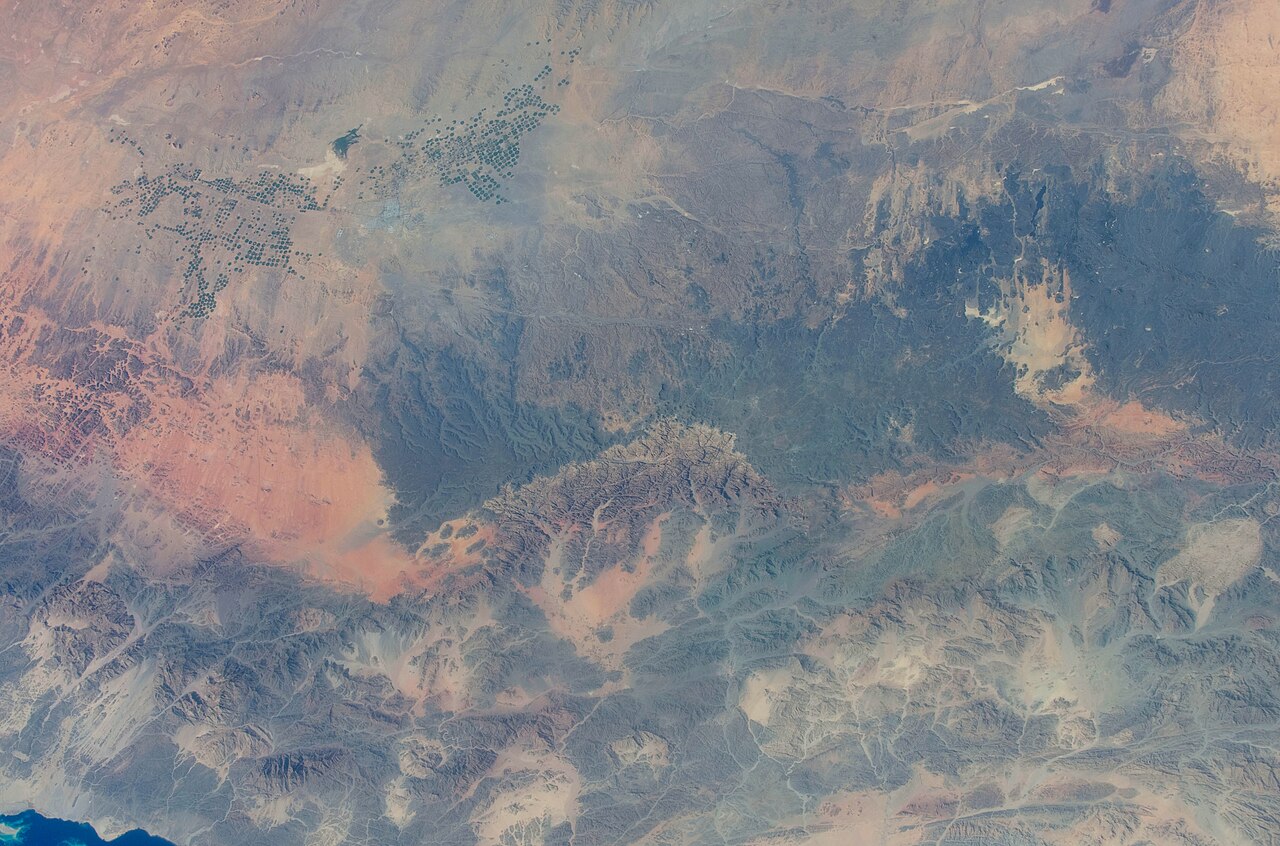
A wadi is a desert streambed that runs with snowmelt and winter rain, then dries in summer heat. Caravans planning their route by such water could die if it failed. Tema is an oasis in north-west Arabia (modern Tayma), Sheba a trading people of south Arabia; both were famous for caravans carrying incense and goods. The image above shows north-west Arabia from space.
Tema in the inscriptions
Tayma is well attested: the Babylonian king Nabonidus lived there for ten years in the 6th century BC, and Aramaic inscriptions from the oasis survive. Job's poet knew the trade world of Arabia.
The arrows of the Almighty
The divine name Shaddai, "the Almighty," appears 31 times in Job, more than in the rest of the Bible put together. Its origin is debated ("mountain one," "the one of the fields," "breasts"); the Greek often renders it pantokratōr. Job pictures God as an archer, an image also used of gods of plague in the ancient Near East.
Words for a broken body
Job pictures his pain as poison: the arrows of the Almighty, "the poison whereof drinketh up my spirit" (6:4). Arrow poison was used in ancient hunting and war, and Mesopotamian texts speak of gods shooting arrows of disease. Job asks for his flesh to be weighed, for his strength to be stone or bronze (6:12): he is made of neither.
Job asks for evidence
Job's demand, "cause me to understand wherein I have erred," is the right question in a lawcourt: name the offence. The friends never do, until Eliphaz invents one in chapter 22. The reader knows there is none.
Words in extremity
"Do ye imagine to reprove words, and the speeches of one that is desperate, which are as wind?" (6:26). Job asks his friends to judge his words by his condition. Many readers find here the book's call to listen before correcting.
A hard line in every version
6:6 asks whether there is taste "in the white of an egg" (KJV). The Hebrew rir hallamut is obscure: perhaps the slime of a plant (purslane or mallow) or egg white. The library's Greek reads "is there taste in empty words?", the Vulgate "can anyone taste what brings death?" Each translator guessed. The library's Sahidic Coptic copy, which follows the shorter pre-Origen Greek, lacks 6:9. Whether each missing line was absent from the Old Greek itself, or is damage in the Coptic manuscripts or our digital copy, is to be checked against Ziegler's edition (JOB-C03).
What the evidence shows
- Tema (Tayma) was an Arabian caravan oasis, attested in Babylonian and Aramaic sources.
- Shaddai occurs more often in Job than in the rest of the Hebrew Bible. 31 of 48 occurrences.
Continue the journey
Connected elsewhere in ScriptureIsaiah 21: Watchman, What of the Night?Isaiah 21:13–14: The caravans of Dedan and the land of Tema.More from this lesson
Why this matters to the rest of Scripture
- The caravans of Dedan and the land of Tema.
- "A friend loveth at all times."