"Man that is born of a woman is of few days, and full of trouble. He cometh forth like a flower, and is cut down: he fleeth also as a shadow, and continueth not."
"For there is hope of a tree, if it be cut down, that it will sprout again, and that the tender branch thereof will not cease. Though the root thereof wax old in the earth, and the stock thereof die in the ground; yet through the scent of water it will bud, and bring forth boughs like a plant. But man dieth, and wasteth away: yea, man giveth up the ghost, and where is he?… So man lieth down, and riseth not: till the heavens be no more, they shall not awake."
"O that thou wouldest hide me in the grave, that thou wouldest keep me secret, until thy wrath be past, that thou wouldest appoint me a set time, and remember me! If a man die, shall he live again? all the days of my appointed time will I wait, till my change come. Thou shalt call, and I will answer thee: thou wilt have a desire to the work of thine hands."
"And surely the mountain falling cometh to nought… The waters wear the stones… and thou destroyest the hope of man."
The olive and the stump
Olive trees, terebinths and sycamores can sprout new shoots from a cut stump. Isaiah uses the same picture of hope: "a shoot from the stump of Jesse" (11:1). Farmers in Job's world saw it every year.
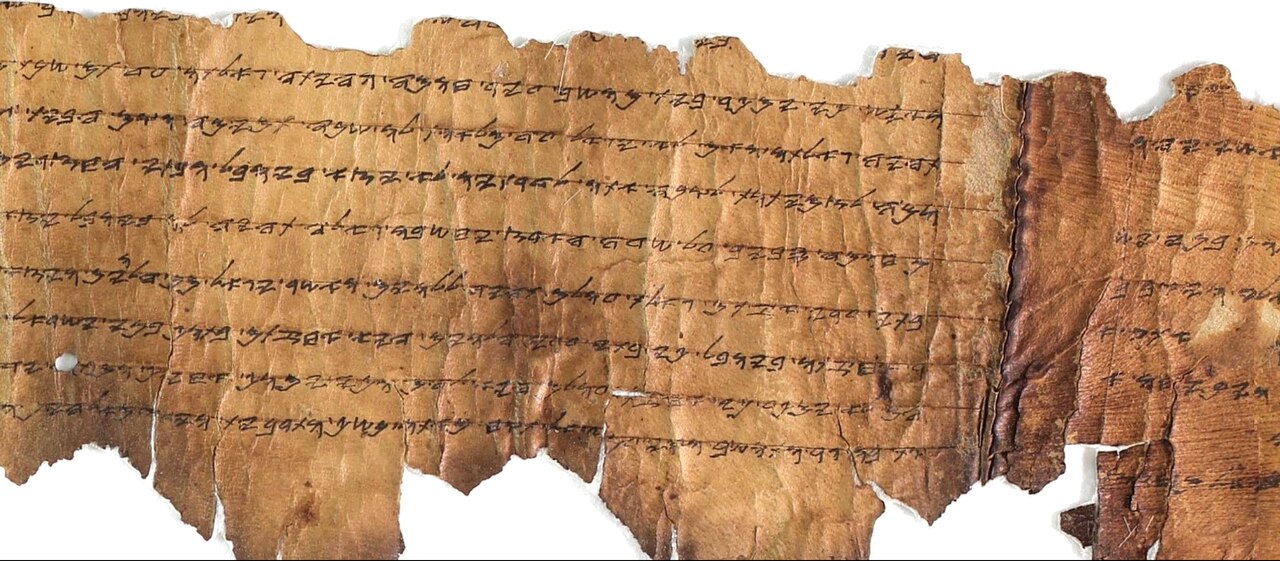
The old Hebrew script
4QpaleoJob-c, one of the Qumran copies of Job, is written in the old Hebrew (paleo-Hebrew) script, like the Leviticus scroll pictured above. At Qumran this script was used almost only for books of the Torah and for Job, perhaps because Job was thought to be by Moses (a tradition recorded in the Talmud). It is reported to preserve parts of Job 13 and of this chapter (14:13–18).
Who can bring a clean thing out of an unclean?
Job 14:4 says no one is born pure. The Vulgate expands it: "Who can make clean what is conceived of unclean seed? Is it not you who alone are?" Church Fathers, especially in the Latin West, read the verse in debates about inherited sin; the Hebrew states human frailty and impurity in general.
A question, not an answer
"If a man die, shall he live again?" (14:14) is a genuine question. Job longs for a hiding place in Sheol and a later summons, but the chapter ends in hopelessness. The Greek translators made it more hopeful: the Old Greek adds at the end of the book that Job "will rise again with those the Lord raises up" (42:17a). Later Jewish and Christian readers found resurrection here. The Hebrew poem holds the hope as a wish.
Poetic moods are not doctrines
Job 7 says no one returns from Sheol; Job 14 imagines it; Job 19 declares a living redeemer. Rather than harmonizing these into one teaching, the site follows them as movements in a mind under pressure.
The versions
The library's Greek (Giguet) reads 14:4 as "Who will be free from all defilement? No one," and the Greek tradition continues into 14:5: "even if his life on earth is but one day," a line later Christian writers quoted often. The Greek also makes 14:14 a statement ("he will live"). The library's Sahidic Coptic copy, which follows the shorter pre-Origen Greek, lacks 14:18–19. Whether each missing line was absent from the Old Greek itself, or is damage in the Coptic manuscripts or our digital copy, is to be checked against Ziegler's edition (JOB-C03).
What the evidence shows
- Job 14:14 is phrased as a question.
- Paleo-Hebrew script at Qumran is used for Torah books and Job. With a few exceptions; linked to the tradition that Moses wrote Job (Bava Batra 14b–15a).
Continue the journey
Journey of a PassageJob 14:14: "If a man die, shall he live again?"The Hebrew is a question.More from this lesson
Why this matters to the rest of Scripture
- A shoot from the stump.
- "I know that my redeemer liveth."
- Sown and raised.