"How hast thou helped him that is without power?… To whom hast thou uttered words?"
"Dead things are formed from under the waters, and the inhabitants thereof. Hell is naked before him, and destruction hath no covering. He stretcheth out the north over the empty place, and hangeth the earth upon nothing. He bindeth up the waters in his thick clouds; and the cloud is not rent under them… He hath compassed the waters with bounds, until the day and night come to an end."
"The pillars of heaven tremble and are astonished at his reproof. He divideth the sea with his power, and by his understanding he smiteth through the proud (Rahab). By his spirit he hath garnished the heavens; his hand hath formed the crooked serpent. Lo, these are parts of his ways: but how little a portion is heard of him? but the thunder of his power who can understand?"
The storm god and the sea
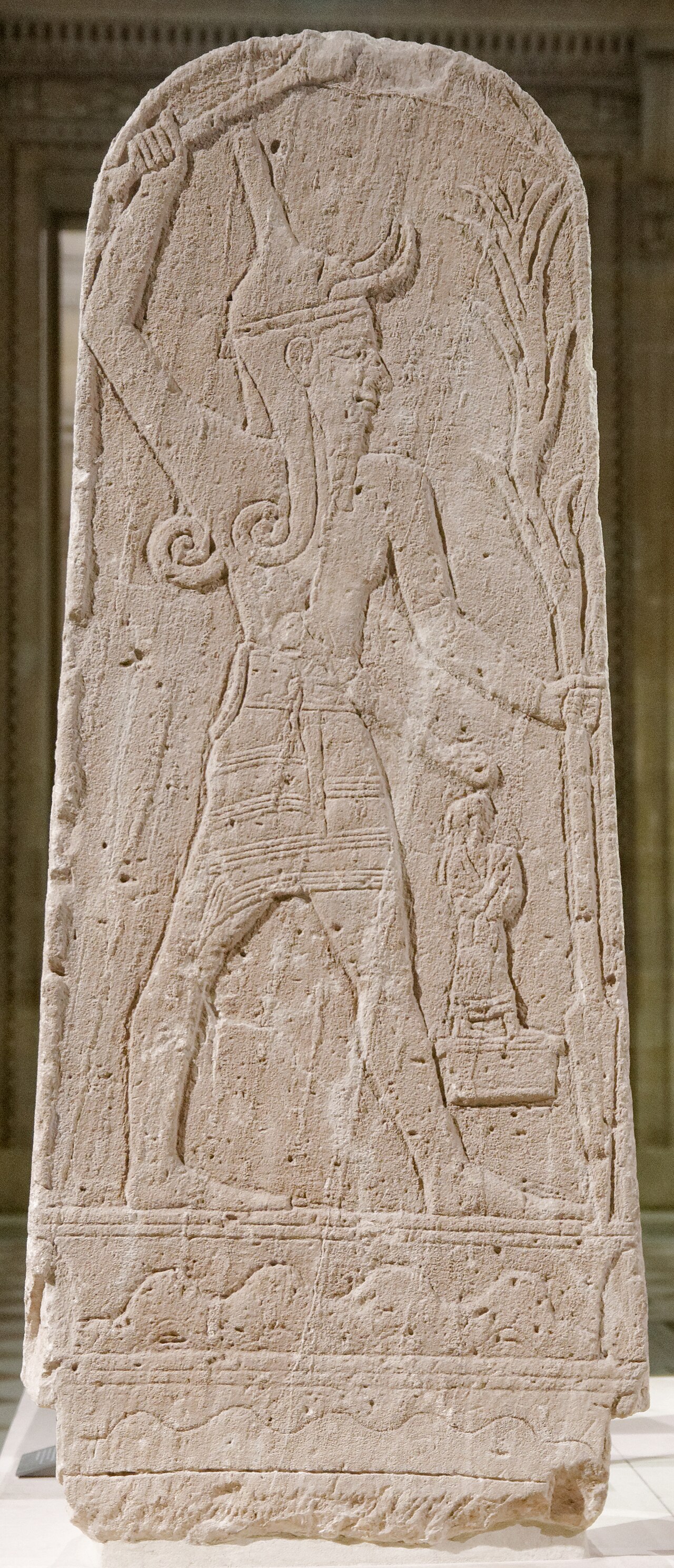
At Ugarit, Baal (pictured above on a stele from the Louvre) defeats Yam, the Sea, and the serpent Lotan. Job 26:12–13 uses the same picture for Israel's God: he stills the sea, strikes Rahab, pierces the "fleeing serpent" (nahash bariah), exactly the phrase Isaiah 27:1 uses for Leviathan and the Ugaritic texts use for Lotan (btn brh). See the Echo on sea-monsters.
The north over emptiness
Zaphon, "the north," is also Mount Zaphon (Jebel Aqra), Baal's holy mountain in Syria; Psalm 48:2 places Zion "on the sides of the north." God stretching Zaphon over the void may claim the gods' mountain for him.
"Hangeth the earth upon nothing"
This line is often cited as advanced scientific knowledge. Within the poem it sits beside other images: pillars of heaven that tremble, a circle on the waters, waters bound in clouds, Sheol beneath. The poet is praising God's power to hold up the world, using the cosmic picture of the time. Elsewhere Job speaks of the earth's foundations and pillars (9:6; 38:4–6). The site does not treat the line as a modern astronomical statement.
Whose speech?
26:5–14 is often reassigned to Bildad as the rest of his short speech in chapter 25. The received text gives it to Job. The site keeps the received speaker in the reader and the lessons.
Greek gaps
The library's Sahidic Coptic lacks 26:5–11 and 13–14; much of this hymn may have been absent from the Old Greek and restored by Origen. Check against Ziegler (JOB-C03).
What the evidence shows
- Job 26:13 and Isaiah 27:1 share the phrase "fleeing serpent" with the Ugaritic description of Lotan.Source: Ugaritic Baal Cycle, KTU 1.5 i 1–3 (Lotan, "the fleeing serpent… the mighty one with seven heads")
- Job 26:7 is a scientific statement about space. It is poetry in an ancient cosmic picture.
- 26:5–14 belongs to Bildad. A reconstruction; manuscripts give it to Job.
Continue the journey
Journey of a PassageJob 26:7, 12–13: The earth over nothing; the fleeing serpent"He stretcheth out the north over the empty place, and hangeth the earth upon nothing." The versions agree.More from this lesson
Echoes Across Civilizations
Optional: how other ancient peoples told similar stories. Open one to compare, then come back to the lesson.
Storm gods, drought and rainUgaritic · Hittite
How did Israel's neighbors explain drought and rain?
- Ugaritic: The Baal Cycle Shared literary world
- Hittite: The vanishing god (Telipinu) Resemblance only
Taming the sea and its monstersUgaritic (Canaanite) · Babylonian · Egyptian
Did other ancient peoples picture a god defeating or restraining the sea and a many-headed sea-serpent?
- Ugaritic (Canaanite): The Baal Cycle Shared literary world
- Babylonian: Enuma Elish Shared literary world
- Egyptian: Apophis, the chaos serpent Resemblance only
Why this matters to the rest of Scripture
- Leviathan the fleeing serpent.
- "Thou hast broken Rahab in pieces."
- "He sitteth upon the circle of the earth."