"At this also my heart trembleth, and is moved out of his place. Hear attentively the noise of his voice… He directeth it under the whole heaven, and his lightning unto the ends of the earth… God thundereth marvellously with his voice."
"For he saith to the snow, Be thou on the earth; likewise to the small rain, and to the great rain of his strength. He sealeth up the hand of every man… Out of the south cometh the whirlwind: and cold out of the north. By the breath of God frost is given."
"Hearken unto this, O Job: stand still, and consider the wondrous works of God… Hast thou with him spread out the sky, which is strong, and as a molten looking glass?… Fair weather cometh out of the north: with God is terrible majesty. Touching the Almighty, we cannot find him out."
A mirror of cast bronze
Ancient mirrors were polished bronze, cast and then burnished. Elihu pictures the sky as a hard, shining dome (compare the "firmament," Genesis 1:6). It is ancient cosmic imagery, not a physical claim about the atmosphere.
Gold from the north
37:22 literally says "out of the north comes gold." Some take it as golden light (the KJV's "fair weather"); others as the gold that comes from northern mountains, or the brilliance of God's appearing from Zaphon, the northern mountain of the gods.
Storm and mountain
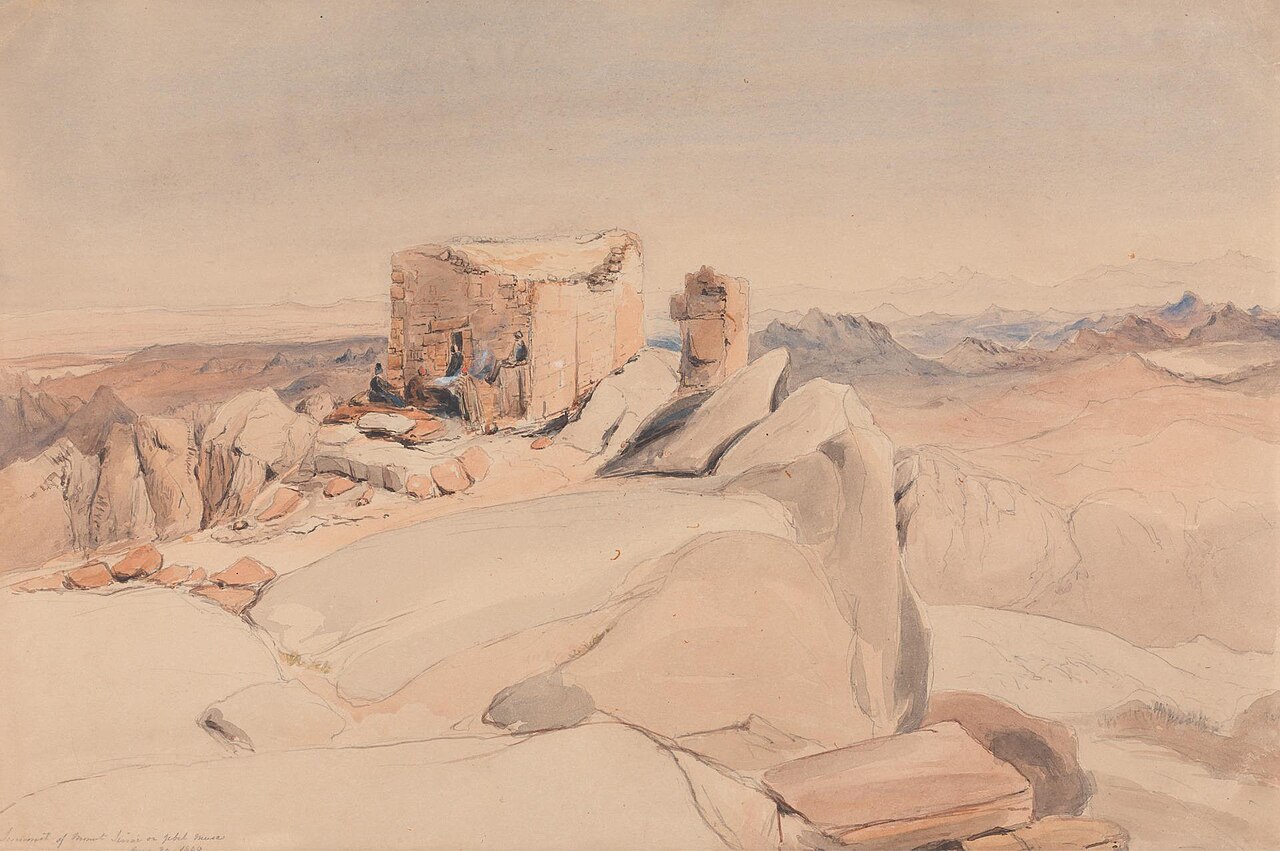
God's voice in thunder recalls Sinai (Exodus 19:16–19; Psalm 29). The painting of Jebel Musa above shows the mountain traditionally identified with Sinai.
A book and a scribe
37:20 in the library's Greek reads: "Shall I have a book or a scribe beside me, that I may stand and silence him like a man?" The Hebrew says "Shall it be told him that I speak?" The Greek translator seems to have read the Hebrew verb sapper ("recount") as sefer/sofer ("book/scribe"), a different vocalization of the same consonants.
A bridge to the whirlwind
Elihu ends in a storm, and in 38:1 God speaks "out of the whirlwind." Those who see Elihu as integral read this as a deliberate transition; those who see him as added think an editor built the bridge. Either way, the reader moves from human talk about God to God's own voice.
The versions
37:18: the library's Greek pictures the sky "solid, yet looking like flowing water"; the Vulgate "solid as if cast in bronze." 37:22: the Vulgate "from the north comes gold." The library's Sahidic Coptic copy, which follows the shorter pre-Origen Greek, lacks 37:1–4, 37:11, 37:13 and 37:18. Whether each missing line was absent from the Old Greek itself, or is damage in the Coptic manuscripts or our digital copy, is to be checked against Ziegler's edition (JOB-C03).
What the evidence shows
- Ancient mirrors were made of polished bronze.
Continue the journey
Connected elsewhere in ScripturePsalm 29: The Voice of the LORDPsalm 29: The voice of the LORD in the storm.More from this lesson
Why this matters to the rest of Scripture
- The voice of the LORD in the storm.
- Thunder at Sinai.
- The whirlwind.