Investigation: Behemoth and Leviathan
Hippopotamus, crocodile, whale, dinosaur or chaos-monster?
Readers of every age have tried to picture these two. Medieval manuscripts drew them as monsters; William Blake engraved them coiled together in a sphere beneath God's hand (1825); 19th-century commentators saw a hippo and a crocodile; some 20th-century readers saw a brachiosaurus and a plesiosaur.
What do the words actually say? And what did ancient readers in Israel know of such creatures?
Behemoth: the evidence
Eats grass like an ox (40:15); strength in loins and belly muscles (16); "tail" stiffens like a cedar (17); bones like bronze tubes and iron bars (18); "first of the ways of God" (19); mountains bring it food, wild beasts play nearby (20); lies under lotus plants (tse'elim) in reeds and marsh (21–22); unalarmed when the river surges, "he trusteth that he can draw up Jordan into his mouth" (23); can anyone capture it by the eyes or pierce its nose with a snare? (24).
Leviathan: the evidence
Cannot be hooked or bridled (41:1–2); will not make a covenant or be a pet (4–5); merchants cannot divide it (6); harpoons useless (7); terrifying teeth (14); scales like shields sealed together (15–17); sneezes flash light, eyes like dawn (18); fire and smoke from mouth and nostrils (19–21); neck strength, hard heart (22–24); weapons useless (26–29); underparts like sharp potsherds (30); makes the deep boil like a pot of ointment, leaves a shining wake (31–32); no equal on earth, king over all proud beasts (33–34).
| Identification | Supporting details | Problems |
|---|---|---|
| Hippopotamus (Behemoth) | Grass-eating, river and reeds, lotus, massive body, impervious to floods | "Tail like a cedar" (short tail; may be a euphemism or exaggeration) |
| Crocodile (Leviathan) | Scales, teeth, armoured hide, river habitat, near-impossible to catch in antiquity | Fire and smoke; "the deep," "the sea" |
| Whale (Leviathan) | Spouting ("sneezes"), the deep boiling, shining wake (M. V. Fox, 2012) | Scales and teeth fit poorly |
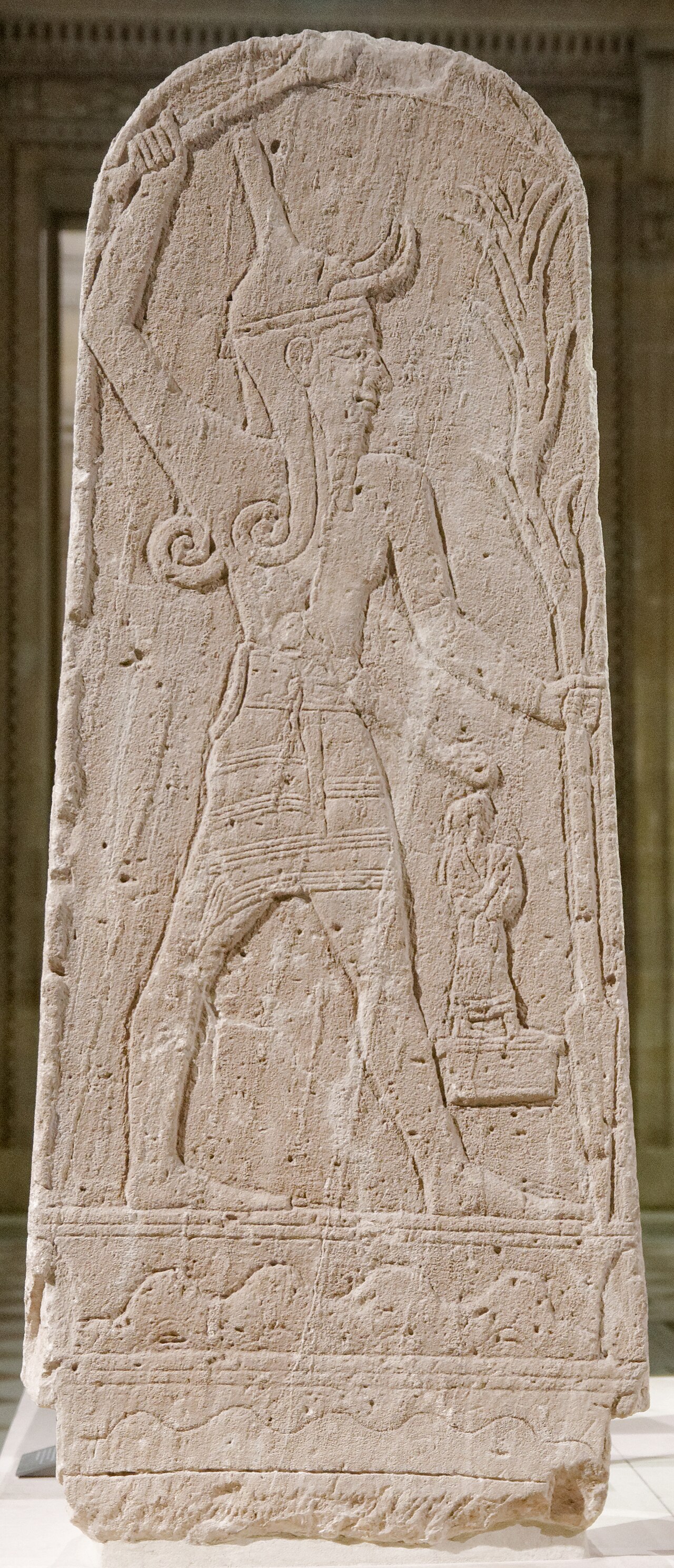
| Mythic chaos-monster | Ugaritic Lotan, Isaiah 27:1, Psalm 74:14 (heads crushed), fire-breathing | Behemoth's ordinary grass-eating |
| Dinosaurs | Size; "tail like a cedar" | The passage as a whole; no human contact with dinosaurs; ancient readers' world |
Leviathan beyond Job
Leviathan appears in Psalm 74:13–14 (God crushed the heads of Leviathan, broke the dragons in the waters), Psalm 104:26 (God made Leviathan to play in the sea), Isaiah 27:1 (on that day the LORD will punish Leviathan the fleeing serpent, the twisting serpent, and slay the dragon in the sea) and Job 3:8. Isaiah's words match the Ugaritic description of Lotan (KTU 1.5 i 1–3): "when you smite Lotan the fleeing serpent, finish off the twisting serpent, the mighty one with seven heads." Biblical poets used a shared Canaanite image, transforming it: in Psalm 104 and Job 41 Leviathan is God's creature, not his rival.
Later tradition
1 Enoch 60:7–9 says Leviathan (female) lives in the depths of the sea and Behemoth (male) in a desert called Dendain. 4 Ezra 6:49–52 says God kept them from creation to be food for whom he chooses. The Talmud (Bava Batra 74b–75a) has the righteous feast on Leviathan in the world to come. These traditions grew from Job, Psalms and Isaiah.
Ancient translations
The library's Greek renders Behemoth as "the beast" (thēria, "wild beasts") and Leviathan as "the dragon" (drakōn); it numbers Behemoth at 40:10 and Leviathan at 40:20, like the Vulgate, which keeps the Hebrew names. Hebrew Bibles number Leviathan's poem 40:25–41:26.
Why the creatures matter
The point of the speech is not zoology. God shows Job creatures that humans cannot master, which God made and rules. If Job cannot tame Leviathan, how can he govern justice in the cosmos (40:8–14)? The monsters are God's, and so is the chaos Job fears.
What the evidence shows
- Behemoth is best identified with the hippopotamus. Majority scholarly view.
- Leviathan is a single identifiable modern animal.Source: M. V. Fox, "Behemoth and Leviathan," Biblica 93 (2012) 261–267 ↗
- Isaiah 27:1 echoes the Ugaritic description of Lotan.Source: Ugaritic Baal Cycle, KTU 1.5 i 1–3 (Lotan, "the fleeing serpent… the mighty one with seven heads")
- Job 40–41 describes dinosaurs. Not supported by the passage taken as a whole or by its ancient context.
Continue the journey
Journey of a PassageJob 40:15–24: Behold now BehemothBehemoth is a plural form for one great beast.More from this lesson
Investigations
Optional deep dives: the ancient sources, the physical evidence, and every interpretation side by side, including unconventional ones, each labeled for what it is.
Behemoth and LeviathanBehemoth: hippopotamus (majority view) · Leviathan: disputed · Dinosaurs: not supported
What creatures do Job 40–41 describe?
Behemoth is most often identified as the hippopotamus; Leviathan as the crocodile, a whale, or the mythic sea-serpent known from Ugarit as Lotan. Later Jewish tradition made them primeval monsters. Some modern readers identify them as dinosaurs; the description as a whole and its ancient context do not support certainty.
Open the full investigation →Echoes Across Civilizations
Optional: how other ancient peoples told similar stories. Open one to compare, then come back to the lesson.
Taming the sea and its monstersUgaritic (Canaanite) · Babylonian · Egyptian
Did other ancient peoples picture a god defeating or restraining the sea and a many-headed sea-serpent?
- Ugaritic (Canaanite): The Baal Cycle Shared literary world
- Babylonian: Enuma Elish Shared literary world
- Egyptian: Apophis, the chaos serpent Resemblance only
Why this matters to the rest of Scripture
- The heads of Leviathan crushed.
- Leviathan made to play.
- Leviathan the fleeing serpent.