"Should a wise man utter vain knowledge, and fill his belly with the east wind?… Yea, thou castest off fear, and restrainest prayer before God. For thy mouth uttereth thine iniquity… Thine own mouth condemneth thee, and not I."
"Art thou the first man that was born? or wast thou made before the hills? Hast thou heard the secret of God? and dost thou restrain wisdom to thyself?… With us are both the grayheaded and very aged men, much elder than thy father."
"The wicked man travaileth with pain all his days… A dreadful sound is in his ears: in prosperity the destroyer shall come upon him… He shall shake off his unripe grape as the vine, and shall cast off his flower as the olive. For the congregation of hypocrites shall be desolate."
The first man
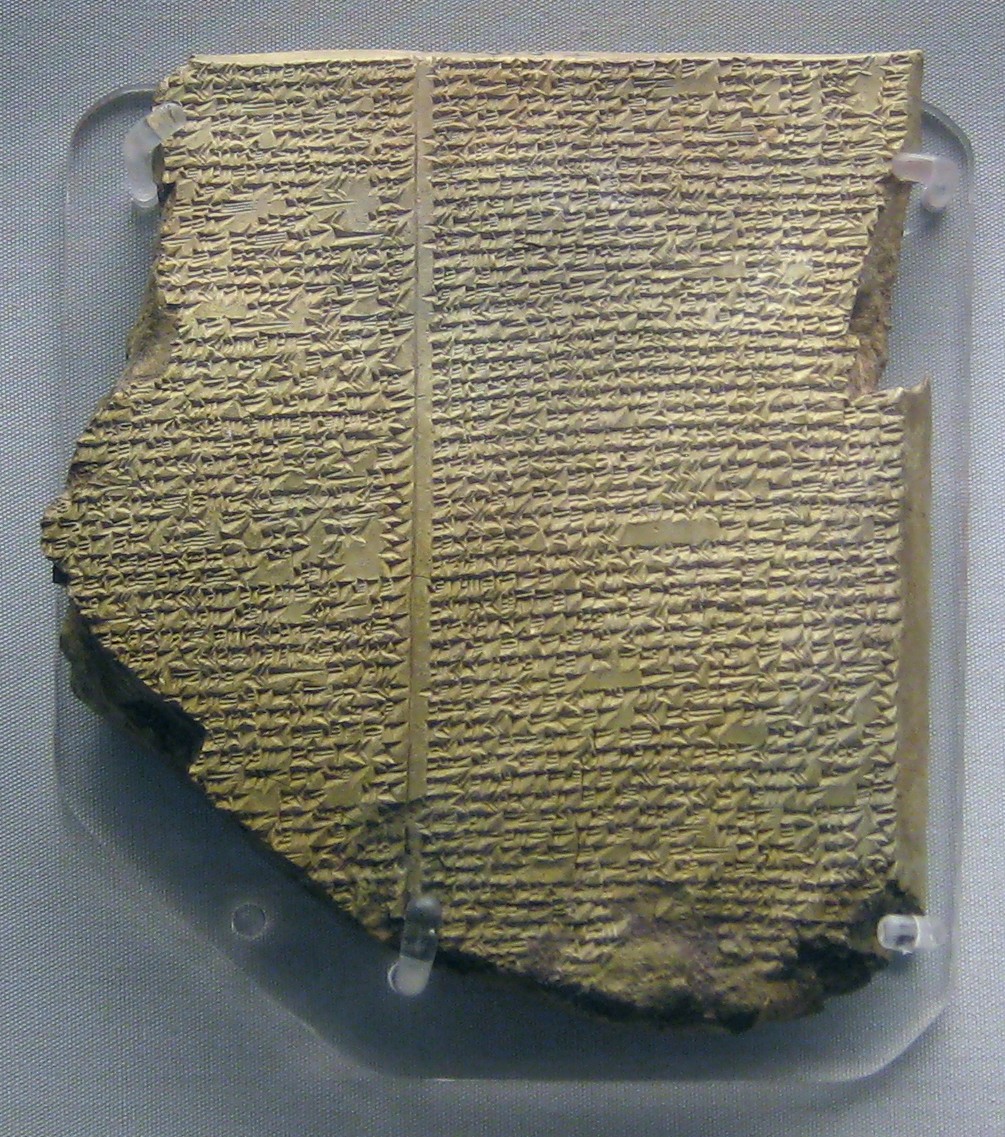
"Art thou the first man that was born?" alludes to a primeval wise man, perhaps the one Ezekiel pictures in Eden "full of wisdom" (Ezekiel 28:12–15), or to Wisdom herself, "brought forth before the hills" (Proverbs 8:25). Eliphaz mocks Job for claiming wisdom that only the first being could have. Ancient stories also had primeval sages, like the Mesopotamian apkallu sent before the Flood; the Gilgamesh flood tablet above comes from that world of ancient wisdom.
The council of God
"Hast thou heard the secret (sod) of God?" uses the word for the divine council (Jeremiah 23:18, 22). Eliphaz asks whether Job has stood in that council. The reader, who saw chapters 1–2, knows that no human there present understood what was happening, including the friends.
Holy ones and heavens
Eliphaz repeats his vision's theme (15:14–16): God "putteth no trust in his saints (qedoshim, holy ones); yea, the heavens are not clean in his sight. How much more abominable and filthy is man, which drinketh iniquity like water?" The holy ones are the heavenly beings; the Greek has "his saints" and "the heaven is not pure."
From comfort to accusation
In chapter 4 Eliphaz praised Job's past; now Job's "mouth uttereth thine iniquity." The friends' speeches escalate: tentative diagnosis becomes presumption of guilt. Eliphaz's portrait of the wicked (15:20–35) is generic, but its details (fire, loss of house, withered branch) look like Job's life, a technique the friends repeat.
The versions
The library's Sahidic Coptic copy, which follows the shorter pre-Origen Greek, lacks 15:10 and 15:27. Whether each missing line was absent from the Old Greek itself, or is damage in the Coptic manuscripts or our digital copy, is to be checked against Ziegler's edition (JOB-C03).
Escalation
Compare 4:6 ("Is not thy fear thy confidence?") with 15:4–6 ("thou castest off fear… thine own mouth condemneth thee"). In one round Eliphaz moves from reassurance to accusation. Literary critics note the friends' speeches grow shorter and harsher, until in round three one barely speaks.
What the evidence shows
- Sod in 15:8 refers to the divine council.
- Job claimed to have been in God's council. Eliphaz's rhetorical charge; Job made no such claim.
Continue the journey
Echoes Across CivilizationsThe heavenly council and the nationsDid other ancient peoples picture a high god ruling a council of divine beings who were assigned to the nations?More from this lesson
Echoes Across Civilizations
Optional: how other ancient peoples told similar stories. Open one to compare, then come back to the lesson.
The heavenly council and the nationsUgarit · Mesopotamia · Second Temple Judaism
Did other ancient peoples picture a high god ruling a council of divine beings who were assigned to the nations?
- Ugarit: El and "the sons of El" (bn ilm) Possible historical contact
- Mesopotamia: The assembly of the gods (Enuma Elish, Atrahasis) Resemblance only
- Second Temple Judaism: Angels over the nations (Daniel, Jubilees, 1 Enoch) Shared literary world
Why this matters to the rest of Scripture
- Wisdom before the hills.
- "Who hath stood in the counsel of the LORD?"