Where Shall Wisdom Be Found?
Miners in the dark, and wisdom hidden from all living
"Surely there is a vein for the silver, and a place for gold where they fine it. Iron is taken out of the earth, and brass is molten out of the stone. He setteth an end to darkness… The flood breaketh out from the inhabitant; even the waters forgotten of the foot: they are dried up, they are gone away from men… There is a path which no fowl knoweth, and which the vulture's eye hath not seen… He putteth forth his hand upon the rock; he overturneth the mountains by the roots. He cutteth out rivers among the rocks; and his eye seeth every precious thing."
"But where shall wisdom be found? and where is the place of understanding? Man knoweth not the price thereof; neither is it found in the land of the living. The depth saith, It is not in me: and the sea saith, It is not with me. It cannot be gotten for gold… It cannot be valued with the gold of Ophir, with the precious onyx, or the sapphire… The topaz of Ethiopia shall not equal it."
"Whence then cometh wisdom?… Destruction and death say, We have heard the fame thereof with our ears. God understandeth the way thereof, and he knoweth the place thereof. For he looketh to the ends of the earth, and seeth under the whole heaven… And unto man he said, Behold, the fear of the Lord, that is wisdom; and to depart from evil is understanding."
Ancient mining
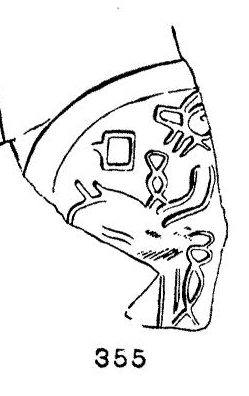
Copper was mined at Timna and Faynan (Wadi Feinan) in the Arabah, turquoise in Sinai (Serabit el-Khadim, where the early alphabetic inscription pictured above was cut by workers), gold in Egypt and Nubia. Miners cut shafts and galleries, lowered themselves on ropes, lit the dark with lamps and dealt with flooding. The poem describes this world accurately. It does not name a mine, and none of these sites is "the" mine of Job 28.
Precious things
Gold of Ophir, shoham (onyx or carnelian), sappir (lapis lazuli rather than modern sapphire), coral, pearls (or rubies), pitdah of Cush (topaz or peridot) are luxury goods of long-distance trade. The exact identifications are uncertain.
Abaddon and Death
Abaddon ("Destruction") and Death (Mot) are personified as rulers of the underworld; even they know wisdom only by rumour.
Who speaks Job 28?
The poem follows Job's speech without a new heading, so the text presents it as Job's. But its calm tone and conclusion ("the fear of the Lord, that is wisdom") seem to anticipate God's speeches and to differ from Job's anguish. Proposals: an interlude by the narrator; a separate wisdom poem placed here by an editor; Job's own reflection at a turning point; or misplaced from elsewhere. Rachel Frish (2024) argues it has a deliberate rhetorical role within chapters 27–31; David Clines proposed moving it to Elihu's speeches. No manuscript places it elsewhere, and no Qumran copy shows it moved.
Job 28 and Proverbs 8
Proverbs 8 pictures Wisdom as God's first creation, near at hand, calling in the streets. Job 28 makes wisdom inaccessible except to God. Both end in the fear of the LORD (Proverbs 1:7; 9:10). Job 28:28 uses Adonai ("Lord"), the only time in Job.
Greek gaps
The library's Sahidic Coptic lacks 28:5–8, 10 and 14–19; much of the mining description and the list of jewels may have been absent from the Old Greek. Check against Ziegler (JOB-C03).
What the evidence shows
- Copper mining at Timna and Faynan and turquoise mining in Sinai are well documented.
- Job 28 describes a particular identified mine.
- Job 28 was originally a separate poem.Source: R. Frish, "The Wisdom Poem in Job 28 and its Role," Vetus Testamentum (2024) ↗; D. J. A. Clines, "Putting Elihu in His Place," JSOT 29 (2004) ↗
Continue the journey
Journey of a PassageJob 28:28: "The fear of the Lord, that is wisdom"The poem's conclusion is stable: "Behold, the fear of the Lord, that is wisdom; and to depart from evil is understanding." The Hebrew uses Adonai, its only use in Job; the library's Greek reads "piety" (theosebeia, Giguet "la piété").More from this lesson
Echoes Across Civilizations
Optional: how other ancient peoples told similar stories. Open one to compare, then come back to the lesson.
The wise kingBabylonian · Egyptian · Aramaic / Assyrian
Did other ancient kings claim divine wisdom and fame for justice?
- Babylonian: Hammurabi's prologue and epilogue Shared literary world
- Egyptian: Royal and scribal instructions (Amenemope, Merikare) Possible historical contact
- Aramaic / Assyrian: The Words of Ahiqar Resemblance only
Why this matters to the rest of Scripture
- Wisdom at creation.
- "The fear of the LORD is the beginning of knowledge."
- "It is not in heaven… neither is it beyond the sea."