The heavenly council meets again, and the LORD repeats his praise of Job, adding: "still he holdeth fast his integrity, although thou movedst me against him, to destroy him without cause." The accuser replies with a proverb: "Skin for skin, yea, all that a man hath will he give for his life. But put forth thine hand now, and touch his bone and his flesh, and he will curse thee to thy face." The LORD gives Job into his hand: "only save his life."
Job is struck "with sore boils from the sole of his foot unto his crown. And he took him a potsherd to scrape himself withal; and he sat down among the ashes." The ash heap outside a town, where refuse was burned, is where the outcast sat.
His wife speaks, in Hebrew, only one line: "Dost thou still retain thine integrity? curse God, and die." Job answers: "Thou speakest as one of the foolish women speaketh. What? shall we receive good at the hand of God, and shall we not receive evil?" And the narrator says again: "In all this did not Job sin with his lips."
Three friends hear and come "to mourn with him and to comfort him": Eliphaz the Temanite, Bildad the Shuhite and Zophar the Naamathite. At a distance they do not recognize him. They weep aloud, tear their robes, throw dust toward heaven on their heads. "So they sat down with him upon the ground seven days and seven nights, and none spake a word unto him: for they saw that his grief was very great."
What disease?
The Hebrew shehin ra' means "evil boils" or inflamed sores, the same word as the boils of Egypt (Exodus 9:9) and Hezekiah's illness (2 Kings 20:7). Later Job describes itching, worms, blackened and peeling skin, fever, wasting and bad breath (7:5; 19:17, 20; 30:17, 30). Readers have proposed leprosy, smallpox, pemphigus and others. Poetry gathers symptoms; it is not a medical chart, and the site does not diagnose Job.
A potsherd
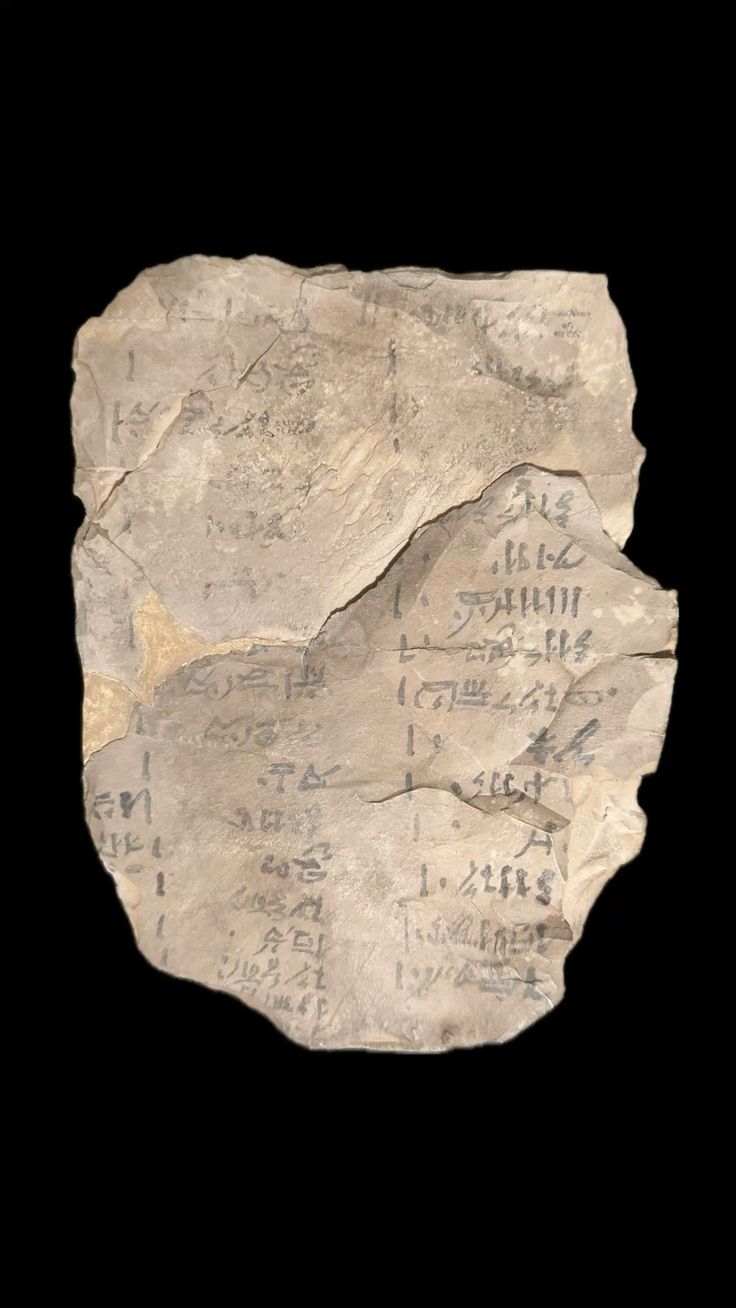
Broken pottery (ostraca) was everywhere in an ancient town: scrap material for writing notes and lists, and for scraping. Job's tool is the cheapest thing on the rubbish heap. The picture above shows an ostracon used for writing, the same kind of material.
The friends' homes
Teman is a region or town of Edom (Genesis 36:11; Jeremiah 49:7: "Is wisdom no more in Teman?"). Shuah is a son of Abraham and Keturah sent "eastward" (Genesis 25:2, 6). Naamah is unknown outside this book (a Naamah in Judah, Joshua 15:41, is unlikely). The friends come from the edges of Edom and Arabia, places associated with wisdom.
Seven days
Seven days was the customary period of mourning for the dead (Genesis 50:10; 1 Samuel 31:13; later Jewish shiva). The friends treat Job as one already mourning a death, perhaps his own.
The longer speech of Job's wife in Greek
In the Hebrew she speaks one line. In the Greek tradition she speaks a whole paragraph. The library's Greek (Giguet) reads: "After many days his wife said to him: How long will you hold out, saying, 'I will wait a little longer, expecting the hope of my deliverance'? Your memory has vanished from the earth, your sons and daughters, the pains and labours of my womb, whom I bore in vain with sorrow. And you sit in the rot of worms, spending the night in the open air, while I wander as a hired servant from place to place and house to house, waiting for the sun to set so I can rest from my labours and griefs. Now say some word against the Lord, and die." The Church Slavonic and Sahidic Coptic in the library carry the same expansion. It gives her grief a voice the Hebrew does not. It is an ancient interpretation within the translation tradition, not a lost Hebrew original, so far as the evidence shows.
"Without cause" is God's own word
In 2:3 the LORD himself says the accuser incited him "to destroy him without cause (hinnam)." Whatever the book later says about suffering, the narrator's frame has God admit that Job's suffering is not punishment. That is why the friends' later theories fail.
Is the wife foolish or faithful?
Job calls her words those of "one of the foolish (nebalot) women," not that she is one. Her words echo the accuser's prediction ("he will curse thee"). Some readers see her as the accuser's tool (Augustine called her "the devil's helper"); others see a grieving mother who has also lost ten children, urging an end to suffering. The Testament of Job, a later Greek work, names her Sitis and has her sell her hair to buy bread for him. The Hebrew leaves her to the reader's judgment.
What the evidence shows
- The Greek tradition gives Job's wife a long speech at 2:9; the Hebrew has one line.Source: The site's library: Westminster Leningrad Codex (Hebrew), Giguet's French of the Greek, Clementine Vulgate, KJV, Church Slavonic, Sahidic Coptic; NETS, "Iob," translator's introduction and translation (after Ziegler's Göttingen edition, 1982) ↗
- Job's illness can be identified with a modern disease.
- Teman and Shuah are associated with Edom and the eastern desert. From Genesis and Jeremiah; Naamah is unknown.
Continue the journey
Journey of a PassageJob 2:3: "Without cause"God says the satan moved him "to destroy him without cause (hinnam)." The same word was the satan's question in 1:9: "Doth Job fear God for nought (hinnam)?" The Greek and Latin keep the sense.More from this lesson
Why this matters to the rest of Scripture
- The same word for boils.
- Wisdom in Teman.
- Seven days of mourning.