"I know it is so of a truth: but how should man be just with God? If he will contend with him, he cannot answer him one of a thousand."
Job describes God's power: "Which removeth the mountains… Which shaketh the earth out of her place… Which commandeth the sun, and it riseth not; and sealeth up the stars. Which alone spreadeth out the heavens, and treadeth upon the waves of the sea. Which maketh Arcturus, Orion, and Pleiades, and the chambers of the south." God passes by and he does not see him; "if God will not withdraw his anger, the proud helpers do stoop under him." (The Hebrew says "the helpers of Rahab.")
"Though I were righteous, yet would not I answer, but I would make supplication to my judge… This is one thing, therefore I said it, He destroyeth the perfect and the wicked. If the scourge slay suddenly, he will laugh at the trial of the innocent. The earth is given into the hand of the wicked: he covereth the faces of the judges thereof; if not, where, and who is he?"
"For he is not a man, as I am, that I should answer him, and we should come together in judgment. Neither is there any daysman betwixt us, that might lay his hand upon us both. Let him take his rod away from me, and let not his fear terrify me: Then would I speak, and not fear him."
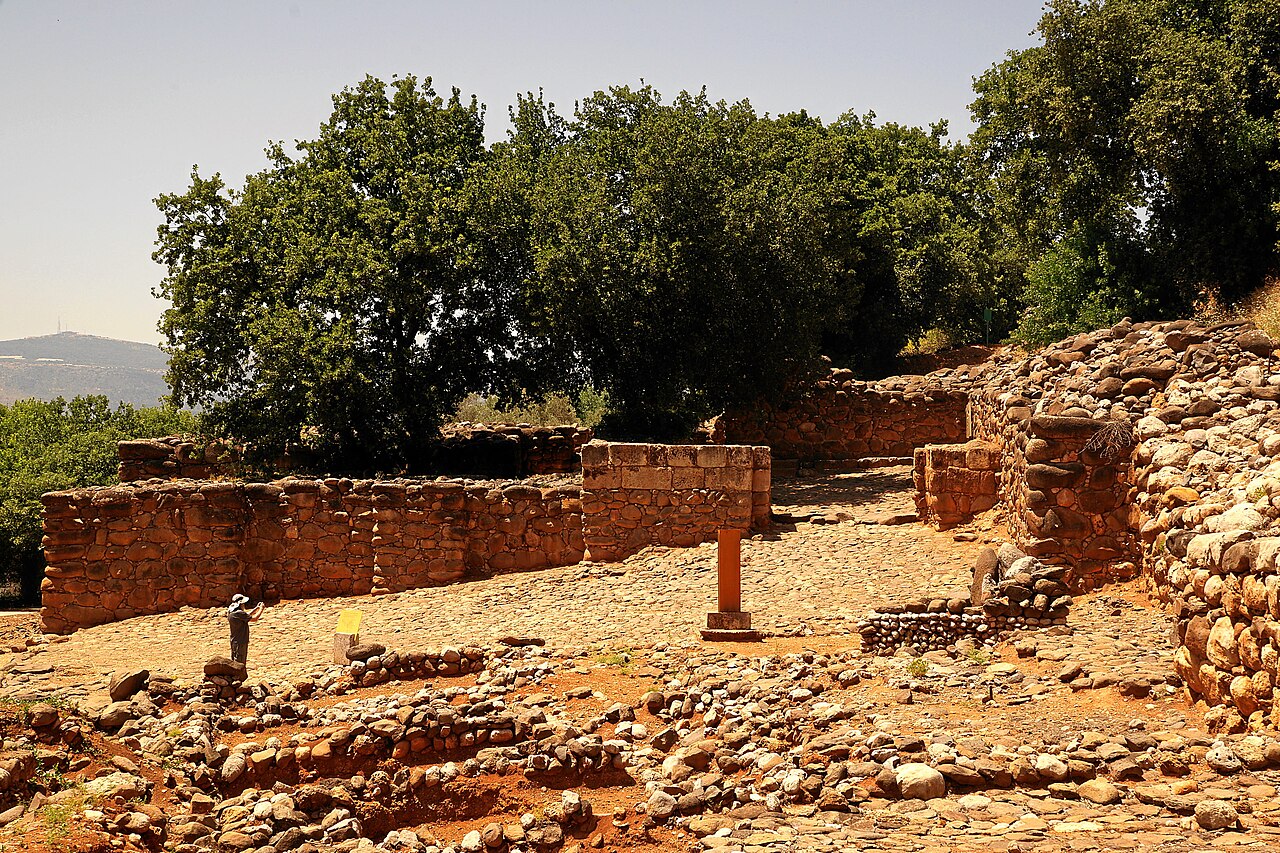
The gate court
In ancient Israel disputes were heard at the city gate before the elders (Ruth 4; Deuteronomy 21:19). Job speaks the language of that court: contend (rib), answer, be in the right (tsadaq), summon, judge, arbiter. The picture above shows an Iron Age gate at Tel Dan, where such hearings could be held.
The stars of Job
'Ash (or 'Ayish), Kesil and Kimah are star groups; translations guess Arcturus or the Bear, Orion and the Pleiades. Kesil means "fool" (perhaps a giant bound in the sky, as later Jewish tradition had it); kimah perhaps "cluster." The exact identifications are uncertain; 38:31–32 names them again.
Rahab's helpers
Rahab (not Joshua's Rahab) is a sea-monster of chaos (26:12; Psalm 89:10; Isaiah 51:9). "The helpers of Rahab" bowing under God echo the Babylonian Enuma Elish, where Tiamat's helpers are captured by Marduk. Job uses the old myth to say God's power is overwhelming.
The "daysman": mokhiah
The Hebrew mokhiah (9:33) is one who decides or reproves, an arbiter. "Daysman" in the KJV is old English for an umpire who sets a day for a hearing. The library's Greek reads "a mediator, a censor"; the Vulgate, "there is none who can rebuke both." Christian readers later saw Christ as the mediator Job longed for (1 Timothy 2:5). In the poem the arbiter is a legal role Job says does not exist. See the investigation "Job's Lawsuit Against God."
"He destroyeth the perfect and the wicked"
Job's charge (9:22) contradicts the friends' theology outright. It is the boldest line so far. The book does not erase it; God's answer in chapters 38–41 addresses Job's challenge without accusing him of the sins the friends imagined.
What the evidence shows
- The identifications of 'Ash, Kesil and Kimah are certain. Orion and the Pleiades are traditional guesses.
- Mokhiah in 9:33 means an arbiter or umpire.
Continue the journey
Journey of a PassageJob 9:33: No arbiter between usHebrew: "There is not between us an arbiter (mokhiah) who might lay his hand on us both." A few Hebrew manuscripts and the Greek read "Would that there were" (lu for lo').More from this lesson
Why this matters to the rest of Scripture
- A witness in heaven.
- "One mediator between God and men."
- "Seek him that maketh the seven stars and Orion."