The Poor of the Earth Hide Themselves
Crimes in daylight, and a disputed ending
"Why, seeing times are not hidden from the Almighty, do they that know him not see his days? Some remove the landmarks; they violently take away flocks, and feed thereof. They drive away the ass of the fatherless, they take the widow's ox for a pledge. They turn the needy out of the way: the poor of the earth hide themselves together."
"Behold, as wild asses in the desert, go they forth to their work… They cause the naked to lodge without clothing, that they have no covering in the cold. They are wet with the showers of the mountains… They… take away the sheaf from the hungry; which make oil within their walls, and tread their winepresses, and suffer thirst. Men groan from out of the city, and the soul of the wounded crieth out: yet God layeth not folly to them."
"They are of those that rebel against the light… The murderer rising with the light killeth the poor and needy, and in the night is as a thief. The eye also of the adulterer waiteth for the twilight…"
Then the tone shifts: "He is swift as the waters; their portion is cursed in the earth… Drought and heat consume the snow waters: so doth the grave those which have sinned… They are exalted for a little while, but are gone… And if it be not so now, who will make me a liar, and make my speech nothing worth?"
Moving the landmark
Boundary stones marked family land; moving them was theft of inheritance (Deuteronomy 19:14; 27:17; Proverbs 22:28; 23:10). In Babylon, kudurru stones recorded land grants and cursed anyone who moved them.
Labourers who starve among the harvest
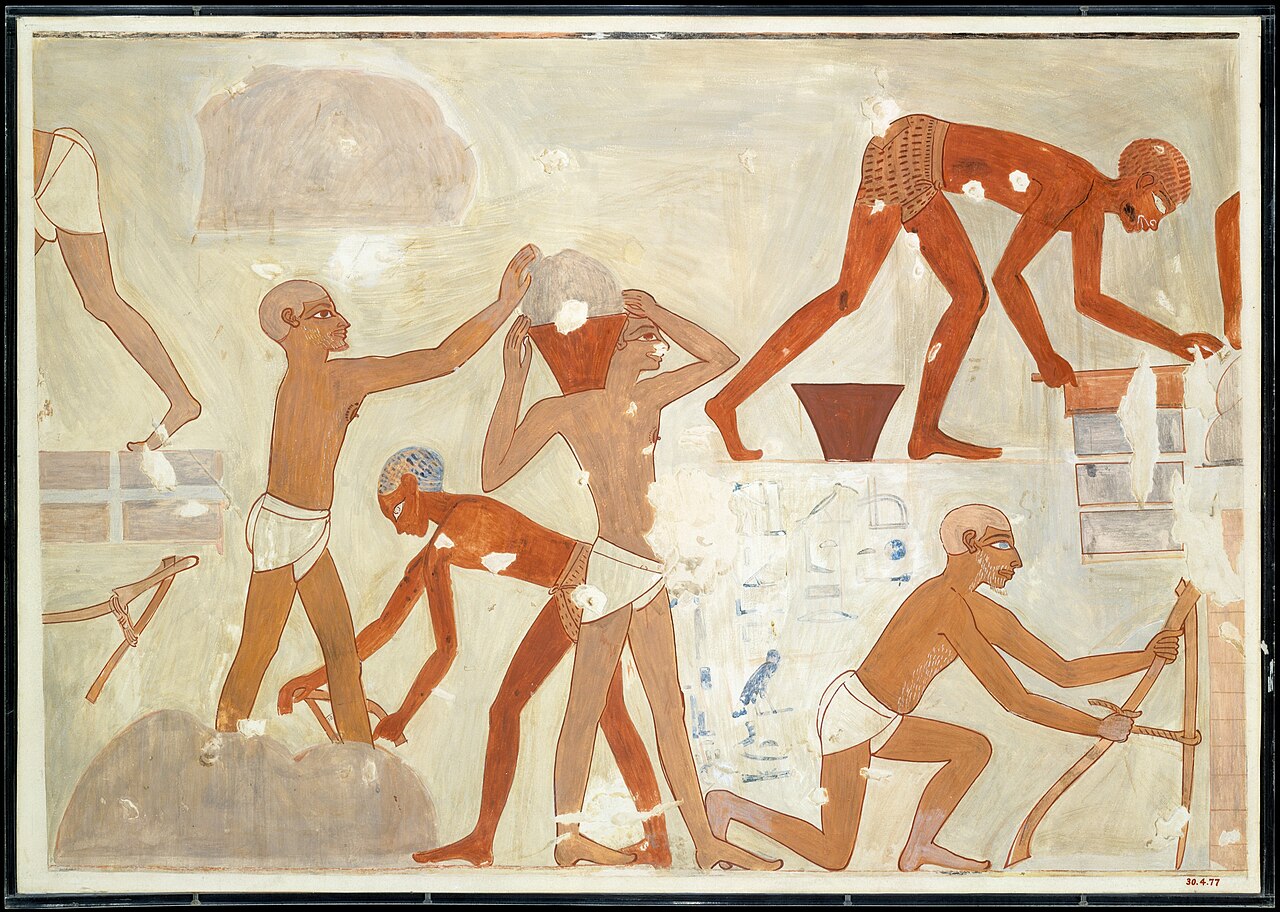
The poor carry sheaves but are hungry, press olives and grapes but are thirsty. Deuteronomy 25:4 forbids muzzling an ox treading grain; here humans fare worse. The Egyptian tomb painting of brickmakers above shows the kind of forced labour ancient economies depended on.
Night crimes
Job's catalogue ends with the murderer who rises at dawn, the adulterer who waits for twilight and disguises his face, and the house-breaker who digs through walls in the dark (24:13–17). Mud-brick walls could be dug through (compare Exodus 22:2; Ezekiel 12:5). These "rebels against the light" are at home in darkness; Job's point is that God does not seem to expose them.
Who speaks 24:18–25?
Verses 18–24 describe the wicked perishing, which sounds more like the friends than Job. Proposals: Job is quoting the friends' view to refute it; the verses are a curse Job wishes on the wicked ("let their portion be cursed"); or they belong to a lost speech of Bildad or Zophar, displaced in the third cycle. These are modern reconstructions; no manuscript arranges the speeches differently. The site keeps the received order and labels the proposals.
Greek gaps
24:15–17 is absent from the library's Sahidic Coptic copy, which follows the shorter Old Greek; Origen supplied many such lines from Theodotion. The status of each line must be checked in Ziegler's edition (JOB-C03).
The versions
The library's Sahidic Coptic copy, which follows the shorter pre-Origen Greek, lacks 24:15–17, the lines on the adulterer and the night-thieves. Whether each missing line was absent from the Old Greek itself, or is damage in the Coptic manuscripts or our digital copy, is to be checked against Ziegler's edition (JOB-C03).
What the evidence shows
- Moving boundary markers is condemned in biblical law and Babylonian kudurru inscriptions.
- 24:18–25 originally belonged to another speaker. A modern proposal; no manuscript evidence for a different order.
Continue the journey
Journey of a PassageJob 24:18–25: Who is speaking?These verses describe the wicked swept away, which sounds like the friends rather than Job.More from this lesson
Why this matters to the rest of Scripture
- Do not move your neighbour's landmark.
- Garments taken in pledge, the poor trampled.
- "Their redeemer is mighty."