I Know That My Redeemer Liveth
The most famous words in Job, and the hardest Hebrew
"How long will ye vex my soul, and break me in pieces with words? These ten times have ye reproached me… Know now that God hath overthrown me… Behold, I cry out of wrong, but I am not heard: I cry aloud, but there is no judgment. He hath fenced up my way that I cannot pass… He hath stripped me of my glory."
"He hath put my brethren far from me, and mine acquaintance are verily estranged from me. My kinsfolk have failed… My breath is strange to my wife… Yea, young children despised me… My bone cleaveth to my skin and to my flesh, and I am escaped with the skin of my teeth. Have pity upon me, have pity upon me, O ye my friends; for the hand of God hath touched me."
"Oh that my words were now written! oh that they were printed in a book! That they were graven with an iron pen and lead in the rock for ever!"
"For I know that my redeemer liveth, and that he shall stand at the latter day upon the earth: And though after my skin worms destroy this body, yet in my flesh shall I see God: Whom I shall see for myself, and mine eyes shall behold, and not another; though my reins be consumed within me."
The go'el
A go'el is the next-of-kin who buys back land, frees a relative sold into slavery, or avenges a killing (Leviticus 25:25, 47–49; Numbers 35:19; Ruth 4). God is called Israel's go'el in Isaiah (41:14; 43:14; 44:6). Job has lost his family; he claims a kinsman-redeemer who "lives." See the Echo on redeemers and widows.
Words cut in rock
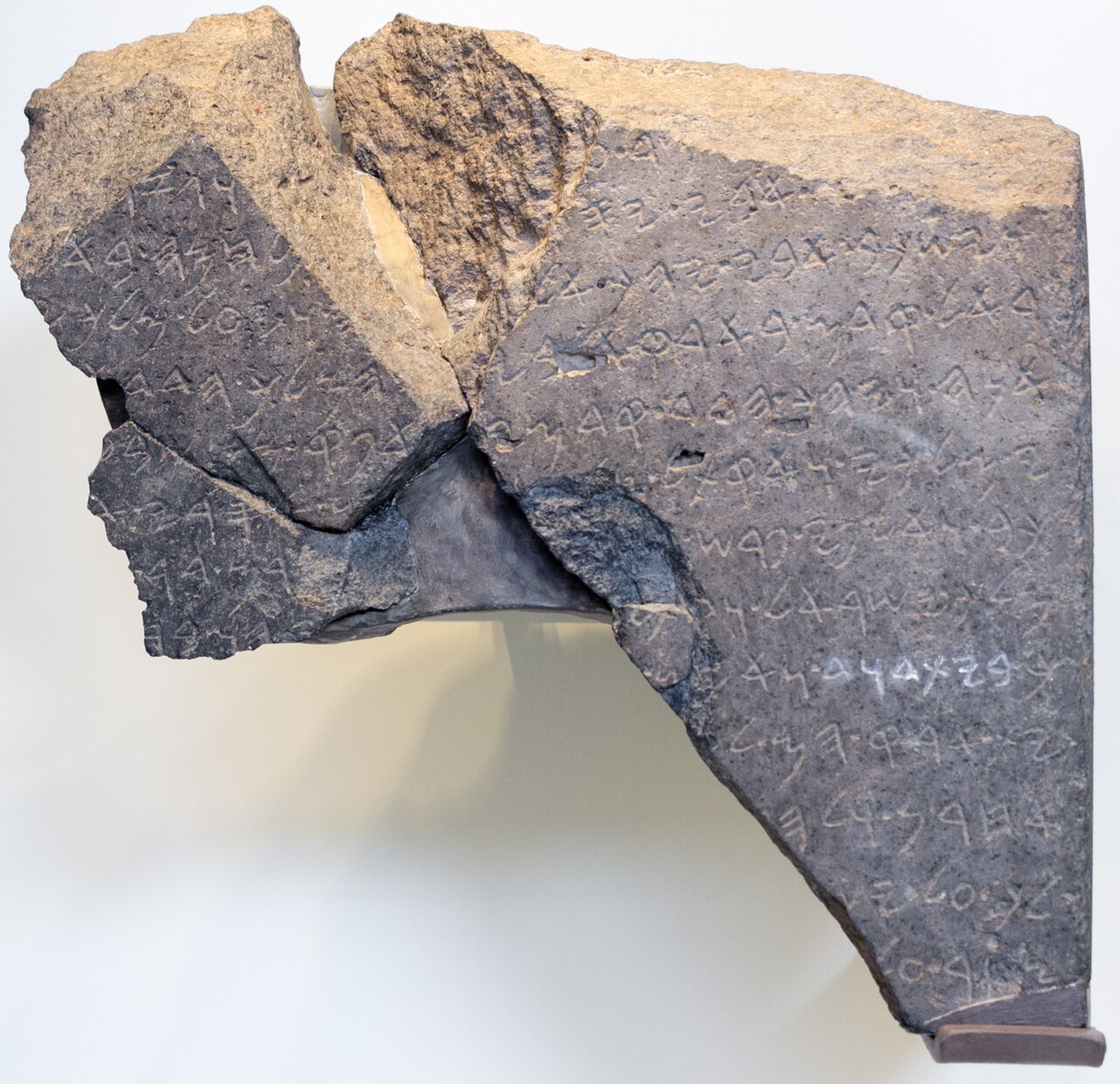
Kings carved their deeds in stone so they would last: the Tel Dan Stele above (9th century BC), the Behistun inscription of Darius cut into a cliff, the Mesha Stele. "An iron pen and lead" may describe chiselled letters filled with lead. Job wants his testimony to outlast him like a monument.
The skin of my teeth
An English idiom from this verse (19:20). The Hebrew is obscure: perhaps the gums, or nothing at all (teeth have no skin): Job has escaped with nothing.
Five hard questions in three verses
(1) Who is the go'el: God, a heavenly advocate, or a human vindicator after Job's death? (2) "At the latter day" ('aharon) may mean "at last" or "as the last one," not necessarily the end of time. (3) "Upon the earth" ('al 'afar) means "upon the dust," possibly Job's grave. (4) "In my flesh" (mibbesari) can mean "from my flesh" (still alive, in the body) or "without my flesh" (after death). (5) "Though after my skin worms destroy this body": "worms" and "body" are not in the Hebrew, which reads roughly "after my skin has been struck off thus."
The ancient versions read it differently
The library's Greek (Giguet) reads: "For I know that he is eternal who is to deliver me on this earth, and to raise up my skin that endures these things." The Greek verb (anastēsai, "raise up") opened the way to a resurrection reading. Jerome's Vulgate goes further: "I know that my redeemer lives, and on the last day I shall rise from the earth; and I shall be clothed again with my skin, and in my flesh I shall see my God." The KJV follows the Hebrew more closely; its "worms" and "body" are words the translators supplied, printed in italics in the 1611 edition. The Aramaic Targum from Qumran (11Q10) is reported not to preserve these verses.
Faith histories
Christians have long read 19:25 as a prophecy of the risen Christ (Handel's Messiah sets it). Jewish interpreters have read the go'el as God vindicating Job, sometimes in this life. Many modern scholars read it as Job's confidence that God will vindicate him, before or after death. These readings matter; none removes the difficulty of the Hebrew.
What the evidence shows
- Go'el is the kinsman-redeemer of Israelite law, and a title of God in Isaiah.
- Job 19:25–27 explicitly teaches bodily resurrection in the Hebrew. The Greek and Latin move toward it; the Hebrew is ambiguous.
- The Vulgate reads "on the last day I shall rise from the earth."Source: The site's library: Westminster Leningrad Codex (Hebrew), Giguet's French of the Greek, Clementine Vulgate, KJV, Church Slavonic, Sahidic Coptic
- The redeemer is God. A widely held reading, Jewish and Christian; alternatives exist.
Continue the journey
Journey of a PassageJob 19:25–27: "I know that my redeemer liveth"Hebrew: "I know my go'el lives, and at the last he will stand upon the dust; and after my skin has been struck off, from (or without) my flesh I shall see God." The library's Greek speaks of one "eternal" who will "raise up my skin"; the Vulgate has "on the last day I shall rise from the earth… and in my flesh I shall see my God." The KJV adds "worms" and "body."More from this lesson
Echoes Across Civilizations
Optional: how other ancient peoples told similar stories. Open one to compare, then come back to the lesson.
A widow and her husband's familyHittite · Middle Assyrian · Israelite
Did other ancient laws provide for a widow to marry into her late husband's family?
- Hittite: Hittite Laws §193 Shared literary world
- Middle Assyrian: Middle Assyrian Laws A §§30, 33, 43 Shared literary world
- Israelite: Tamar and Judah Possible historical contact
Why this matters to the rest of Scripture
- Boaz as go'el.
- "The LORD… and his redeemer."
- "Now mine eye seeth thee."