"Hear my words, O ye wise men… For Job hath said, I am righteous: and God hath taken away my judgment… What man is like Job, who drinketh up scorning like water?… For he hath said, It profiteth a man nothing that he should delight himself with God."
"Therefore hearken unto me, ye men of understanding: far be it from God, that he should do wickedness; and from the Almighty, that he should commit iniquity. For the work of a man shall he render unto him… If he set his heart upon man, if he gather unto himself his spirit and his breath; All flesh shall perish together."
"Is it fit to say to a king, Thou art wicked?… How much less to him that accepteth not the persons of princes, nor regardeth the rich more than the poor?… There is no darkness, nor shadow of death, where the workers of iniquity may hide themselves… Job hath spoken without knowledge, and his words were without wisdom. My desire is that Job may be tried unto the end."
The ideal of the impartial king
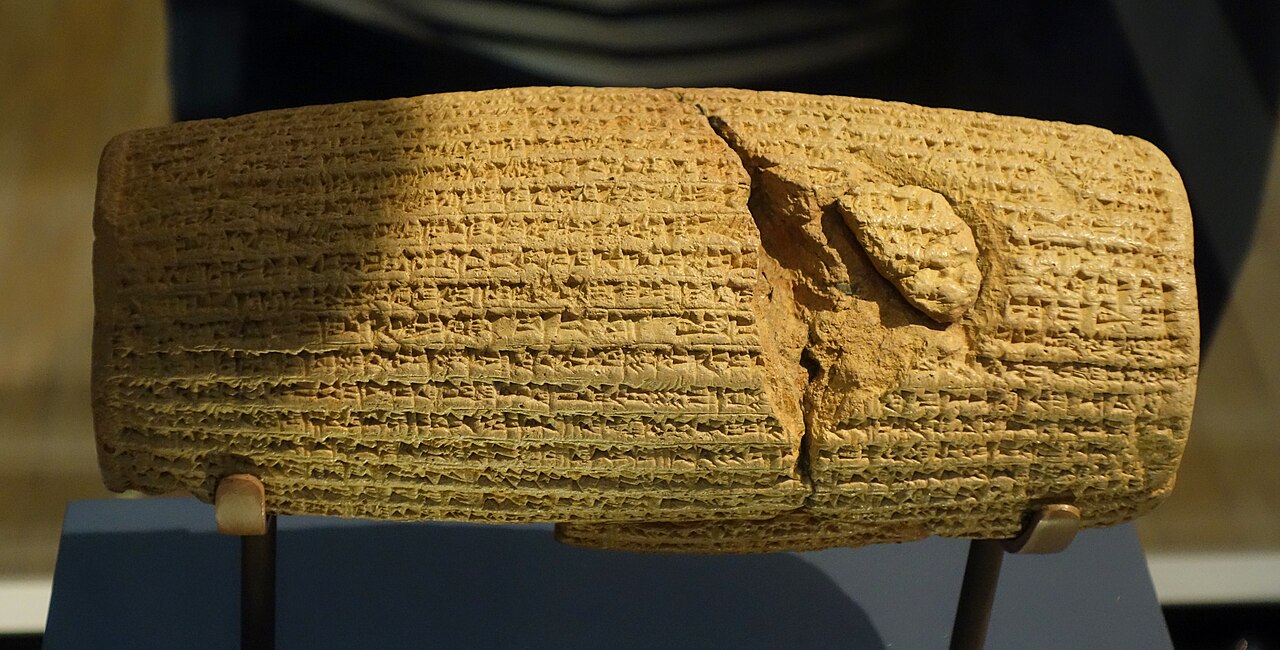
Ancient rulers claimed to judge rich and poor alike; the Cyrus Cylinder, pictured above, presents Cyrus as a just ruler chosen by Marduk. Elihu argues that if we expect impartiality from kings, God, the king of kings, must be more just still.
Breath and life
"If he gather unto himself his spirit and his breath" echoes Genesis 2:7 and Psalm 104:29: life depends on God's breath moment by moment.
The godless ruler
34:30, "That the hypocrite reign not, lest the people be ensnared," became in the library's Greek and the Vulgate "he makes a hypocrite reign because of the people's sins," an idea later used in political theology: bad rulers as judgment on a nation.
Does Elihu quote Job fairly?
Job did say God took away his right (27:2) and that he is righteous (27:6). But "It profiteth a man nothing that he should delight himself with God" (34:9) is closer to Job's description of what the wicked say (21:15) than to Job's own words. Elihu's moral ideal (God does not do wrong) is sound; his characterization of Job is partly unfair.
Silence about Elihu in 42:7
God rebukes the three friends but does not mention Elihu. That silence is not an endorsement: it may mean Elihu was a later addition, or that his partial truth needed no verdict.
The versions
The library's Sahidic Coptic copy, which follows the shorter pre-Origen Greek, lacks 34:3–5, 34:7 and 34:28–33. Whether each missing line was absent from the Old Greek itself, or is damage in the Coptic manuscripts or our digital copy, is to be checked against Ziegler's edition (JOB-C03).
What the evidence shows
- Elihu accurately quotes Job in 34:9. Closer to Job's account of the wicked (21:15).
- The Cyrus Cylinder presents Cyrus as a just king chosen by Marduk.
Continue the journey
Connected elsewhere in ScriptureVisitors, Judgment, and SodomGenesis 18:25: "Shall not the Judge of all the earth do right?"More from this lesson
Why this matters to the rest of Scripture
- "Shall not the Judge of all the earth do right?"
- "Thou takest away their breath, they die."