"Then answered Bildad the Shuhite, and said, Dominion and fear are with him, he maketh peace in his high places. Is there any number of his armies? and upon whom doth not his light arise? How then can man be justified with God? or how can he be clean that is born of a woman? Behold even to the moon, and it shineth not; yea, the stars are not pure in his sight. How much less man, that is a worm? and the son of man, which is a worm?"
That is all. Eliphaz spoke three times, Bildad three times, but the third speech is a fragment; Zophar, who spoke in rounds one and two, never speaks again.
Peace in the heights
"He maketh peace in his high places" may recall battles among heavenly powers (Isaiah 24:21; the sea and dragon myths). The phrase entered Jewish liturgy: "He who makes peace in his heights, may he make peace for us" (Oseh shalom), recited at the end of the Kaddish and the Amidah.
The moon and stars
In the ancient Near East the moon (Sin, Yarikh) and stars were gods. Bildad says even they are not pure before God. Job will swear he never worshipped the sun or moon (31:26–28).
Short speeches, long silence
Each friend speaks less as the debate goes on: Eliphaz's three speeches total about 110 verses, Bildad's about 50, Zophar's about 50 in two speeches. Bildad's last word, that man is "a worm" (25:6), is the friends' last word altogether.
A broken third cycle
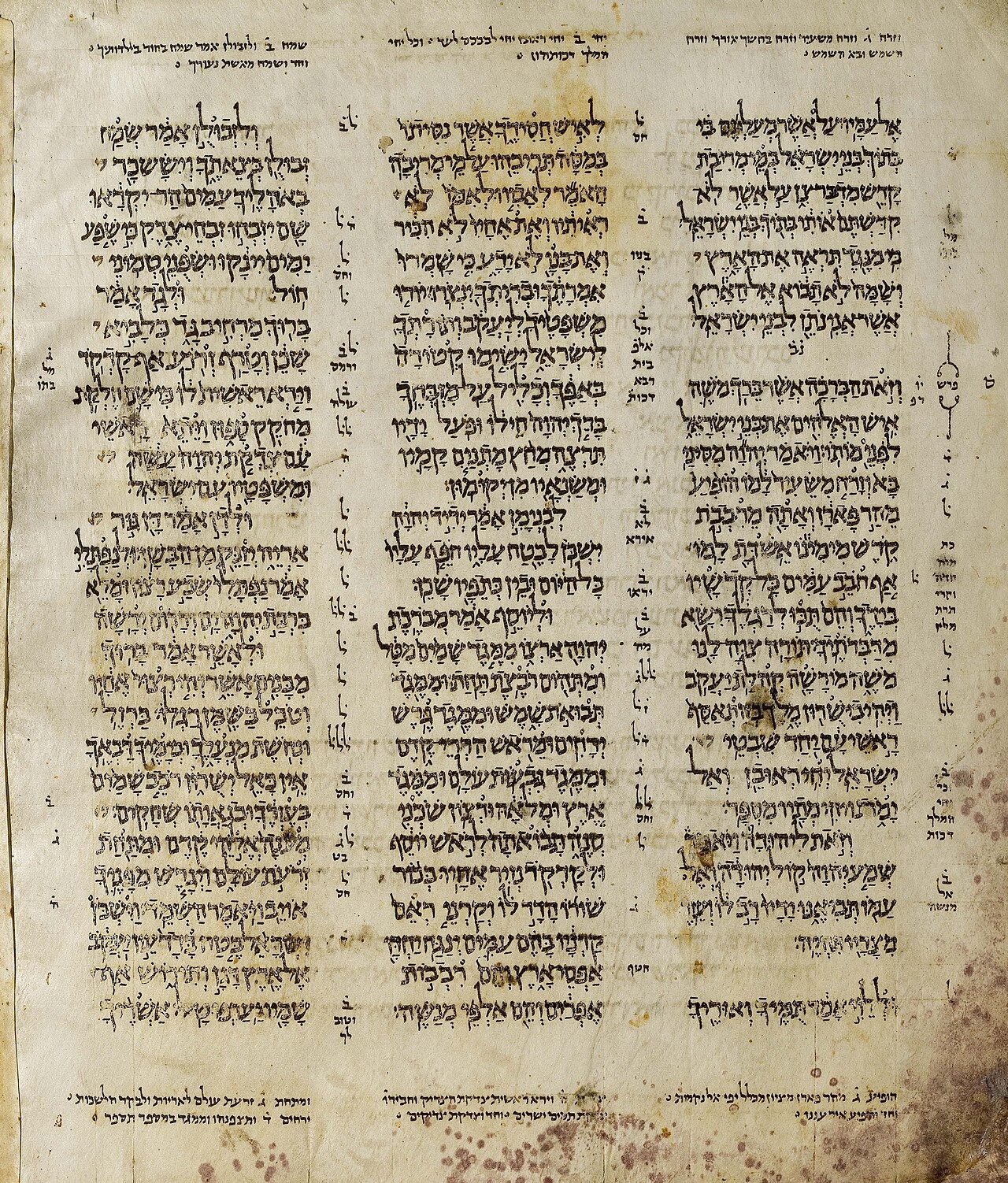
Rounds one (chs. 4–14) and two (15–21) are complete: Eliphaz, Job, Bildad, Job, Zophar, Job. Round three (22–27) has Eliphaz (22), Job (23–24), Bildad (25, six verses), Job (26–27 with two headings, 26:1 and 27:1), and no Zophar. Some of Job's words in 24 and 27 sound like the friends. Scholars propose reconstructions: 25 + 26:5–14 as Bildad's full speech; 27:13–23 as Zophar's missing speech. Others think the breakdown is deliberate: the friends have run out of arguments, and Job takes over. No ancient manuscript, Hebrew or Greek, preserves a different arrangement. The picture above shows the Aleppo Codex, the most carefully copied Masoretic manuscript, whose Job survives.
The versions
The library's Greek opens Bildad's speech differently: "What can one expect but fear from him who makes all things on high?" The Vulgate stays close to the Hebrew ("power and terror are with him"). Neither preserves a longer speech.
What the evidence shows
- The third cycle lacks a speech by Zophar in all known manuscripts.
- A longer Bildad speech was displaced from chapter 25. A modern literary proposal.
- "Oseh shalom" in Jewish liturgy echoes Job 25:2.
Continue the journey
Journey of a PassageJob 25:1–6: Bildad's six verses and the missing ZopharBildad's third speech is six verses long, and Zophar has no third speech at all.More from this lesson
Why this matters to the rest of Scripture
- Eliphaz's vision with a similar thought.
- "But I am a worm, and no man."