Thou Hast Made Me as the Clay
"Wherefore then hast thou brought me forth out of the womb?"
"My soul is weary of my life; I will leave my complaint upon myself; I will speak in the bitterness of my soul. I will say unto God, Do not condemn me; shew me wherefore thou contendest with me. Is it good unto thee that thou shouldest oppress, that thou shouldest despise the work of thine hands…? Hast thou eyes of flesh? or seest thou as man seeth?"
"Thine hands have made me and fashioned me together round about; yet thou dost destroy me. Remember, I beseech thee, that thou hast made me as the clay; and wilt thou bring me into dust again? Hast thou not poured me out as milk, and curdled me like cheese? Thou hast clothed me with skin and flesh, and hast fenced me with bones and sinews. Thou hast granted me life and favour, and thy visitation hath preserved my spirit."
"And these things hast thou hid in thine heart… For it increaseth. Thou huntest me as a fierce lion… Wherefore then hast thou brought me forth out of the womb? Oh that I had given up the ghost, and no eye had seen me!… Are not my days few? cease then, and let me alone, that I may take comfort a little, before I go whence I shall not return, even to the land of darkness and the shadow of death."
Milk and cheese: ancient embryology
Job's picture of conception and growth (semen poured like milk, the embryo set like cheese, then skin, flesh, bones and sinews) matches ancient ideas found also in Greek medicine and later rabbinic texts. It is a poet's wonder at being made, not a modern account of biology.
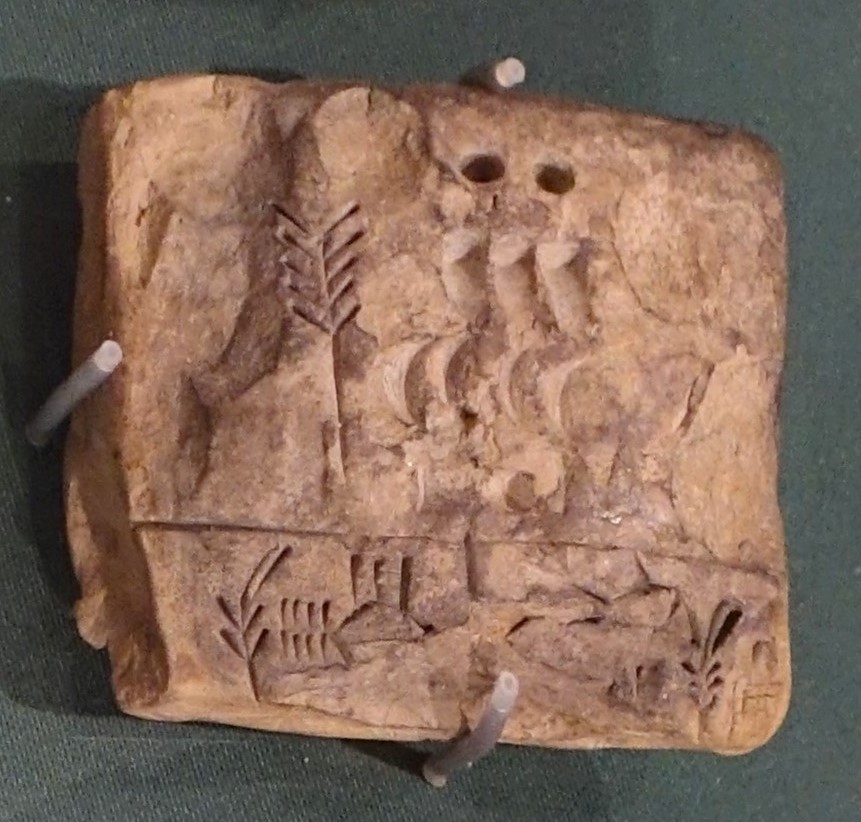
Clay
The potter shaping clay is a common image of creation in the Bible (Genesis 2:7; Isaiah 64:8; Jeremiah 18) and in Mesopotamia, where gods form humans from clay (Atrahasis). The early clay tablet above is a reminder that the same earth that made bricks and tablets was the picture of human frailty.
The land of no return
Job ends (10:21–22) with a picture of Sheol: "a land of darkness, as darkness itself; and of the shadow of death, without any order, and where the light is as darkness." The phrase "without any order" (lo sedarim) means the opposite of creation's order: the underworld is uncreation. Mesopotamian texts call it "the land of no return" (Descent of Ishtar).
Psalm 139 inverted
Psalm 139:13–16 praises God for knitting the psalmist together in the womb. Job 10 uses the same imagery to ask why God would destroy his own careful work. As with Psalm 8 in chapter 7, Job turns a hymn into an accusation.
Dangerous words, accurately attributed
Job's words in chapter 10 (God as a hunter, hiding a plan to destroy him) are hard to read. The book does not tidy them or call them blasphemy. Translations should not soften them, and lessons should not put them in the narrator's or God's mouth: they are Job's honest protest, which God later answers.
A watchful God
"If I sin, then thou markest me" (10:14) uses shamar, "guard, watch," the same verb used for God's protecting care (Psalm 121). Job feels God's watch as surveillance, as in 7:20 ("O thou preserver [watcher] of men"). The library's Sahidic Coptic copy, which follows the shorter pre-Origen Greek, lacks 10:22, the last line of this picture. Whether each missing line was absent from the Old Greek itself, or is damage in the Coptic manuscripts or our digital copy, is to be checked against Ziegler's edition (JOB-C03).
What the evidence shows
- Job 10 pictures God forming Job in the womb with the images of milk, cheese, skin and bones.
- The imagery parallels Psalm 139:13–16.
Continue the journey
Connected elsewhere in ScripturePsalm 139: You Have Searched Me and Known MePsalm 139:13–16: "Thou hast covered me in my mother's womb."More from this lesson
Why this matters to the rest of Scripture
- "Thou hast covered me in my mother's womb."
- "We are the clay, and thou our potter."