"My breath is corrupt, my days are extinct, the graves are ready for me. Are there not mockers with me?… Lay down now, put me in a surety with thee; who is he that will strike hands with me?"
"He hath made me also a byword of the people; and aforetime I was as a tabret. Mine eye also is dim by reason of sorrow… Upright men shall be astonied at this… The righteous also shall hold on his way, and he that hath clean hands shall be stronger and stronger."
"If I wait, the grave is mine house: I have made my bed in the darkness. I have said to corruption, Thou art my father: to the worm, Thou art my mother, and my sister. And where is now my hope? as for my hope, who shall see it? They shall go down to the bars of the pit, when our rest together is in the dust."
Striking hands
To "strike hands" was to guarantee someone's debt or bail (Proverbs 6:1; 17:18; 22:26). Job asks God to stand surety for him with God. It is the same paradox as chapter 16: God is both judge and only possible guarantor.
Caves and graves
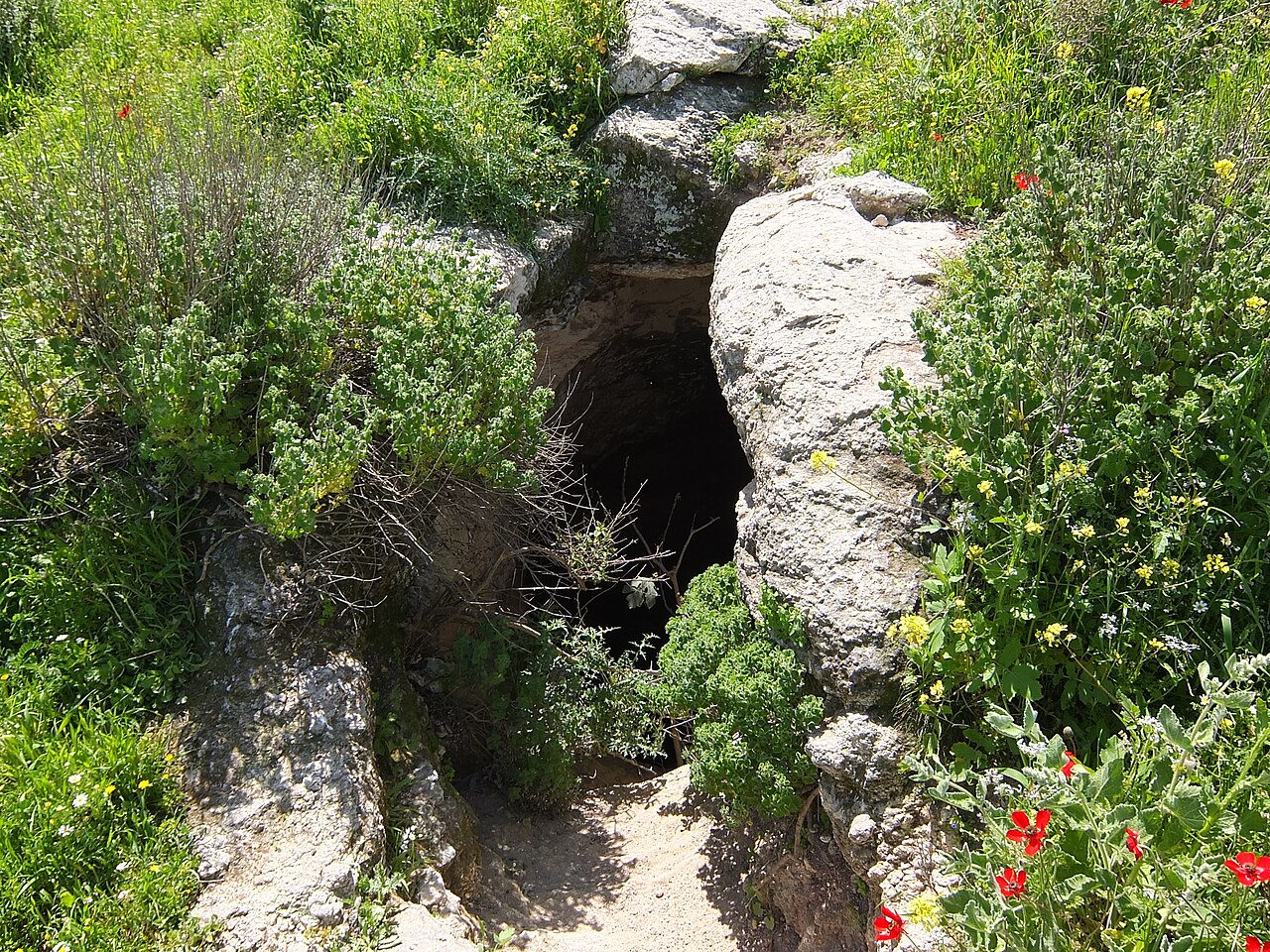
Families in the hill country buried their dead in rock-cut caves and chambers, laying bodies on benches and later gathering the bones. The cave in the Adullam region pictured above is a reminder of the rocky landscape where "the grave is mine house" was a literal picture.
Spat upon
17:6, "aforetime I was as a tabret" (KJV), translates Hebrew tofet, which most now read as "spitting": "I am one in whose face people spit." The library's Greek reads "you have made me a fable of the nations," the Vulgate "an example." The KJV's "tabret" (tambourine) took tofet from tof, a drum.
Hope in two moods
Chapter 17 is darker than chapter 14. Job's hope goes down to the bars of Sheol. Rather than harmonizing chapters 14, 17 and 19 into one doctrine, the site reads them as moods in a long argument.
The versions
The library's Sahidic Coptic copy, which follows the shorter pre-Origen Greek, lacks 17:4 and 17:12. Whether each missing line was absent from the Old Greek itself, or is damage in the Coptic manuscripts or our digital copy, is to be checked against Ziegler's edition (JOB-C03). Chapter 17 is one of the hardest in Job to translate; many verses (17:5, 12, 16) have several possible readings, and translations differ widely.
What the evidence shows
- "Strike hands" means to stand surety for a debt. Proverbs 6:1; 17:18.
Continue the journey
Connected elsewhere in ScriptureProverbs 6: Go to the Ant, Thou SluggardProverbs 6:1: "If thou hast stricken thy hand with a stranger."More from this lesson
Why this matters to the rest of Scripture
- "If thou hast stricken thy hand with a stranger."
- The witness in heaven.