"Is there not an appointed time to man upon earth? are not his days also like the days of an hireling? As a servant earnestly desireth the shadow, and as an hireling looketh for the reward of his work: so am I made to possess months of vanity, and wearisome nights are appointed to me. When I lie down, I say, When shall I arise, and the night be gone? and I am full of tossings to and fro unto the dawning of the day."
"My days are swifter than a weaver's shuttle, and are spent without hope. O remember that my life is wind." He will go down to the grave and not return; "he shall return no more to his house."
"Therefore I will not refrain my mouth… Am I a sea, or a whale, that thou settest a watch over me?" When he hopes for comfort in bed, God scares him with dreams. "I loathe it; I would not live alway."
"What is man, that thou shouldest magnify him? and that thou shouldest set thine heart upon him? And that thou shouldest visit him every morning, and try him every moment? How long wilt thou not depart from me, nor let me alone till I swallow down my spittle?… And why dost thou not pardon my transgression?… for now shall I sleep in the dust; and thou shalt seek me in the morning, but I shall not be."
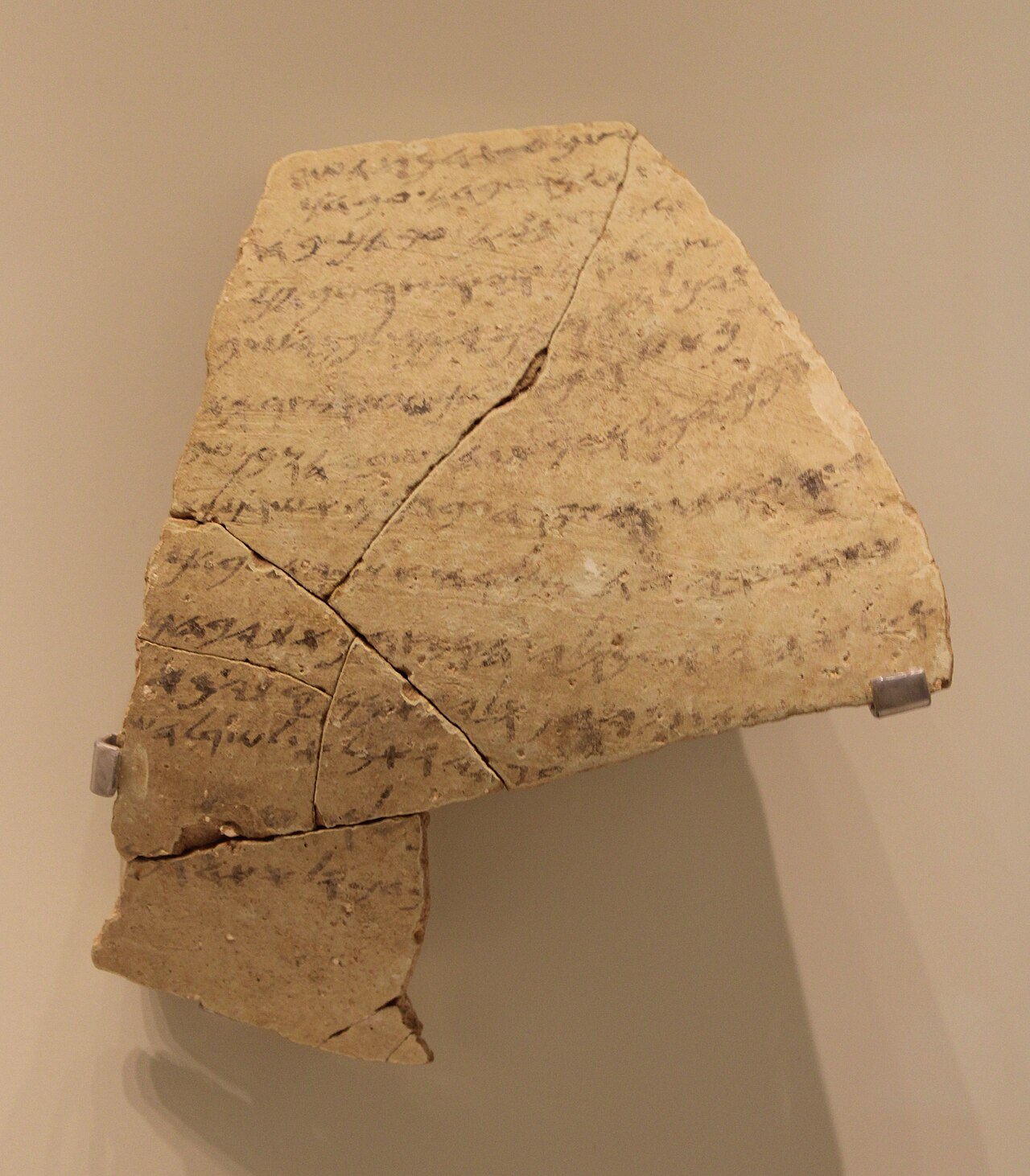
A labourer's complaint in clay
The ostracon pictured above, from Mesad Hashavyahu near Yavneh-Yam (late 7th century BC), is a field worker's petition: he says an official took his garment though he had finished his harvest quota, and asks for it back. It is a real voice of the kind of worker Job describes, waiting for wages and shade (compare Deuteronomy 24:14–15).
The weaver's shuttle
On an upright or ground loom the shuttle carrying the weft passes quickly back and forth. Life is gone as fast. In 7:6 Job may also pun on tiqwah, "hope," which can mean "thread": his days end "without thread."
The sea and the dragon
"Am I a sea (yam), or a whale (tannin)?" Yam is both the sea and, at Ugarit, the sea-god whom Baal defeats; tannin is a sea-dragon (Genesis 1:21; Isaiah 27:1). Job asks if God is treating him like the chaos-powers that must be guarded and penned in (compare 38:8–11).
Job and Psalm 8
Psalm 8:4: "What is man, that thou art mindful of him? and the son of man, that thou visitest him?" Job 7:17–18: "What is man, that thou shouldest magnify him?… that thou shouldest visit him every morning?" Many scholars think Job is parodying the psalm: the same divine attention that the psalmist praises has become, for Job, constant scrutiny. The direction of influence is not certain, but the contrast is deliberate.
Sheol and "no return"
"He that goeth down to the grave shall come up no more" (7:9). Job here reflects the older Hebrew view of Sheol as a land of no return. In chapter 14 and especially 19 he reaches toward something more; later Jewish and Christian readers found resurrection in some of these lines. The site keeps each poem's mood rather than harmonizing them.
What the evidence shows
- Job 7:17–18 reuses Psalm 8's question "What is man?" Shared wording; direction of dependence debated.
- The Yavneh-Yam ostracon is a field worker's petition about a seized garment.
Continue the journey
Journey of a PassageJob 7:17–18: "What is man?"Job asks, "What is man, that thou shouldest magnify him?… that thou shouldest visit him every morning?", turning Psalm 8's wonder into a plea to be left alone.More from this lesson
Why this matters to the rest of Scripture
- "What is man, that thou art mindful of him?"
- The same question, and life as breath.
- Pay the hired worker before sunset.