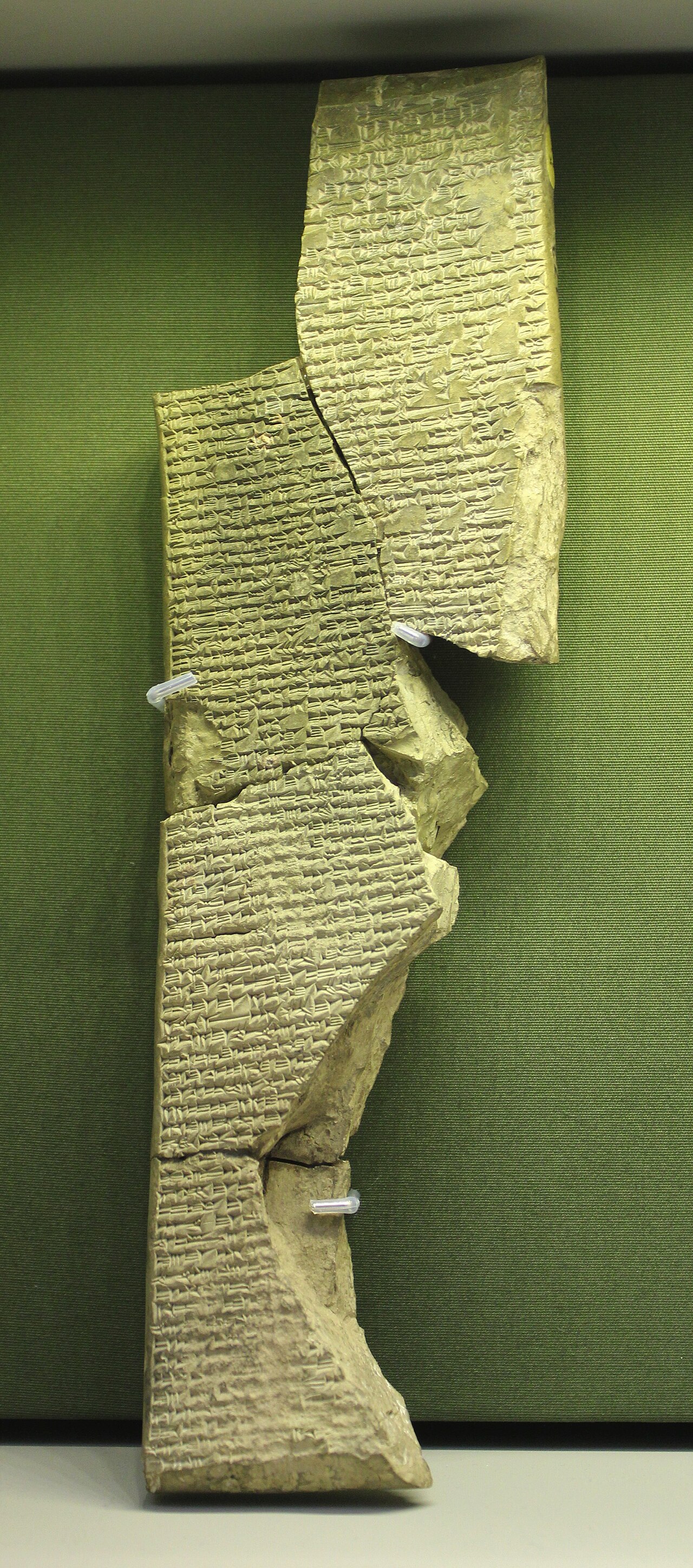
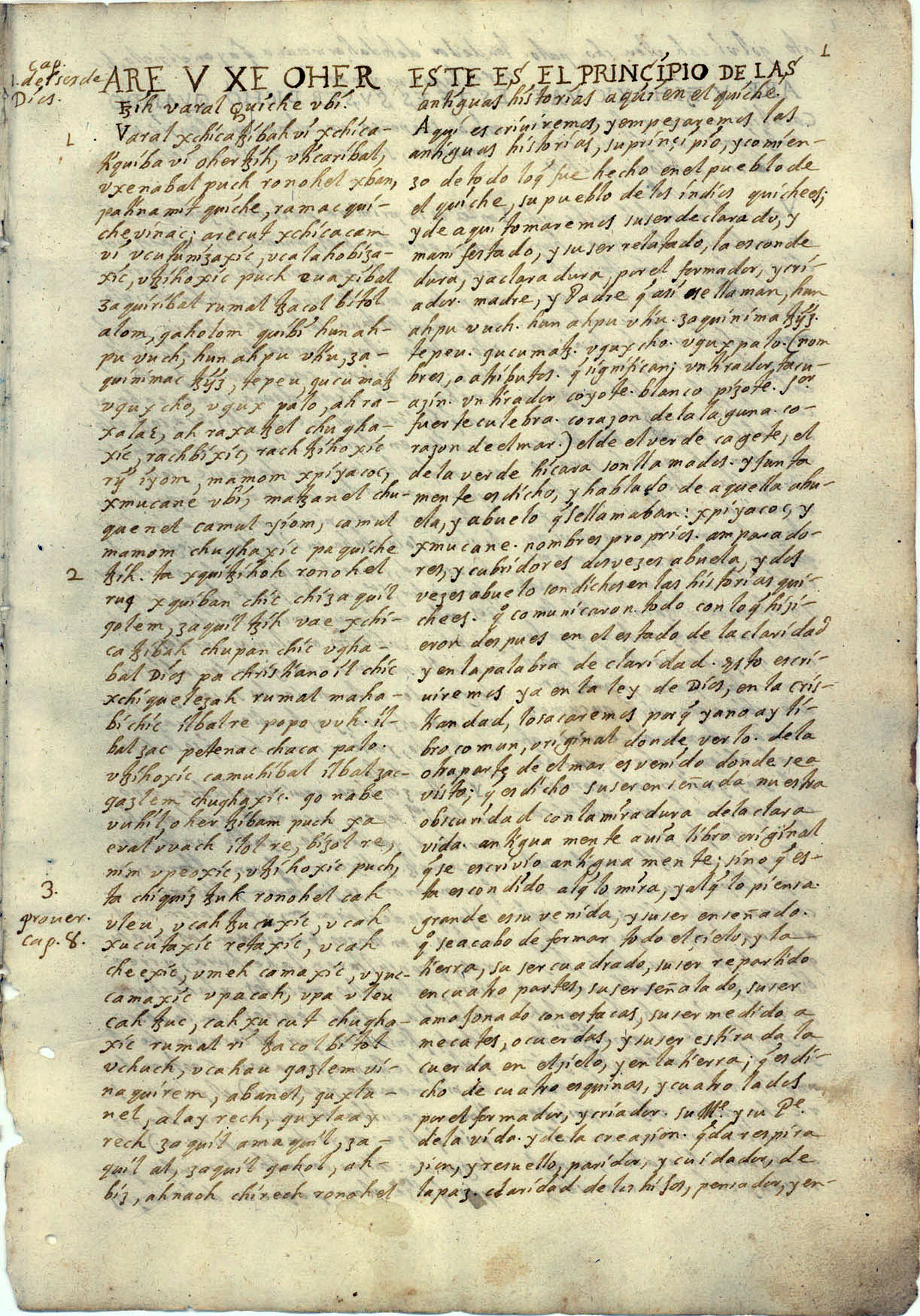
Before heaven and earth were named, the fresh waters (Apsu) and salt sea (Tiamat) mingled. Generations of gods are born, war breaks out, and Marduk kills Tiamat, splitting her body to form sky and earth. Humans are made from a rebel god's blood to do the gods' work.
Similar
Begins with primordial waters
The world is ordered by dividing the waters above and below
Lights are set in the sky to mark time
Ends with humanity's creation and divine rest
Different
Many gods born in generations; creation follows a war
Humans are created as laborers for the gods
Genesis has no battle, no rival, and gives humanity dignity
Claims great antiquity; date debated (possibly c. 1300–700 BC)
Earliest surviving copy
Carved in stone c. 710 BC (British Museum)
The god Ptah creates the other gods and all things by conceiving them in his heart and speaking them with his tongue.
Similar
Creation by a divine word
A single creator god as the source of all things
Different
Ptah creates other gods; Genesis knows no other gods beside the Creator
Set within Egyptian royal and temple theology
India · South Asia
Rig Veda 10.129, the Hymn of Creation (Nāsadīya Sūkta)
Resemblance only
Composed
c. 1200–1000 BC, passed down orally
Earliest surviving copy
Written manuscripts from the 11th century AD onward
"Then there was neither non-existence nor existence… Darkness was hidden by darkness… all this was water." The hymn ends by wondering whether even the highest being knows how creation began.
Before anything existed there was only still sea and empty sky. The creator gods spoke, "Earth!" and the earth arose. They made animals, then tried several times to make people who would honor them.
In the Beginning →Genesis opens with one Creator who brings order out of the deep, and makes humanity in His image.
Where Wast Thou? →"Then the LORD answered Job out of the whirlwind." God does not explain the heavenly test. He asks questions: where was Job when the earth was founded and the morning stars sang? Who shut in the sea with doors? Has Job commanded the dawn, walked in the depths, seen the gates of death? Where do light and darkness live? Who made the storehouses of snow and hail, the channels for rain on land where no one lives? Can Job bind the Pleiades or loose Orion, hunt prey for the lion, feed the raven's young?
Isaiah 40: Comfort Ye My People →A new voice: "Comfort ye, comfort ye my people… her warfare is accomplished" (40:1–2). A voice cries: prepare the LORD's way in the wilderness; every valley raised, every mountain lowered; all flesh shall see his glory (vv. 3–5). Another voice: "All flesh is grass… but the word of our God shall stand for ever" (vv. 6–8). Zion, herald of good news, announces: "Behold your God!", who comes with power and feeds his flock like a shepherd (vv. 9–11). Who measured the waters in his hand? The nations are a drop in a bucket; to whom will you liken God? An idol has to be made so that it will not totter (vv. 12–20). He sits above the circle of the earth, names every star, gives strength to the weary: "they that wait upon the Lord shall renew their strength; they shall mount up with wings as eagles" (vv. 21–31).
Isaiah 45: To His Anointed, to Cyrus →"Thus saith the Lord to his anointed, to Cyrus, whose right hand I have holden": God will open gates before him and give him hidden treasures, "though thou hast not known me," for Israel's sake and so that all may know "I am the Lord, and there is none else" (45:1–6). "I form the light, and create darkness: I make peace, and create evil" (v. 7). Let the heavens rain righteousness; woe to clay that argues with its potter; Cyrus will rebuild the city and free the exiles without payment (vv. 8–13). Nations will come and confess: "God is in thee… Verily thou art a God that hidest thyself" (vv. 14–17). God created the earth to be lived in, not as chaos; "Look unto me, and be ye saved, all the ends of the earth… unto me every knee shall bow, every tongue shall swear" (vv. 18–25).
Isaiah 65: New Heavens and a New Earth →God answers: "I am sought of them that asked not for me… I said, Behold me, behold me"; all day he spread out his hands to a rebellious people who sacrifice in gardens, burn incense on bricks, sit among graves, lodge in secret places, eat swine's flesh, and say "Stand by thyself, come not near to me; for I am holier than thou" (65:1–7). "As the new wine is found in the cluster, and one saith, Destroy it not; for a blessing is in it": God will not destroy all, but will bring forth a seed from Jacob, his chosen and his servants (vv. 8–10). Those who forsake the LORD and set a table for Gad (Fortune) and fill drink for Meni (Destiny) are destined for the sword; "my servants shall eat, but ye shall be hungry… my servants shall sing… but ye shall cry" (vv. 11–16). "For, behold, I create new heavens and a new earth"; Jerusalem a rejoicing; no more weeping; no infant who lives a few days, "for the child shall die an hundred years old"; they will build houses and live in them, plant vineyards and eat their fruit; "as the days of a tree are the days of my people"; before they call, God will answer; "The wolf and the lamb shall feed together… and dust shall be the serpent's meat" (vv. 17–25).
Investigation: The Holy One and the Sea Monsters →Isaiah's God is "the Holy One of Israel," enthroned above seraphim (6), presiding over a heavenly court (6:8; 40:1–8), creator of everything including light and darkness (45:7), who once struck the sea dragon Rahab (51:9) and will slay Leviathan, "the piercing serpent… the crooked serpent" (27:1). Many of these images have close parallels in the literature and art of Israel's neighbors: winged serpents in Egyptian and Judahite art, divine assemblies at Ugarit, the Babylonian creation epic, and the Ugaritic Lotan, "the fleeing serpent, the twisting serpent." This investigation sets each Isaiah text beside its closest ancient comparison and asks what the comparison shows, and what it does not.
Investigation: New Heavens and the Disturbing Ending →Isaiah has several pictures of the future, and they are not the same. In chapters 24–27 the earth is emptied and judged, and then God "will swallow up death in victory" (25:8) and "thy dead men shall live" (26:19). In chapter 35 the desert blooms and the blind see. In 65:17–25 God creates "new heavens and a new earth," where a person who dies at a hundred dies young. In 66:22–24 all flesh worships, and the worshippers look on the corpses of the rebels whose worm does not die. Later writers took up these images: Daniel 12:2, Mark 9:48, 2 Peter 3:13 and Revelation 21:1–5. This investigation compares them without assuming that they describe one event with one timetable.