Isaiah 45: To His Anointed, to Cyrus
A Persian king called messiah, light and darkness, peace and calamity, and every knee bowing
"Thus saith the Lord to his anointed, to Cyrus, whose right hand I have holden, to subdue nations before him… to open before him the two leaved gates; and the gates shall not be shut… For Jacob my servant's sake… I have even called thee by thy name: I have surnamed thee, though thou hast not known me. I am the Lord, and there is none else, there is no God beside me" (45:1–5).
"I form the light, and create darkness: I make peace, and create evil: I the Lord do all these things" (v. 7). "Woe unto him that striveth with his Maker!… Shall the clay say to him that fashioneth it, What makest thou?" (v. 9).
"Verily thou art a God that hidest thyself, O God of Israel, the Saviour" (v. 15). "He created it not in vain, he formed it to be inhabited" (v. 18). "Look unto me, and be ye saved, all the ends of the earth: for I am God, and there is none else. I have sworn by myself… That unto me every knee shall bow, every tongue shall swear" (vv. 22–23).
| Verses | What it says | What to notice |
|---|---|---|
| 45:1–3 | To my anointed (mashiach), Cyrus: I hold your right hand, open double doors, break bronze gates, give treasures of darkness | Cyrus took Babylon in 539 BC; Sardis (Croesus's treasure) about 547/546. |
| 45:4–6 | For Jacob's sake I named you, though you did not know me; I am the LORD, none else, so all may know from east to west | The goal is universal knowledge of God. |
| 45:7 | I form light and create darkness, make peace (shalom) and create calamity (ra); I the LORD do all these | See below. |
| 45:8 | Rain down, heavens, righteousness; let earth open and salvation sprout | Rorate caeli: an Advent chant (Vulgate). |
| 45:9–13 | Woe to the pot that argues with the potter; I made the earth; I raised him (Cyrus) in righteousness; he will build my city and free my exiles, not for a price | Romans 9:20–21 uses the potter image. |
| 45:14–17 | The wealth of Egypt and Cush and the tall Sabeans will come; they will bow: surely God is in you; truly you are a God who hides himself | 1 Corinthians 14:25 echoes "God is in you." |
| 45:18–19 | He did not create the earth a chaos (tohu) but to be inhabited; I did not say seek me in chaos | Tohu from Genesis 1:2. |
| 45:20–25 | Survivors of the nations, gather: idols cannot save; turn to me and be saved, all the ends of the earth; every knee will bow, every tongue swear; in the LORD righteousness and strength | Quoted in Romans 14:11; applied to Jesus in Philippians 2:10–11. |
Cyrus as the gods' chosen king
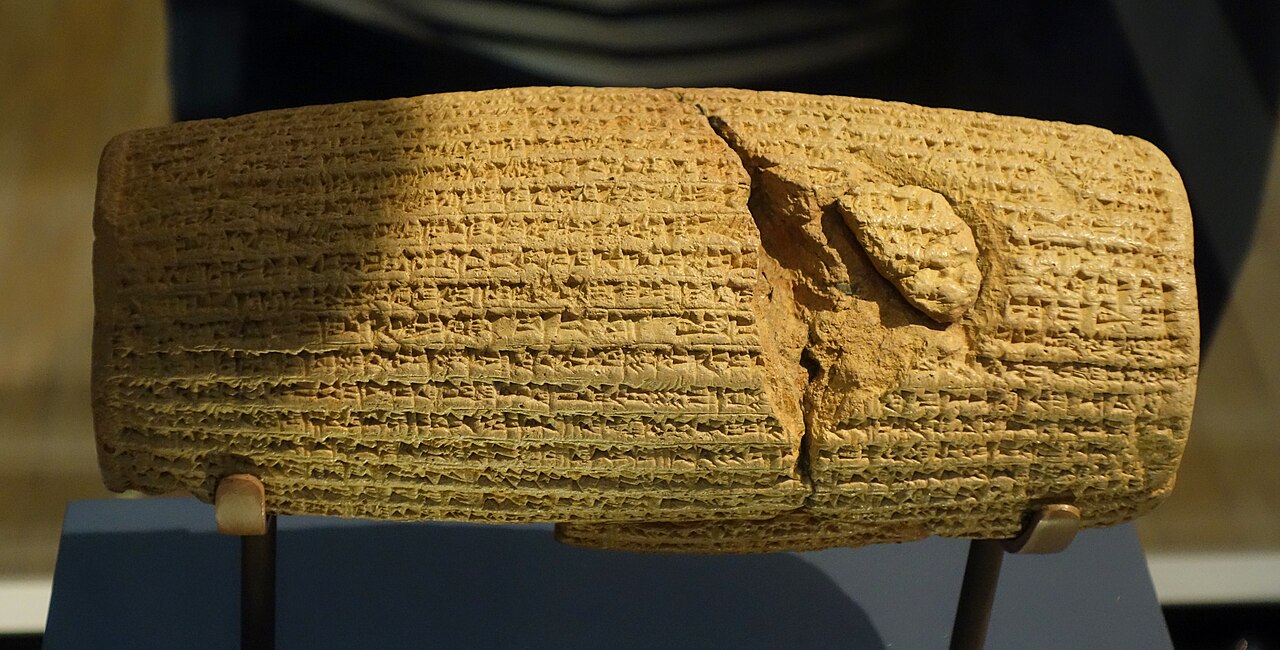
The Cyrus Cylinder (539/538 BC, British Museum), written in Babylonian for Babylon, says that Marduk searched all lands for a righteous king, "called his name" Cyrus, "took him by the hand," and made him walk at his side into Babylon without battle. The parallel to Isaiah 45:1–4 ("whose right hand I have holden… I have called thee by thy name") is striking: two religious communities each claimed that their own god had chosen Cyrus. Isaiah adds that Cyrus did not know the LORD. The Cylinder says nothing about Judah or Jerusalem. See "From Babylon to Cyrus."
"I make peace, and create evil" (45:7)
Ra means "bad" in the widest sense: disaster, calamity, harm, and moral evil. Opposite shalom ("peace, well-being"), most translators take it here as "calamity" or "woe." The verse claims that nothing lies outside God's rule; some scholars read it as a denial of dualism, perhaps of a Persian-style belief in two opposed powers of good and evil, though Cyrus's own religion is debated. Jewish liturgy quotes the verse in the first blessing before the morning Shema but changes its end: "…makes peace and creates all things" (b. Berakhot 11b). The Great Isaiah Scroll reads "makes good (tov) and creates evil" (described from a transcription), sharpening the pair.
Every knee shall bow
Paul quotes 45:23 in Romans 14:11 of standing before God's judgment seat. In Philippians 2:10–11 he applies it to Jesus: "that at the name of Jesus every knee should bow… and that every tongue should confess that Jesus Christ is Lord." Taking a verse in which the one God swears that every knee will bow to him and applying it to Jesus is one of the strongest statements of Jesus' divine status in the New Testament. In Isaiah, the verse concerns the LORD alone.
A God who hides himself
"Verily thou art a God that hidest thyself" (45:15, Deus absconditus in the Vulgate) became a theme in Christian theology (Luther, Pascal). In context, it may be the nations' confession that Israel's God worked hiddenly through history, or the prophet's own wonder. Charles Spurgeon (1850) traced his conversion to a sermon on 45:22, "Look unto me, and be ye saved."
What the evidence shows
- Isaiah 45:1 calls Cyrus the LORD's anointed (mashiach).
- The Cyrus Cylinder says Marduk chose Cyrus and took him by the hand. British Museum; reported translation.
- The Cyrus Cylinder mentions the Judeans. It does not.
- Jewish liturgy adapts Isaiah 45:7 to "creates all things." b. Berakhot 11b; reported.
- Philippians 2:10–11 applies Isaiah 45:23 to Jesus.
Continue the journey
Journey of a PassageIsaiah 45:7: "I make peace, and create evil""I form the light, and create darkness: I make peace, and create evil: I the Lord do all these things." Ra here is the opposite of shalom: calamity, woe.More from this lesson
Echoes Across Civilizations
Optional: how other ancient peoples told similar stories. Open one to compare, then come back to the lesson.
CreationBabylon · Egypt · India · K'iche' Maya
How did other ancient peoples tell the beginning of the world?
- Babylon: Enuma Elish Shared literary world
- Egypt: The Memphite Theology (Shabaka Stone) Resemblance only
- India: Rig Veda 10.129, the Hymn of Creation (Nāsadīya Sūkta) Resemblance only
- K'iche' Maya: Popol Vuh Resemblance only
Kings who restored templesBabylonian (Persian king) · Egyptian · Egyptian (Persian rule) · Lycian / Persian
Did other rulers of the Persian empire restore local temples and peoples, as Cyrus and Darius do in Ezra?
- Babylonian (Persian king): The Cyrus Cylinder Possible historical contact
- Egyptian: Statue of Udjahorresnet Possible historical contact
- Egyptian (Persian rule): Darius' collection of Egyptian law (Demotic Chronicle, verso) Possible historical contact
- Lycian / Persian: Letoon trilingual inscription (Xanthos) Resemblance only
Why this matters to the rest of Scripture
- Ezra 1:1–4; 2 Chronicles 36:22–23Cyrus's proclamation.
- Romans 14:11; Philippians 2:9–11Every knee shall bow.
- The potter and the clay.
- Amos 3:6; Lamentations 3:38Calamity from the LORD.