Isaiah 15: The Burden of Moab
A night of ruin and a prophet who weeps for an enemy
"The burden of Moab. Because in the night Ar of Moab is laid waste, and brought to silence; because in the night Kir of Moab is laid waste, and brought to silence; He is gone up to Bajith, and to Dibon, the high places, to weep: Moab shall howl over Nebo, and over Medeba: on all their heads shall be baldness, and every beard cut off" (15:1–2).
"My heart shall cry out for Moab; his fugitives shall flee unto Zoar… for in the way of Horonaim they shall raise up a cry of destruction. For the waters of Nimrim shall be desolate: for the hay is withered away… Therefore the abundance they have gotten… shall they carry away to the brook of the willows" (vv. 5–7).
"For the waters of Dimon shall be full of blood: for I will bring more upon Dimon, lions upon him that escapeth of Moab" (v. 9).
| Verses | What it says | What to notice |
|---|---|---|
| 15:1 | Ar and Kir of Moab devastated in a night | Ar: probably a city on the Arnon or the region; Kir: Kir-hareseth (Kerak). |
| 15:2–4 | Mourning at Dibon and the high places; Nebo and Medeba; Heshbon, Elealeh, Jahaz cry out | Shaved heads, cut beards, sackcloth: Moabite mourning rites. |
| 15:5 | My heart cries for Moab; fugitives to Zoar, up the ascent of Luhith, on the road to Horonaim | The flight south toward the Dead Sea's southern end. |
| 15:6–7 | Nimrim's waters desolate; goods carried across the Brook of the Willows | Wadi en-Numeira? and the Zered (Wadi al-Hasa)? Identifications uncertain. |
| 15:8–9 | The cry reaches Eglaim and Beer-elim; Dimon's waters full of blood; lions on survivors | Dimon: a wordplay on dam, "blood"; the scroll reads Dibon. |
Moab's towns and the Mesha Stele
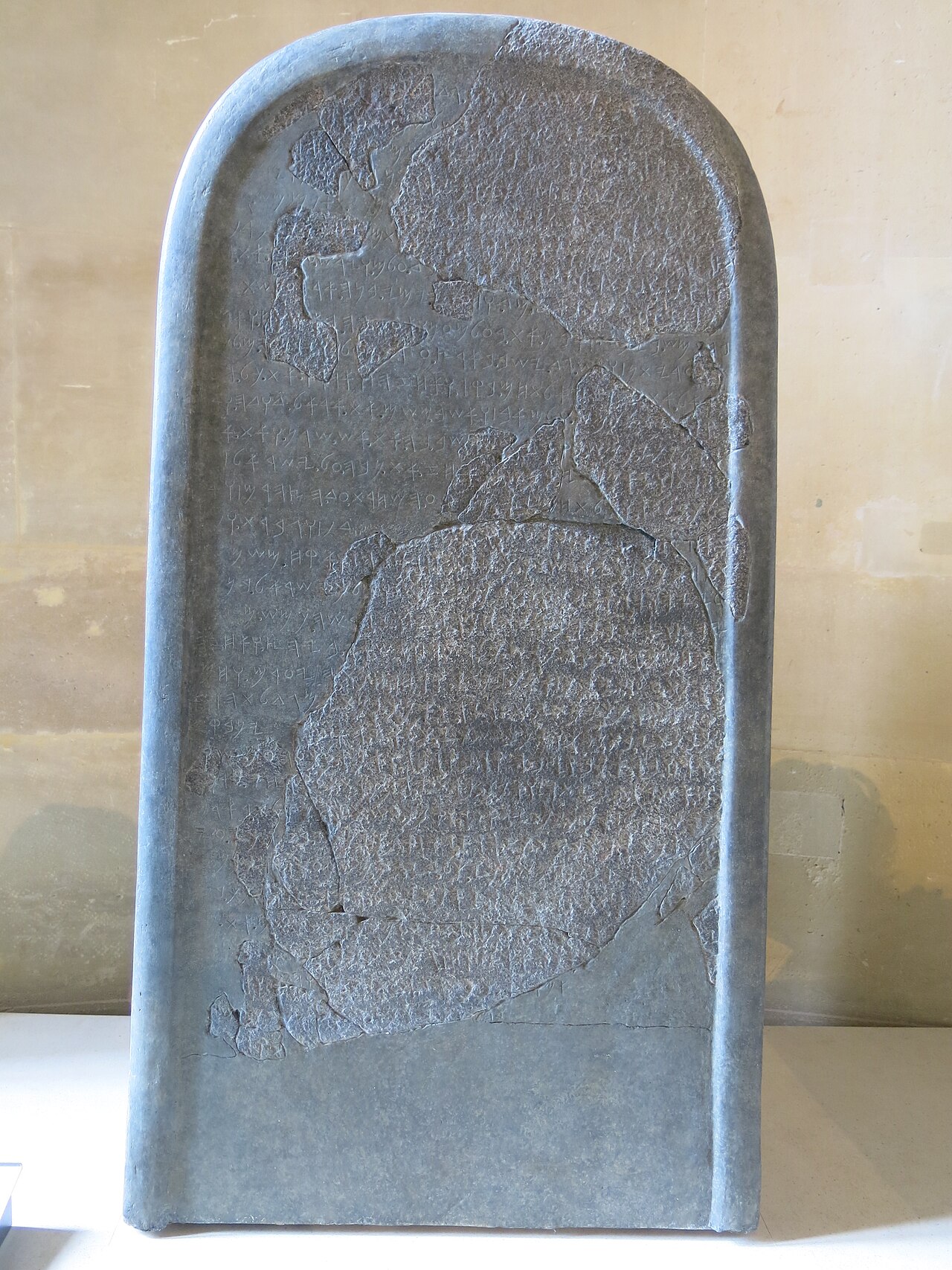
The Mesha Stele (c. 840 BC; found at Dhiban in 1868; now in the Louvre), the inscription of Mesha "king of Moab, the Dibonite," names several of the same places: Dibon, Nebo, Medeba, Jahaz and Horonaim, as well as Aroer, Ataroth and Kiriathaim. It tells how Mesha freed Moab from Israel and built or fortified its towns. The stele confirms that these were real Moabite towns in the 9th century; it says nothing about the disaster of Isaiah 15, which cannot be dated precisely. Ar, Luhith, Nimrim, Eglaim and Beer-elim are not securely located; the site's atlas marks only identified places.
Mourning in Moab
Baldness, cut beards, sackcloth, wailing on rooftops and at high places (vv. 2–3) were mourning customs shared across the Levant (Jeremiah 48:37; Ezekiel 7:18; Amos 8:10). The Israelite law forbade some of them for Israelites (Deuteronomy 14:1); here they describe Moab's grief.
Dimon or Dibon?
The Masoretic Text reads Dimon twice in 15:9; the Great Isaiah Scroll reads Dibon (דיבון) both times, as does the Vulgate (Dibon). 1QIsa-b agrees with the Masoretic Dimon. Dibon (Dhiban) is the well-known Moabite capital of v. 2. Many scholars think Dimon is a deliberate wordplay on dam ("blood": "the waters of Dimon are full of blood"), others that it is an alternative name or a scribal change. Both readings are ancient.
When, and by whom?
Moab suffered under Assyria (Tiglath-pileser III, Sennacherib) and later Babylon, and from Arab tribes. Isaiah 16:13–14 says this oracle was spoken "since that time" and is now given a new time limit, which suggests an older oracle reapplied. Jeremiah 48 reuses much of Isaiah 15–16 (compare Jeremiah 48:5, 29–38). No specific invasion can be matched with certainty.
What the evidence shows
- The Mesha Stele names Dibon, Nebo, Medeba, Jahaz and Horonaim. Reported; Louvre AO 5066.
- The Great Isaiah Scroll reads Dibon where the Masoretic Text reads Dimon in 15:9. Transcription.
- Isaiah 15 describes a datable invasion.
- Jeremiah 48 reuses Isaiah 15–16.
Continue the journey
Journey of a PassageIsaiah 15:9: Dimon or Dibon: "waters full of blood""For the waters of Dimon shall be full of blood." The Masoretic Text and 1QIsa-b read Dimon; the Great Isaiah Scroll and the Vulgate read Dibon, Moab's known capital (15:2).More from this lesson
Investigations
Optional deep dives: the ancient sources, the physical evidence, and every interpretation side by side, including unconventional ones, each labeled for what it is.
The Mesha Stele and Moab's RevoltStele: documented · Revolt: documented · Same events as 2 Kings 3: not established
What does King Mesha's own inscription say about Israel?
Found at Dhiban in 1868 and partly broken before it reached the Louvre (AO 5066), the Mesha Stele is a 34-line Moabite inscription of c. 840 BC. Mesha says Omri and his son oppressed Moab because Chemosh was angry, and that he then took back towns from Israel, devoted Nebo's population to Ashtar-Chemosh, and carried off "the vessels of YHWH." It is the longest Iron Age inscription from the region and the earliest outside text to name YHWH.
Open the full investigation →Why this matters to the rest of Scripture
- Jeremiah's long oracle on Moab, reusing these lines.
- Mesha's revolt against Israel.
- Numbers 21:26–30; 32:3Heshbon, Dibon, Nebo, Elealeh in the conquest stories.
- A Moabite woman in Israel's story.