Isaiah 39: Envoys from Babylon
Hezekiah shows his treasures, and Isaiah announces that all will be carried to Babylon
"At that time Merodach-baladan, the son of Baladan, king of Babylon, sent letters and a present to Hezekiah: for he had heard that he had been sick, and was recovered. And Hezekiah was glad of them, and shewed them the house of his precious things, the silver, and the gold, and the spices… there was nothing in his house, nor in all his dominion, that Hezekiah shewed them not" (39:1–2).
"Then came Isaiah the prophet unto king Hezekiah, and said unto him, What said these men? and from whence came they unto thee? And Hezekiah said, They are come from a far country unto me, even from Babylon" (v. 3).
"Behold, the days come, that all that is in thine house… shall be carried to Babylon: nothing shall be left, saith the Lord. And of thy sons that shall issue from thee… they shall be eunuchs in the palace of the king of Babylon. Then said Hezekiah to Isaiah, Good is the word of the Lord which thou hast spoken. He said moreover, For there shall be peace and truth in my days" (vv. 6–8).
| Verses | What it says | What to notice |
|---|---|---|
| 39:1 | Merodach-baladan of Babylon sends letters and a gift to the recovered Hezekiah | Marduk-apla-iddina II, Assyria's great Babylonian rival. |
| 39:2 | Hezekiah, glad, shows them all his treasure-house, spices, oil and armory | Possibly to prove he was a worthy ally against Assyria. |
| 39:3–4 | Isaiah questions him; from a far country, Babylon; they saw everything | The prophet's skepticism of alliances again. |
| 39:5–7 | All will be carried to Babylon; some of your sons will be eunuchs in its palace | Compare 2 Kings 24:12–16; Daniel 1:3. |
| 39:8 | Good is the word of the LORD; at least peace and security in my days | Relief, resignation or selfishness? Readers differ. |
Merodach-baladan
Marduk-apla-iddina II, a Chaldean chief, seized Babylon in 722 BC and held it against Assyria until Sargon drove him out in 710; he retook it briefly in 703 before Sennacherib expelled him. He sought allies throughout the empire. An embassy to Hezekiah fits either before 710 or, more likely, about 703, as part of the coalition behind Hezekiah's revolt. 2 Kings 20:12 spells his name Berodach-baladan; Isaiah has the correct Merodach. His name appears in Assyrian and Babylonian records; the embassy itself is known only from the Bible.
A hinge in the book
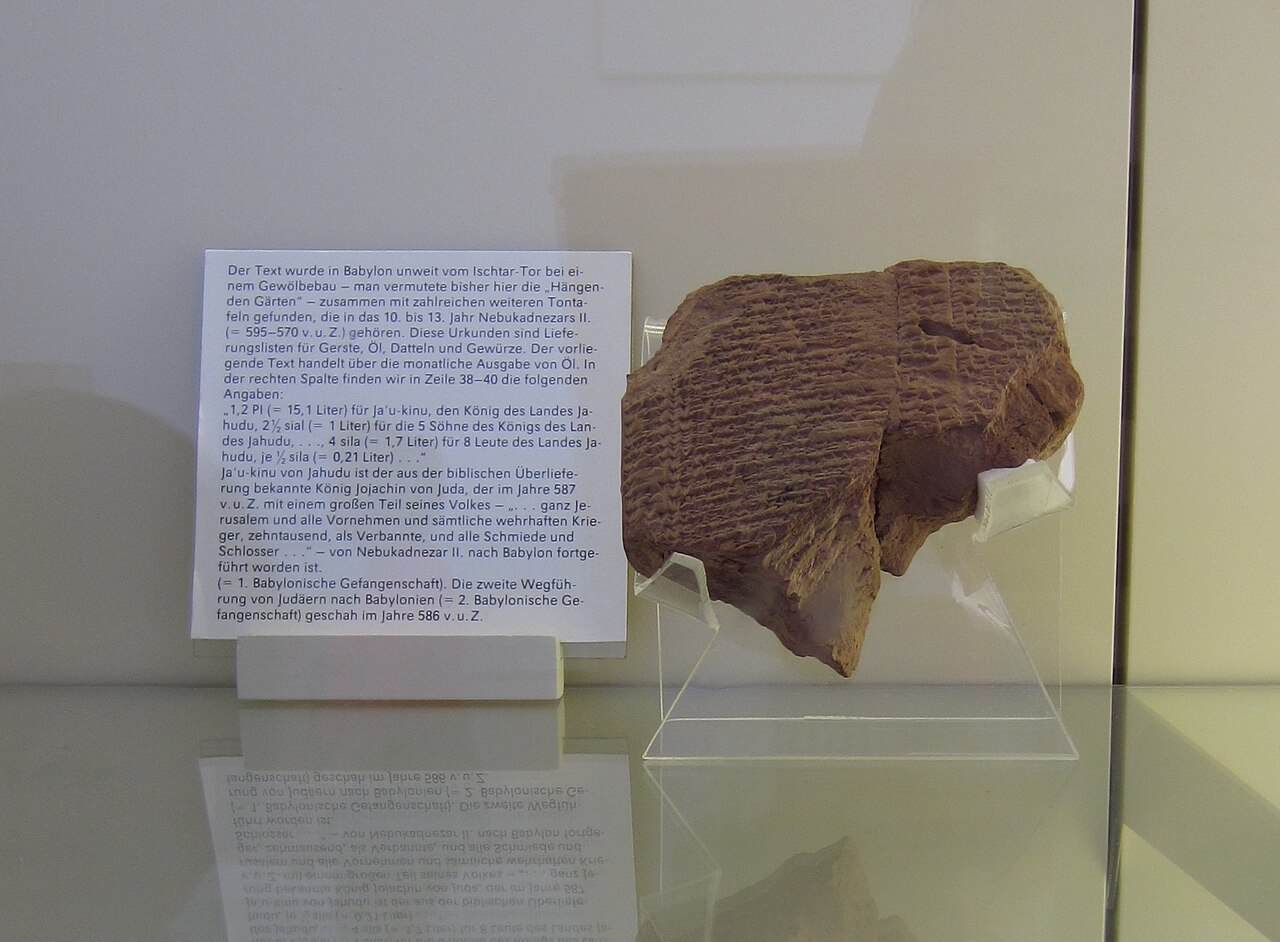
Chapter 39 ends the first half of Isaiah with an announcement of Babylonian exile, and chapter 40 begins after it: "her warfare is accomplished" (40:2). Treasures were carried to Babylon in 597 BC with King Jehoiachin (2 Kings 24:13), and ration tablets from Babylon (c. 592 BC) list oil for "Jehoiachin king of Judah" and his sons. Traditional readers see a prediction a century ahead; many scholars see the chapter shaped (or composed) with knowledge of the exile to introduce 40–66. Both see it as a deliberate bridge.
Hezekiah's reply
"Good is the word of the LORD… For there shall be peace and truth in my days" can be read as humble acceptance of God's word and gratitude for mercy, or as shortsighted relief that the disaster will not fall on him. 2 Chronicles 32:25–26, 31 says Hezekiah's heart was proud and God left him "to try him" in the matter of the Babylonian envoys, but that he humbled himself. The text leaves the tone open.
What the evidence shows
- Merodach-baladan ruled Babylon in 722–710 and briefly in 703 BC.
- Babylonian tablets record rations for Jehoiachin in Babylon. c. 592 BC; reported.
- The embassy of Isaiah 39 is attested outside the Bible.
- Isaiah predicted the Babylonian exile a century in advance. Traditional reading; many scholars date the chapter's shaping later.
Continue the journey
Journey of a PassageIsaiah 39:1–2: Merodach-baladan's envoys: "recovered" or "lived""At that time Merodach-baladan… king of Babylon, sent letters and a present to Hezekiah: for he had heard that he had been sick, and was recovered." The Masoretic Text and 1QIsa-b say "and had become strong"; the Great Isaiah Scroll says "and had lived" (compare 38:21 "and he will live").More from this lesson
Investigations
Optional deep dives: the ancient sources, the physical evidence, and every interpretation side by side, including unconventional ones, each labeled for what it is.
The Babylonian Chronicle and 597 BCCapture of 597 BC: documented · Date: 2 Adar (March 16) 597 BC
Does a Babylonian text record the capture of Jerusalem?
The Babylonian Chronicle for Nebuchadnezzar's early years (British Museum BM 21946) records that in his seventh year he besieged "the city of Judah," took it on the second of Adar, captured the king, appointed a king of his choice, and took heavy tribute to Babylon. This dates the event to 16 March 597 BC. The chronicle does not cover the destruction of 587/586 BC.
Open the full investigation →Why this matters to the rest of Scripture
- The parallel account.
- God left him to test him.
- 2 Kings 24:10–16; Daniel 1:1–7Treasures and royal sons taken to Babylon.
- Comfort after the sentence.