Investigation: From Babylon to Cyrus
Chronology, empire, a named king, and how to weigh a contested prophecy
Nebuchadnezzar II, who destroyed Jerusalem in 586 BC, died in 562. Within seven years three kings followed; in 556 Nabonidus took the throne. He favored the moon god Sin and spent about ten years at the oasis of Tema in Arabia, leaving his son Belshazzar in Babylon; the New Year festival lapsed. Meanwhile Cyrus of Anshan defeated the Medes (about 550) and Lydia (about 547).
In 539 Cyrus defeated the Babylonian army at Opis on the Tigris. According to the Nabonidus Chronicle, Sippar fell without battle; on 16 Tashritu (October 12) his general Ugbaru entered Babylon "without battle"; on 3 Arahsamnu (October 29) Cyrus himself entered, and "peace was established in the city." Herodotus (1.191) and Xenophon tell, a century and more later, of the Euphrates being diverted while the city feasted (compare Daniel 5).
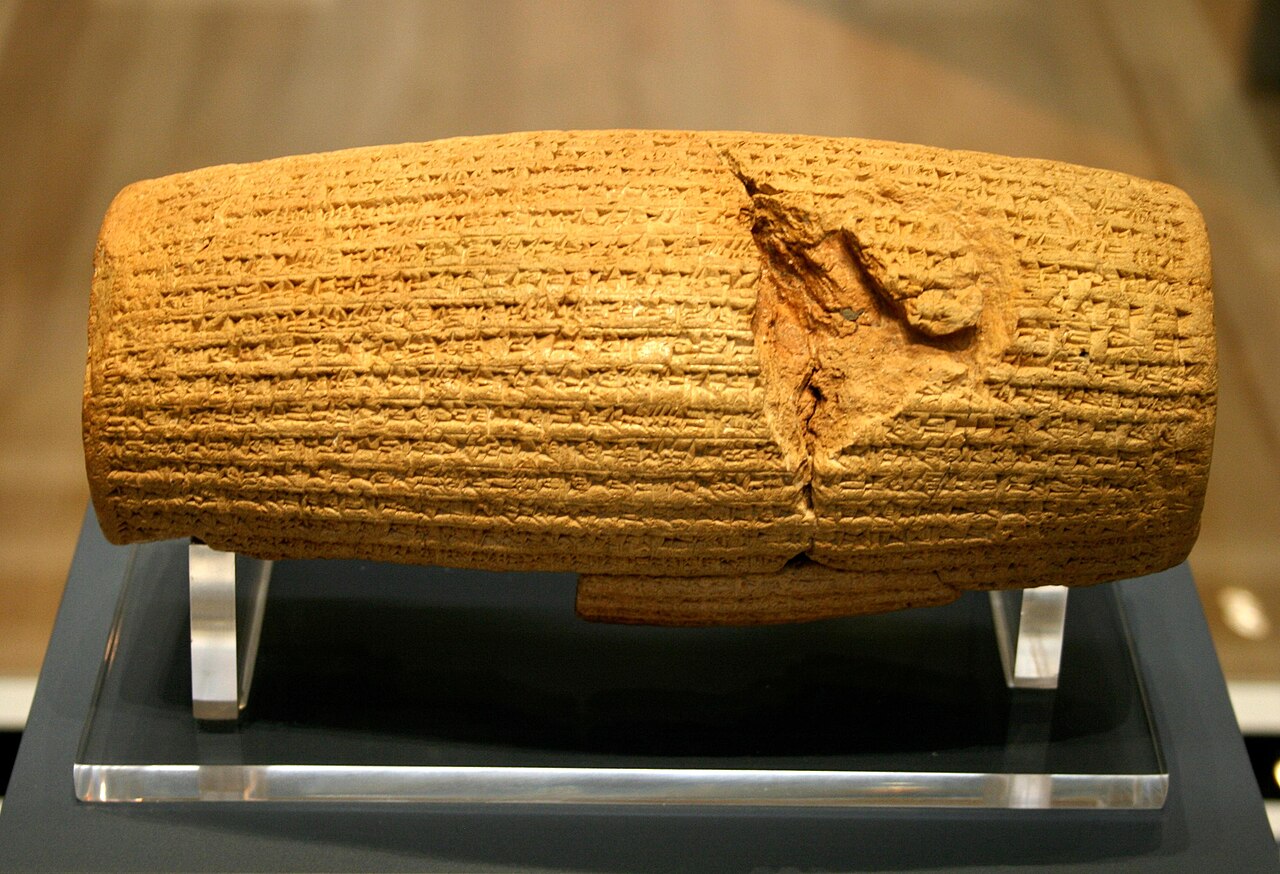
The Cyrus Cylinder, written for Babylon soon after, presents Nabonidus as impious and Cyrus as Marduk's chosen king who restored the gods of cities east of the Tigris to their sanctuaries and "gathered all their people and returned them to their settlements." Ezra 1:1–4 (in Hebrew) and 6:3–5 (an Aramaic memorandum) say Cyrus in his first year ordered the Jerusalem temple rebuilt.
| Year (BC) | Event | Source |
|---|---|---|
| 605 | Nebuchadnezzar defeats Egypt at Carchemish; becomes king | Babylonian Chronicle; Jeremiah 46:2 |
| 597 / 586 | Jerusalem taken; Jehoiachin exiled; temple destroyed | Babylonian Chronicle; 2 Kings 24–25 |
| 562 | Nebuchadnezzar dies; Jehoiachin released (Evil-merodach) | 2 Kings 25:27–30; Babylonian sources |
| 556 | Nabonidus king of Babylon | Babylonian sources |
| c. 552–543 | Nabonidus at Tema; Belshazzar regent in Babylon | Nabonidus Chronicle; Harran inscriptions |
| c. 550 | Cyrus defeats Astyages of Media | Nabonidus Chronicle; Herodotus |
| c. 547/546 | Cyrus conquers Lydia (Croesus) | Herodotus; Nabonidus Chronicle (damaged) |
| 539 | Battle of Opis; Sippar and Babylon taken without battle; Cyrus enters (October) | Nabonidus Chronicle; Cyrus Cylinder |
| 538 | Cyrus's "first year": decree for Jerusalem's temple | Ezra 1:1–4; 6:3–5; 2 Chronicles 36:22–23 |
| 520–515 | Temple rebuilt under Darius I | Ezra 5–6; Haggai; Zechariah |
| 445 | Jerusalem's walls rebuilt under Nehemiah | Nehemiah 1–6 |
| Isaiah says | Babylonian and other sources say | Assessment |
|---|---|---|
| A conqueror from the east/north subdues kings (41:2–3, 25) | Cyrus conquered Media, Lydia and Babylon | Fits Cyrus |
| God names Cyrus, holds his right hand, opens gates (45:1–2) | Marduk "called his name," "took him by the hand" (Cylinder); Babylon's gates opened without battle (Chronicle) | Close parallel of royal-election language; independent claims by two communities |
| Bel and Nebo bow and go into captivity (46:1–2) | Cyrus honored Marduk; other cities' gods returned home | Not fulfilled in that form in 539 |
| Babylon dethroned in one day, sorceries useless (47) | Taken without destruction; declined over centuries | Poetry of reversal; not a description of 539 |
| Cyrus will rebuild Jerusalem and the temple, free exiles without price (44:28; 45:13) | Ezra: decree for the temple; the Cylinder's general policy of returning gods and peoples | Temple authorized (completed 515); city walls later (445) |
| Go out from Babylon (48:20) | Some Judeans returned; many stayed (Al-Yahudu tablets) | A summons, partly answered |
Four ways to explain a named king
(1) Long-range prediction: Isaiah son of Amoz, in the 8th century, was given Cyrus's name about 150 years ahead (compare 1 Kings 13:2); held by traditional Jewish and Christian readers, by Josephus (who says Cyrus read the prophecy, Antiquities 11.5–7), and by scholars such as O. T. Allis, J. A. Motyer and J. N. Oswalt. (2) Composition in the 540s: a prophet among the exiles (often called Second Isaiah or Deutero-Isaiah) saw Cyrus's rise and announced Babylon's fall and the return as God's plan; the majority scholarly view. Its strongest arguments: the chapters treat Cyrus's early victories as known (41:2–3; 45:1), address an audience in Babylon, and predict things that did not happen in 539 (46:1–2; 47), which suggests they were written before the event, not after it. (3) Editorial insertion: some scholars think an anonymous oracle was later made explicit by adding Cyrus's name in 44:28 and 45:1 (R. G. Kratz and others propose layers). (4) Literary unity: readers who focus on the final book (B. S. Childs; C. R. Seitz) read 40–48 as part of a deliberately unified Isaiah, whatever its history.
Not equal kinds of support
The four explanations are presented together, but they are not the same kind of claim and do not have the same kind of support. Model 2 (composition in the 540s) rests on observations anyone can check in the text and the sources: the chapters address an audience in Babylon, treat Cyrus's first victories as known, and predict details of Babylon's fall that did not occur in 539. That is why it is the majority view among historians. Model 1 (long-range prediction) is a theological claim: it is consistent with the manuscripts and is held by many careful scholars, but it depends on a commitment about prophecy that historical evidence can neither confirm nor refute. Model 3 (a later insertion of Cyrus's name) is a historical hypothesis with little direct support: no manuscript or translation lacks the name. Model 4 (literary unity) is a way of reading the final book, compatible with either 1 or 2, not a rival account of when the words were written. The site respects the traditional reading as faith and does not present it as a historical finding, nor the majority view as a disproof of faith.
What each kind of evidence can show
Babylonian chronicles and inscriptions establish the sequence of events and the empire's own propaganda. Literary analysis can show what audience and situation a text assumes. Manuscripts show that the whole 66-chapter book, including the Cyrus texts, existed by the 2nd century BC (the Great Isaiah Scroll; Cyrus's name is present in 44:28 and 45:1 there and in 1QIsa-b). None of these can prove or disprove that God revealed the future. The site states the evidence and leaves that judgment to faith and reason.
Limits of the Cyrus Cylinder
The Cylinder is a Babylonian building inscription written to legitimize Cyrus in Babylon, in Marduk's name. It does not mention Judah, Jerusalem or the Judeans, and its list of returned gods covers cities east and north of Babylon. It shows a policy of restoring local cults that makes Ezra's report plausible; it is not a copy of the Jerusalem decree. The modern description of it as "the first charter of human rights" (popularized in 1971) reads modern ideas into an ancient royal text. See the Echo "Kings who restored temples."
What the evidence shows
- Cyrus entered Babylon in October 539 BC; the Nabonidus Chronicle says the city was taken without battle. Reported translation.
- The Cyrus Cylinder mentions the Judeans or Jerusalem. It does not.
- Isaiah 40–48 was composed in the 540s BC. Majority scholarly view.
- The 8th-century prophet Isaiah foretold Cyrus by name. Traditional reading; not testable historically.
- Cyrus's name in 44:28 and 45:1 is a later addition. A minority proposal; the name is in all ancient witnesses.
- The Cyrus Cylinder is the first human rights charter. A modern characterization.
Continue the journey
Journey of a PassageIsaiah 44:28–45:1: "Cyrus, my shepherd… his anointed""That saith of Cyrus, He is my shepherd, and shall perform all my pleasure… Thus saith the Lord to his anointed, to Cyrus, whose right hand I have holden." Cyrus's name stands in the Masoretic Text, the Great Isaiah Scroll, 1QIsa-b and the Cave 4 copies.More from this lesson
Echoes Across Civilizations
Optional: how other ancient peoples told similar stories. Open one to compare, then come back to the lesson.
Kings who restored templesBabylonian (Persian king) · Egyptian · Egyptian (Persian rule) · Lycian / Persian
Did other rulers of the Persian empire restore local temples and peoples, as Cyrus and Darius do in Ezra?
- Babylonian (Persian king): The Cyrus Cylinder Possible historical contact
- Egyptian: Statue of Udjahorresnet Possible historical contact
- Egyptian (Persian rule): Darius' collection of Egyptian law (Demotic Chronicle, verso) Possible historical contact
- Lycian / Persian: Letoon trilingual inscription (Xanthos) Resemblance only
Making and animating godsBabylonian and Assyrian · Egyptian · Babylonian · Assyrian
How were cult statues made and brought to life in the ancient Near East, and how do the prophets' satires of idol-making compare?
- Babylonian and Assyrian: Mouth-washing and mouth-opening ritual (mis pi / pit pi) Possible historical contact
- Egyptian: Opening of the Mouth ritual Resemblance only
- Babylonian: The New Year (akitu) festival and the journeys of Marduk and Nabu Possible historical contact
- Assyrian: Esarhaddon's renewal of the gods of Babylon Possible historical contact
Why this matters to the rest of Scripture
- Ezra 1:1–4; 6:3–5Cyrus's decree in Hebrew and Aramaic.
- Belshazzar's feast and the fall of Babylon.
- Jeremiah 25:11–12; 29:10Seventy years.
- The end of the Hebrew Bible's last book.