Isaiah 22: The Key of the House of David
A city partying on the brink, water works without God, and two royal stewards
"The burden of the valley of vision. What aileth thee now, that thou art wholly gone up to the housetops? Thou that art full of stirs, a tumultuous city, a joyous city… All thy rulers are fled together, they are bound by the archers… Therefore said I, Look away from me; I will weep bitterly" (22:1–4).
"Ye have seen also the breaches of the city of David, that they are many: and ye gathered together the waters of the lower pool. And ye have numbered the houses of Jerusalem, and the houses have ye broken down to fortify the wall. Ye made also a ditch between the two walls for the water of the old pool: but ye have not looked unto the maker thereof" (vv. 9–11).
"And in that day did the Lord God of hosts call to weeping, and to mourning… And behold joy and gladness, slaying oxen, and killing sheep, eating flesh, and drinking wine: let us eat and drink; for to morrow we shall die" (vv. 12–13).
"Go, get thee unto this treasurer, even unto Shebna, which is over the house, and say, What hast thou here… that thou hast hewed thee out a sepulchre here… And I will call my servant Eliakim the son of Hilkiah… And the key of the house of David will I lay upon his shoulder; so he shall open, and none shall shut; and he shall shut, and none shall open. And I will fasten him as a nail in a sure place… In that day… shall the nail that is fastened in the sure place be removed" (vv. 15–25).
| Verses | What it says | What to notice |
|---|---|---|
| 22:1–4 | The valley of vision: rooftop celebration; rulers fled and captured; Isaiah weeps | "Valley of vision": Jerusalem, surrounded by valleys, the place of Isaiah's visions. |
| 22:5–7 | A day of tumult; Elam's quiver and Kir's shield; chariots fill the valleys | Elamite archers served in Assyrian armies; Kir: the Arameans' homeland (Amos 9:7). |
| 22:8–11 | The armory (House of the Forest), the breaches, the lower pool, houses torn down for the wall, a reservoir between two walls: but not looking to the Maker | Matches Hezekiah's preparations (2 Chronicles 32:2–5, 30). |
| 22:12–14 | God called for mourning; they feasted: let us eat and drink, for tomorrow we die; this sin will not be atoned | Quoted in 1 Corinthians 15:32. |
| 22:15–19 | Shebna, steward over the house, cutting a tomb on high; tossed like a ball into a wide land | Asher al ha-bayit: the palace administrator. |
| 22:20–24 | Eliakim: robe, sash, authority, father to Jerusalem; the key of David's house on his shoulder; a peg in a sure place | Keys of office were large and carried on the shoulder. |
| 22:25 | The peg will give way and its load fall | Eliakim's dependents hang too heavily on him. |
Hezekiah's Jerusalem
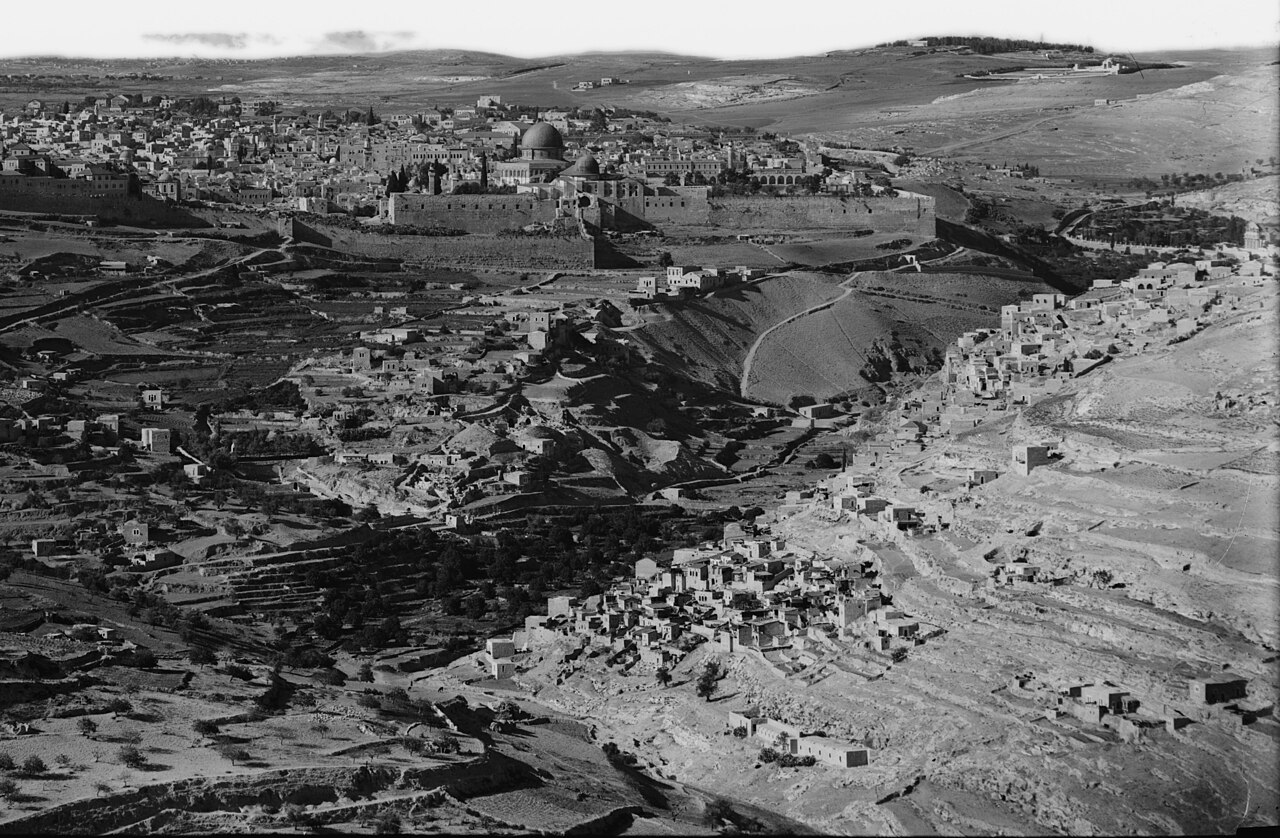
Verses 9–11 describe the measures Hezekiah took before 701 BC (2 Kings 20:20; 2 Chronicles 32:2–5, 30). In the Jewish Quarter, N. Avigad excavated in the 1970s a city wall about 7 meters thick (the "Broad Wall") built across the remains of houses that were demolished to make room for it, dated to the late 8th century: a striking match to "the houses have ye broken down to fortify the wall." The Siloam tunnel carried the Gihon spring's water to a pool inside the city. Which pool is "the lower pool" or "the old pool" is debated; the site does not tie every water installation in the City of David to this verse.
Shebna's tomb
In the village of Silwan, facing the City of David across the Kidron, are rock-cut Iron Age tombs. Over the door of one, an inscription (found by C. Clermont-Ganneau in 1870, read by N. Avigad in 1953, now in the British Museum) reads: "This is [the tomb of …]yahu, who is over the house. There is no silver or gold here, only [his bones] and the bones of his slave-wife with him. Cursed be the man who opens this." The name is broken. Some scholars propose Shebanyahu, the long form of Shebna; that is possible, not proven.
Which crisis?
The rooftop celebration may be the relief when Sennacherib withdrew in 701 BC, which Isaiah regarded as a reprieve wasted. The fleeing, captured rulers (v. 3) recall 586 BC, when Zedekiah fled and was caught (2 Kings 25:4–7). Many think an oracle from 701 was later read in the light of 586.
Shebna and Eliakim in Isaiah 36
In 36:3 (and 2 Kings 18:18) Eliakim son of Hilkiah is "over the household" and Shebna is "the scribe": the transfer of office announced in 22:20–22 appears to have happened, with Shebna demoted rather than exiled. Whether Shebna was later deported, as v. 18 says, is not recorded.
The key of David
Revelation 3:7 applies 22:22 to the risen Christ, in a message to the church at Philadelphia: "he that hath the key of David, he that openeth, and no man shutteth; and shutteth, and no man openeth." In Matthew 16:19 Jesus gives Peter "the keys of the kingdom of heaven" (Matthew's report); many see an allusion to the steward's key of Isaiah 22, but Matthew does not cite it. The library's Greek adds "the glory of David" to 22:22.
Two oracles from Hezekiah's reign: a rebuke of Jerusalem's self-reliance and revelry around a military crisis (probably 701 BC), and a personnel oracle replacing the steward Shebna with Eliakim; v. 25 adds a sober coda about Eliakim's house.
The Targum and rabbinic tradition expand Shebna into a traitor who plotted to surrender Jerusalem to Sennacherib (b. Sanhedrin 26a; reported).
Revelation 3:7 gives the key of David to Christ. 1 Corinthians 15:32 quotes 22:13 ("let us eat and drink; for to morrow we die") as the logic of those who deny the resurrection.
Later Christian interpreters read Eliakim as a type of Christ (because of the key) and, in Catholic tradition, the steward's office as background to Peter's keys. Both are later interpretations built on the New Testament's reuse.
What the evidence shows
- Excavations found a late-8th-century wall in Jerusalem built over demolished houses. Avigad's Broad Wall; reported.
- The Silwan tomb inscription belonged to Shebna. The name is broken; Shebanyahu is a proposal.
- 1 Corinthians 15:32 quotes Isaiah 22:13.
- Revelation 3:7 applies Isaiah 22:22 to Christ.
- In 36:3 Eliakim is over the household and Shebna is scribe.
Continue the journey
Journey of a PassageIsaiah 22:20–25: Eliakim and the key of the house of David"And the key of the house of David will I lay upon his shoulder; so he shall open, and none shall shut; and he shall shut, and none shall open." Eliakim replaces Shebna as steward over the palace.More from this lesson
Investigations
Optional deep dives: the ancient sources, the physical evidence, and every interpretation side by side, including unconventional ones, each labeled for what it is.
The Siloam Tunnel and InscriptionTunnel and inscription: documented · Builder: Hezekiah (strongly supported, inferred)
Did Hezekiah cut the tunnel, and what does the inscription say?
A winding tunnel 533 m long carries the Gihon spring's water to the Siloam pool. An inscription found inside in 1880 describes the moment two teams of diggers met. It names no king; its script and the biblical texts make Hezekiah the most likely builder, but some studies have proposed other dates.
Open the full investigation →Why this matters to the rest of Scripture
- Hezekiah's walls and water works.
- Isaiah 36:3, 22; 37:2Eliakim and Shebna in 701.
- Revelation 3:7; Matthew 16:19The key of David; the keys of the kingdom.
- "Let us eat and drink."