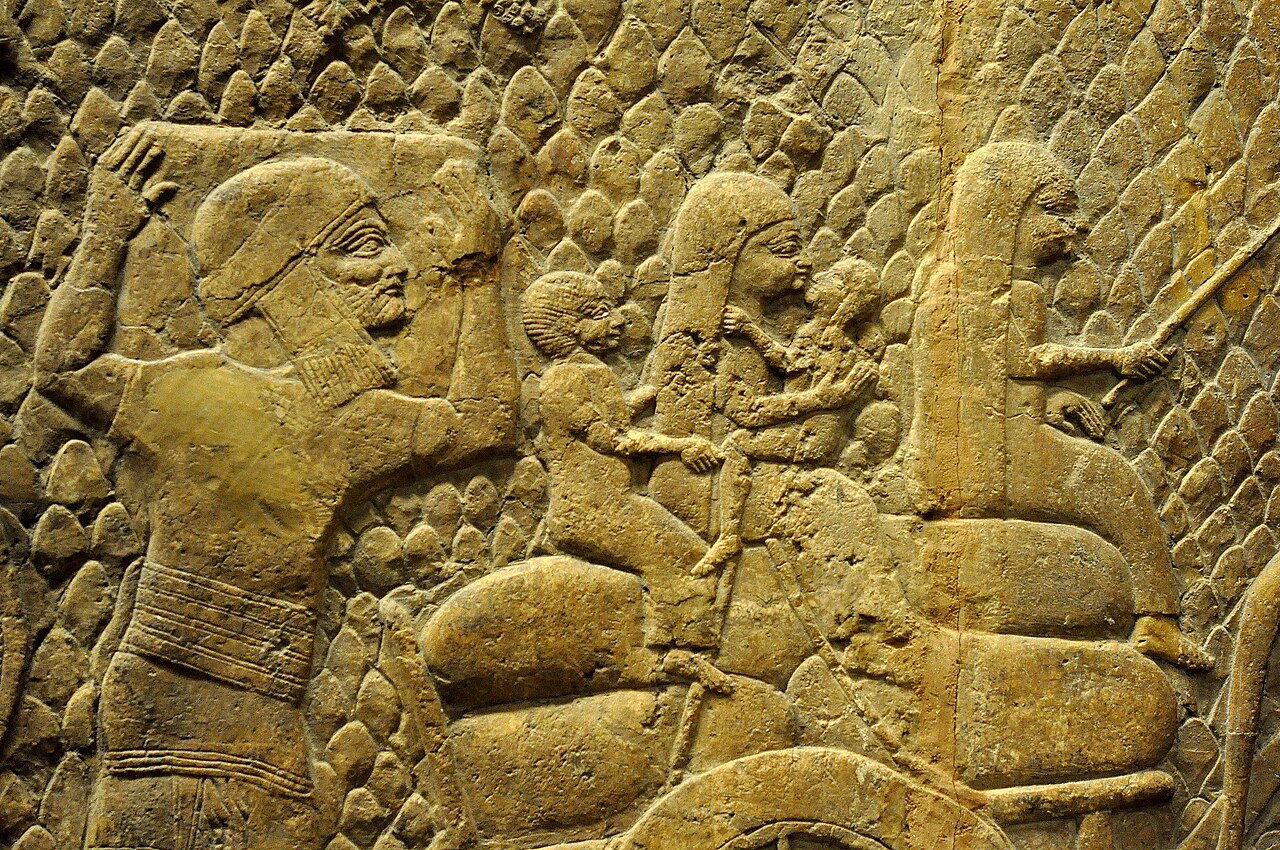
Isaiah's career coincides with Assyria's greatest expansion. Tiglath-pileser III (745–727 BC) turned raids into conquest; Shalmaneser V and Sargon II ended the kingdom of Israel (722–720); Sennacherib (705–681) crushed Hezekiah's revolt in 701. Isaiah calls Assyria "the rod of mine anger" (10:5) and then condemns its pride (10:12–15).
Many of the people Isaiah names appear in Assyrian texts. Tiglath-pileser records tribute from Rezin (Raqianu) of Damascus and from "Jehoahaz (Ahaz) of Judah"; he says the Israelites overthrew their king Pekah and he set Hoshea in his place. Sargon II is known in the Bible only from Isaiah 20:1; his palace at Khorsabad was the first Assyrian palace excavated (from 1843).
Sennacherib's annals, written on clay prisms, describe the 701 campaign: forty-six walled towns of Hezekiah taken, people deported, Hezekiah shut up in Jerusalem "like a bird in a cage," and heavy tribute sent to Nineveh. His palace reliefs show the siege and capture of Lachish. They do not claim that Jerusalem fell.
| Claim in Isaiah or Kings | Independent evidence | Strength | Limits |
|---|---|---|---|
| Rezin of Damascus and Pekah of Israel attack Ahaz (Isa 7:1; 2 Kgs 16:5) | Tiglath-pileser III's annals and summary inscriptions name Rezin and Pekah | Names and period documented | The Syro-Ephraimite war itself is described only in the Bible |
| Ahaz turns to Assyria (2 Kgs 16:7–9) | "Jehoahaz of Judah" in a list of tributaries of Tiglath-pileser (Nimrud tablet, c. 734–733) | Strong | Says tribute, not request; Isaiah 7 opposes the appeal |
| Damascus falls; Galilee annexed (Isa 8:4; 9:1; 2 Kgs 15:29; 16:9) | Annals for 733–732 BC; provinces formed | Strong | Fragmentary texts; numbers vary |
| Samaria falls (2 Kgs 17:6; implied Isa 28:1–4) | Babylonian Chronicle (Shalmaneser V); Sargon II's claim for 720 | Strong | Two kings claim it |
| Sargon's commander takes Ashdod (Isa 20:1) | Sargon's annals and display texts: Ashdod's revolt crushed, 712/711 | Strong | Isaiah's three-year sign is the Bible's alone |
| Hezekiah prepares Jerusalem's water (2 Kgs 20:20; 2 Chr 32:30; Isa 22:9–11) | Siloam tunnel and its inscription; Broad Wall | Strong for a tunnel and wall | The inscription names no king |
| Sennacherib takes Judah's fortified cities (Isa 36:1) | Prism annals: 46 cities; Lachish reliefs; Lachish Level III destruction | Very strong | Assyrian numbers are boasts |
| Hezekiah pays tribute (2 Kgs 18:14–16; not in Isaiah) | Annals: 30 talents of gold, 800 of silver | Strong (Kings has 300 silver) | Kings places the payment before the siege threat; the annals after |
| Jerusalem not taken; Sennacherib returns home (Isa 37:36–37) | Annals claim no capture; Hezekiah "shut up" in his city | Strong that Jerusalem did not fall | No independent source for the 185,000 |
| Sennacherib killed by his sons (Isa 37:38) | Babylonian Chronicle; Esarhaddon's inscriptions (681 BC) | Strong | Twenty years after 701; the Bible's narrative joins the events |
| Merodach-baladan's envoys (Isa 39) | Marduk-apla-iddina II, king of Babylon 722–710 and 703 | Name and anti-Assyrian policy documented | The embassy itself is the Bible's alone |
The prisms
Sennacherib's annals survive on several clay prisms, each written years after 701 and each updated with later campaigns: the Taylor Prism (British Museum, dated 691 BC), the Oriental Institute Prism in Chicago (689 BC), and the Jerusalem Prism in the Israel Museum. Dates of manufacture are not the date of the campaign; the site keeps the two apart (IS-C06 open for exact museum details).
Why did Sennacherib withdraw?
Isaiah 37:36 says "the angel of the LORD went forth, and smote in the camp of the Assyrians a hundred and fourscore and five thousand." Herodotus (2.141), writing in the 5th century BC from Egyptian informants, tells that field mice gnawed the bowstrings and shield straps of Sennacherib's army near Pelusium, so that it fled. Some scholars connect the two as memories of a disaster, perhaps disease; others see legend in both. The annals report a successful campaign ending with Hezekiah's tribute. Historical method can say that Jerusalem was not taken; it cannot confirm or exclude the angel.
Tirhakah
Isaiah 37:9 says Sennacherib heard that "Tirhakah king of Ethiopia" was coming against him. Taharqa became pharaoh of the Kushite 25th Dynasty in 690 BC. In 701 he may have led the army as a young prince, called king in the narrative because of what he later became; or the narrative may have combined events; some have proposed a second, later campaign by Sennacherib, of which there is no Assyrian record. The difficulty is real and the site leaves it open.
Lachish
The reliefs from Room XXXVI of Sennacherib's Southwest Palace at Nineveh (British Museum) show the siege ramp, battering rams, defenders on the walls, deportees leaving the city and Sennacherib enthroned receiving them. Excavations at Tel Lachish found the Assyrian siege ramp, a counter-ramp, hundreds of arrowheads and the destruction of Level III. The reliefs show Lachish, not Jerusalem. (D. Ussishkin.)
What the evidence shows
- Tiglath-pileser III's inscriptions name Rezin, Pekah and Ahaz (Jehoahaz). Reported; IS-C06.Source: H. Wildberger, Isaiah 1–12; 13–27; 28–39 (Continental Commentary, English 1991–2002)
- Isaiah 20:1 is the only biblical mention of Sargon II.
- Sennacherib's annals claim 46 of Hezekiah's walled towns.Source: Israel Museum, "The Assyrian Campaign in Judah as Told in the Sennacherib Prism" (2025–26) ↗
- Sennacherib captured Jerusalem. Neither the Bible nor the annals claims it.
- 185,000 Assyrians died outside Jerusalem. No independent source; Herodotus tells a different story.
- The Lachish reliefs depict the siege of Lachish in 701 BC.Source: D. Ussishkin, The Conquest of Lachish by Sennacherib (1982) and open-access studies of the Lachish reliefs
Continue the journey
Journey of a PassageIsaiah 8:1–4: Maher-shalal-hash-baz: a name written before witnessesIsaiah writes "Maher-shalal-hash-baz" ("swift is the spoil, speedy the plunder") on a large tablet before two witnesses, then names his newborn son with it: before the child can say "my father, my mother," Assyria will plunder Damascus and Samaria.More from this lesson
Investigations
Optional deep dives: the ancient sources, the physical evidence, and every interpretation side by side, including unconventional ones, each labeled for what it is.
Tiglath-pileser III, Sargon II and the Fall of SamariaKings named: documented · Fall of Samaria: documented · One fall or two: debated
How do Assyrian records describe Israel's last decades?
Tiglath-pileser III names Menahem of Samaria and Jehoahaz (Ahaz) of Judah as tributaries, says Israel's people overthrew Pekah, and claims he made Hoshea king. Sargon II claims to have conquered Samaria and deported 27,290 people. The Babylonian Chronicle says Shalmaneser V ravaged Samaria. Together they confirm the biblical sequence while raising questions about who took Samaria and when.
Open the full investigation →Why this matters to the rest of Scripture
- The parallel narrative.
- The Chronicler's version, with the water works.
- Micah's lament over the towns of the Shephelah, including Lachish.
- The fall of Nineveh, 612 BC.