Investigation: The Great Isaiah Scroll
How to read a two-thousand-year-old copy of a biblical book
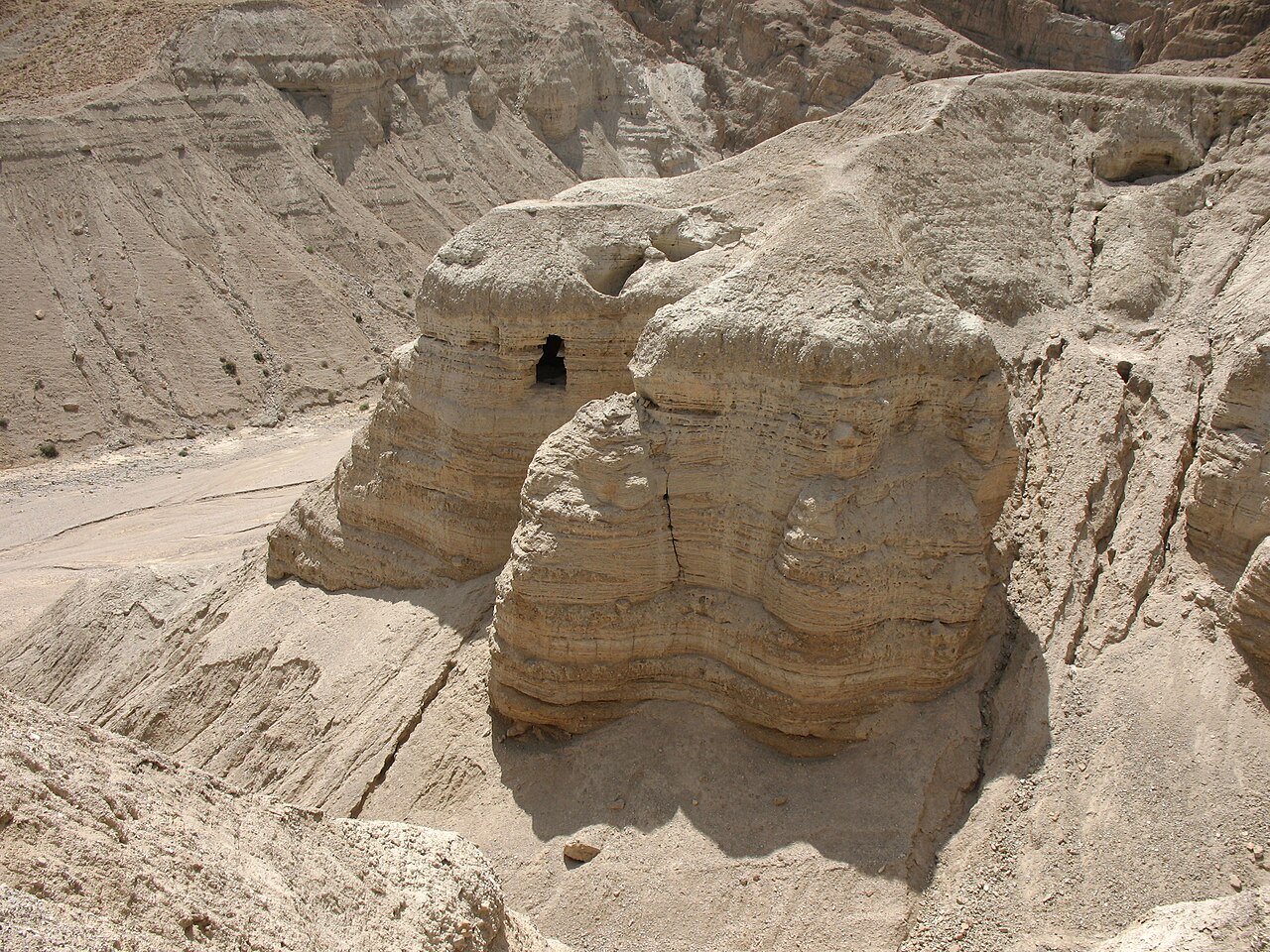
In 1947 Bedouin shepherds found jars in a cave above Wadi Qumran, near the northwest shore of the Dead Sea. Among seven scrolls from what became Cave 1 was a complete copy of Isaiah: seventeen sheets of leather sewn into one roll about 7.3 meters long, written in 54 columns. It was bought by the Syrian Orthodox Metropolitan of Jerusalem, Athanasius Samuel, studied at the American Schools of Oriental Research, and published in photographs by Millar Burrows in 1950.
In 1954 the Metropolitan advertised "The Four Dead Sea Scrolls" for sale in the Wall Street Journal; Yigael Yadin bought them for the State of Israel. The scroll is now in the Israel Museum's Shrine of the Book. A second Isaiah manuscript from Cave 1, 1QIsa-b (1Q8), had been bought in 1947 by Eleazar Sukenik; it is fragmentary and very close to the Masoretic Text.
Its handwriting dates 1QIsa-a to about 125 BC (other palaeographic estimates range from 150 to 100 BC; radiocarbon tests in the 1990s gave a broadly similar window). The oldest complete Hebrew manuscripts of Isaiah otherwise are the Aleppo Codex (c. AD 930) and the Leningrad Codex (AD 1008).
The scroll is a working copy, not a museum piece: words written above the line, letters erased, a later hand inserting what the first scribe skipped. In 40:7–8, for example, the first scribe's eye seems to have jumped from one "the grass withers, the flower fades" to the next; the missing words were added between the lines and down the margin. Readings of the Great Isaiah Scroll (1QIsa-a) and the other Qumran copies are described here in the site's own words, from Martin Abegg's published transcription (ETCBC/CACCHT Dead Sea Scrolls dataset). The transcription's text is not reproduced; single words are cited as facts about the manuscript. Checking every reading against the photographs and the critical edition (DJD XXXII) is still open, and an older copy is not assumed to have the better reading: each reading is weighed on its own.
How collation works
Comparing two English Bibles compares translators' choices. Comparing 1QIsa-a with the Masoretic Text compares two copies in the same language, letter by letter. Most differences are of kinds that do not change the meaning: fuller spelling (kol and ki written with extra vowel letters, the ending -kem written -kemah), grammar typical of the Hebrew of the period, and simple scribal slips. A smaller set are real variants: different words, a word added or missing, a different verb form. Only some of those change the sense.
| Passage | 1QIsa-a (described from a transcription) | Masoretic Text | Kind of difference | Does the meaning change? |
|---|---|---|---|---|
| 1:18 | Same words; fuller spelling of yo'mar, a non-final mem at word end, an erased letter | The same words in standard spelling | Spelling and letter-form | No |
| 2:3 | Lacks "to the mountain of the LORD" | "to the mountain of the LORD, to the house of the God of Jacob" | Minus (probably a skip) | Slightly |
| 2:9b–10 | Absent: the verse ends "and man is brought low" | "…forgive them not. Enter into the rock…" | Missing text (accidental skip or shorter text?) | Yes, a sentence and a verse missing |
| 4:2 | "for the survivors of Israel and Judah" | "for the survivors of Israel" | Plus (one word) | Slightly |
| 6:3 | "Holy, holy, YHWH of hosts" | "Holy, holy, holy is YHWH of hosts" | Minus (repeated word) | Liturgically striking; most explain it as a slip |
| 7:14 | "YHWH himself"; ve-qara ("he/one will call") | "the Lord (Adonai) himself"; ve-qarat ("she/you will call") | Divine name; verb form | The second, slightly |
| 9:5 (Eng. 9:6) | "Prince of the Peace" (sar ha-shalom) | "Prince of Peace" | Article | No |
| 8:3 | ha-navi, "the prophet" | ha-nevi'ah, "the prophetess" | Variant (one letter) | Possibly |
| 11:6 | yimru, "will graze" | u-meri, "and the fatling" | Variant (agrees with the Greek) | Yes |
| 19:18 | ir ha-cheres, "City of the Sun" | ir ha-heres, "City of Destruction" | One-letter variant | Yes (see chapter 19) |
| 40:6 | ve-omrah, "and I said" | ve-amar, "and he (one) said" | Variant (agrees with the Greek) | Yes: the prophet speaks |
| 53:11 | yir'eh or, "he shall see light" (also 1QIsa-b) | yir'eh, "he shall see" | Plus (agrees with the Greek) | Yes (see chapter 53) |
The other copies
Isaiah is one of the most copied books at Qumran: twenty-one manuscripts, 1QIsa-a and 1QIsa-b from Cave 1, eighteen fragmentary copies from Cave 4 (4Q55–4Q69b) and one from Cave 5 (5Q3), with another copy from Wadi Murabba'at (Mur 3) farther south. Five or six commentaries on Isaiah (pesharim, 3Q4 and 4Q161–165) apply its words to the community's own time; they quote Isaiah but are not copies of it. Most of the Cave 4 copies, like 1QIsa-b, are close to the later Masoretic Text.
A popular reading of the scroll
E. Y. Kutscher's study (1959, English 1974) showed that 1QIsa-a reflects the spoken Hebrew and Aramaic of its time: the scribe modernized spelling and some grammar as he copied. That is why it differs so often from the more conservative Masoretic Text, and why many of its differences are not evidence for an older text. Where 1QIsa-a agrees with the Greek translation (the Septuagint) against the Masoretic Text (40:6; 53:11; 11:6), scholars take it more seriously as a witness to an older reading.
"Identical to our Bible" and "full of changes"
Two popular claims misrepresent the scroll. "The Isaiah Scroll is word for word identical to the Masoretic Text" is true of 1QIsa-b more than of 1QIsa-a. "The scroll proves the Bible was changed" ignores that the great majority of its differences are spelling and grammar, and that the real variants are known, few and studied. The accurate summary: the words of Isaiah in the medieval text are substantially those of the scroll, with a set of documented differences, some of which matter.
What the site has checked
The site reads 1QIsa-a, 1QIsa-b and the Cave 4 copies in Martin Abegg's transcription, published in the ETCBC/CACCHT Dead Sea Scrolls dataset (version 2.0.5) under a Creative Commons Attribution-NonCommercial licence. Because the site's long-term status has not been settled, the site does not reproduce that transcription's text: it describes each reading in its own words, citing single words as facts about the manuscript. Nothing here has yet been checked against the photographs (Israel Museum / Leon Levy Digital Library) or the critical edition (E. Ulrich and P. W. Flint, DJD XXXII, 2010), so every scroll reading is labeled as described from a published transcription. An older manuscript does not automatically have the better reading; each difference is weighed on its own. In the transcription, 1,290 of the 1,291 verses of the Hebrew book have some surviving text in 1QIsa-a; the one without any is 2:10.
What the evidence shows
- 1QIsa-a contains all 66 chapters of Isaiah.Source: 1QIsa-a and 1QIsa-b: M. Abegg's transcription, ETCBC/CACCHT Dead Sea Scrolls dataset v2.0.5 (CC BY-NC 4.0), read by the site's script; images: Israel Museum / Leon Levy Digital Library; edition: DJD XXXII (2010)
- 1QIsa-a dates to about 125 BC. Palaeography; radiocarbon broadly agrees. Reported.
- 1QIsa-a lacks Isaiah 2:9b–10. In the transcription; photograph check open.
- 1QIsa-a reads "light" in 53:11, with 1QIsa-b and the Greek. Transcription; Greek via the library's French (Giguet).
- The Isaiah Scroll is identical to the Masoretic Text. Close in wording; thousands of small differences and some real variants.
- Most differences between 1QIsa-a and the Masoretic Text are spelling and grammar. Kutscher; Ulrich and Flint.
Continue the journey
Journey of a PassageIsaiah 6:1–8: The throne vision: seraphim, "Holy, holy, holy," and the coalIsaiah sees the Lord enthroned and seraphim calling "Holy, holy, holy." The Great Isaiah Scroll differs in v.More from this lesson
Why this matters to the rest of Scripture
- A later hand restores skipped words.
- The scroll's readings in the Servant passage.
- The Habakkuk Pesher from the same cave: commentary, not copy.