Isaiah 8: Speed the Spoil, Hasten the Plunder
A named child, the gentle waters of Shiloah, the flood of Assyria, a stone of stumbling, and a sealed testimony
"Moreover the LORD said unto me, Take thee a great roll, and write in it with a man's pen concerning Mahershalalhashbaz. And I took unto me faithful witnesses to record, Uriah the priest, and Zechariah the son of Jeberechiah" (8:1–2). "And I went unto the prophetess; and she conceived, and bare a son. Then said the LORD to me, Call his name Mahershalalhashbaz. For before the child shall have knowledge to cry, My father, and my mother, the riches of Damascus and the spoil of Samaria shall be taken away before the king of Assyria" (vv. 3–4).
"Forasmuch as this people refuseth the waters of Shiloah that go softly… Now therefore, behold, the Lord bringeth up upon them the waters of the river, strong and many, even the king of Assyria… And he shall pass through Judah; he shall overflow and go over, he shall reach even to the neck; and the stretching out of his wings shall fill the breadth of thy land, O Immanuel" (vv. 6–8).
"Associate yourselves, O ye people, and ye shall be broken in pieces… Take counsel together, and it shall come to nought; speak the word, and it shall not stand: for God is with us (immanu el)" (vv. 9–10). "Say ye not, A confederacy… neither fear ye their fear… Sanctify the LORD of hosts himself; and let him be your fear… And he shall be for a sanctuary; but for a stone of stumbling and for a rock of offence to both the houses of Israel" (vv. 12–14).
"Bind up the testimony, seal the law among my disciples. And I will wait upon the LORD, that hideth his face from the house of Jacob, and I will look for him. Behold, I and the children whom the LORD hath given me are for signs and for wonders in Israel" (vv. 16–18). "And when they shall say unto you, Seek unto them that have familiar spirits… should not a people seek unto their God?… To the law and to the testimony: if they speak not according to this word, it is because there is no light in them" (vv. 19–20).
| Verses | What it says | What to notice |
|---|---|---|
| 8:1–2 | Write "Maher-shalal-hash-baz" on a large tablet before reliable witnesses, Uriah the priest and Zechariah | Uriah the priest appears in 2 Kings 16:10–16 under Ahaz. |
| 8:3–4 | The prophetess bears a son so named; before he can say "Abba, Imma," Damascus and Samaria are plundered | Fulfilled in 732 (Damascus) and the invasions of 733–732 (Israel). |
| 8:5–8 | The people reject the gentle waters of Shiloah; Assyria's River floods to the neck: "O Immanuel" | Shiloah: Jerusalem's gentle stream, later the Siloam pool. |
| 8:9–10 | Nations, plot and be shattered: for God is with us | Immanu el as a battle cry of confidence. |
| 8:11–15 | Do not call conspiracy what this people calls conspiracy; fear the LORD; a sanctuary, a stone of stumbling, a trap | Quoted in 1 Peter 2:8 and Romans 9:33 (with 28:16). |
| 8:16–18 | Bind the testimony, seal the teaching among my disciples; I and my children are signs | Hebrews 2:13 quotes v. 17–18 (Greek). |
| 8:19–20 | Do not consult mediums and the dead: to the teaching and the testimony | Necromancy forbidden (Deuteronomy 18:10–11). |
| 8:21–22 | Hungry wanderers curse king and God; distress and darkness | Leads into 9:1. |
Writing on a tablet
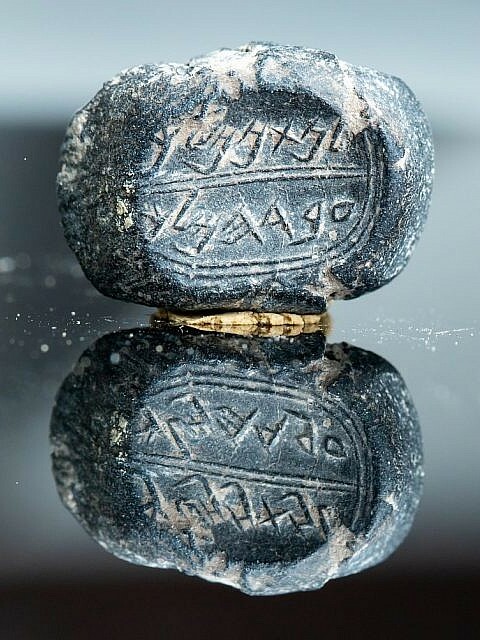
Gillayon (8:1) is probably a tablet or sheet, and cheret enosh "a man's stylus" may mean ordinary script anyone could read. Seal impressions (bullae) and inscribed ostraca from Iron Age Judah show that names, ownership and short messages were commonly written. The scene, with official witnesses, resembles a legal deed. Isaiah 30:8 again commands him to write "in a table… and note it in a book, that it may be for the time to come."
The waters of Shiloah
Shiloah ("sent") was a channel leading water gently from the Gihon spring along the Kidron valley, before Hezekiah's tunnel (late 8th century) brought the water inside the city to the Siloam pool. The contrast between the quiet stream and the great River (the Euphrates, standing for Assyria) is the contrast between trusting God and trusting empire. John 9:7 later explains Siloam as "Sent."
8:14 in the Greek and the New Testament
The Hebrew says the LORD will be a sanctuary, and also a stone of stumbling and rock of offense to both houses of Israel. The library's Greek turns it into a conditional promise: "if you trust in him, he will be your sanctification, and you will not strike against him as a stone of stumbling" (Giguet: "et tu ne te heurteras pas à lui"). Romans 9:33 combines Isaiah 28:16 and 8:14 into one quotation ("Behold, I lay in Sion a stumblingstone and rock of offence"), and 1 Peter 2:6–8 quotes 28:16, Psalm 118:22 and 8:14 together. Both use wording closer to the Hebrew than to the library's Greek at 8:14, which suggests other Greek forms or direct use of Hebrew. The passage page compares them.
8:16: disciples and the formation of the book
"Bind up the testimony, seal the law (torah, teaching) among my disciples (limmudai)." Many scholars see here a glimpse of how Isaiah's words were preserved: by a circle of disciples who kept the written testimony until it was vindicated. It supports models in which the book grew through a school of tradents over generations; traditional readers see the prophet's own written record. Either way, 8:16 is the text's own account of a sealed, preserved teaching. The library's Greek has a different sentence ("those who seal the law so as not to learn it").
What the evidence shows
- Isaiah names a son Maher-shalal-hash-baz as a sign of Assyria's plunder of Damascus and Samaria.
- Damascus fell to Assyria in 732 BC. Assyrian records and 2 Kings 16:9.
- Romans 9:33 combines Isaiah 28:16 and 8:14.
- Isaiah 8:16 shows a circle of disciples preserving Isaiah's teaching. A natural reading; how far it explains the book's formation is debated.
Continue the journey
Journey of a PassageIsaiah 8:1–4: Maher-shalal-hash-baz: a name written before witnessesIsaiah writes "Maher-shalal-hash-baz" ("swift is the spoil, speedy the plunder") on a large tablet before two witnesses, then names his newborn son with it: before the child can say "my father, my mother," Assyria will plunder Damascus and Samaria.More from this lesson
Echoes Across Civilizations
Optional: how other ancient peoples told similar stories. Open one to compare, then come back to the lesson.
Calling up the deadMesopotamian · Greek · Israelite
Did other ancient peoples try to consult the dead, and how?
- Mesopotamian: Ghost-raising rituals and Gilgamesh XII Shared literary world
- Greek: The Odyssey, book 11 (the Nekyia) Resemblance only
- Israelite: Isaiah against necromancers Possible historical contact
Also covered: A hologram at En-dor?, clearly labeled as a modern theory.
Compare side by side →Why this matters to the rest of Scripture
- Tiglath-pileser takes Damascus; Uriah the priest builds Ahaz's altar.
- Romans 9:33; 1 Peter 2:6–8The stone of stumbling in the New Testament.
- "Behold I and the children which God hath given me": quotes 8:18.
- A child "set for the fall and rising again of many": echo of the stumbling stone.
- Mediums and necromancers forbidden.