Investigation: Jerusalem Besieged, 701 BC
What Sennacherib claimed, what the biblical writers reported, and what the evidence can establish
In 705 BC Sargon II died in battle and Hezekiah joined a revolt against Assyria with Philistine cities, Phoenicians, Egypt and Kush, and Merodach-baladan of Babylon. He prepared: walls, water, weapons and supplies (2 Chronicles 32:2–8; Isaiah 22:8–11). In 701 Sennacherib marched west, took the Phoenician cities, defeated the Egyptian–Kushite army at Eltekeh, and turned on Judah.
His annals, first written in 700 BC on the Rassam Cylinder and recopied on later prisms, say: "As for Hezekiah the Judean, who had not submitted to my yoke, I surrounded and conquered 46 of his fortified walled cities and countless small towns… I brought out 200,150 people… Himself I locked up in Jerusalem, his royal city, like a bird in a cage. I surrounded him with earthworks and made it unthinkable for him to go out of his city gate." Hezekiah later sent 30 talents of gold, 800 talents of silver, his daughters, palace women and musicians to Nineveh (quoted in paraphrase from the published translations; reported).
The Bible tells it differently, and in more than one way. 2 Kings 18:14–16 reports Hezekiah's submission and tribute at Lachish; 2 Kings 18:17–19:37, followed almost exactly by Isaiah 36–37, tells of envoys, a blasphemous challenge, Hezekiah's prayer, Isaiah's oracles and the angel's night of death. 2 Chronicles 32 abridges both, stresses Hezekiah's preparations and faith, omits the tribute, and has the angel cut off "all the mighty men of valour."
| Point | Isaiah 36–37 | 2 Kings 18:13–19:37 | 2 Chronicles 32 | Sennacherib's annals |
|---|---|---|---|---|
| Date | Hezekiah's 14th year | Hezekiah's 14th year | "After these things" | Third campaign (701 BC) |
| Judah's cities | All fortified cities taken | All fortified cities taken | Sennacherib intends to take them | 46 walled cities and many villages taken; 200,150 people |
| Hezekiah's submission and tribute | Not mentioned | Sends to Lachish; pays 300 talents of silver, 30 of gold; strips temple doors (18:14–16) | Not mentioned | Tribute of 30 gold, 800 silver talents and more, sent to Nineveh |
| Envoys and speeches | Rabshakeh's two speeches; a letter | Tartan, Rabsaris, Rabshakeh; speeches; a letter | Servants' speeches and letters, abridged | None |
| Hezekiah and Isaiah | Prayer in the temple; Isaiah's oracles | Same | Hezekiah and Isaiah pray | None |
| Jerusalem | Not besieged with a ramp; no arrow shot (37:33) | Same (19:32) | Not taken | Hezekiah shut up "like a bird in a cage," surrounded by earthworks; no capture claimed |
| Outcome | Angel strikes 185,000; Sennacherib returns to Nineveh | Same | Angel cuts off the army's leaders; he returns in shame | Campaign presented as success; return not explained |
| Sennacherib's death | Killed by two sons in Nisroch's temple | Same | Killed by his own offspring in his god's temple | Not in the annals; Babylonian Chronicle: killed by his son, 681 BC |
| Statement | Assyria claimed | The Bible reports | Independent evidence can establish |
|---|---|---|---|
| Judah's countryside was devastated | Yes, in detail | Yes (Isaiah 1:7–9; 36:1) | Yes: destruction layers at Lachish (Level III) and many Judahite sites; settlement in the Shephelah collapsed |
| Lachish was besieged and taken | Yes, in palace reliefs | Implied (Sennacherib at Lachish, 36:2) | Yes: the Assyrian siege ramp, Judahite counter-ramp, arrowheads, sling stones and burnt destruction (Ussishkin) |
| Hezekiah prepared for war | — | Yes (2 Chronicles 32; Isaiah 22) | Strongly suggested: the Siloam tunnel, the Broad Wall, royal lmlk storage jars across Judah in the destruction layers |
| Hezekiah paid tribute | Yes (30 gold, 800 silver) | Kings yes (30 gold, 300 silver); Isaiah and Chronicles silent | The agreement of two independent sources on 30 talents of gold is strong; the silver figures differ |
| Jerusalem was not captured | No capture claimed | Yes | Yes: no destruction layer of 701 in Jerusalem; Hezekiah remained king |
| The siege was lifted by divine action | — | Yes: the angel and 185,000 dead | Not testable; no independent evidence for or against |
| Sennacherib was killed by his son(s) | — | Yes, by two sons | Yes: Babylonian Chronicle and Assyrian texts, 681 BC (twenty years later) |
How the biblical accounts relate
Since B. Stade (1886), many scholars divide 2 Kings 18:13–19:37 into an annal-like account A (18:13–16, the submission and tribute) and a narrative B (18:17–19:37), often further split into B1 (18:17–19:9a, 36–37: a rumor and Sennacherib's return) and B2 (19:9b–35: a letter, Hezekiah's prayer, the angel). Isaiah 36–37 contains B without A. Most think Isaiah took the narrative from Kings and left out the submission; a minority (e.g., K. A. D. Smelik) argue the narrative was composed for Isaiah. Chronicles used Kings and shaped it to its theology of faithful kings rewarded.
Earthworks or no siege ramp?
The annals claim Sennacherib "surrounded" Hezekiah with earthworks (a blockade); Isaiah 37:33 says he would not "cast a bank (siege ramp) against" the city. The two need not conflict: a blockade around Jerusalem is not an assault ramp against its wall, like the ramp excavated at Lachish. No Assyrian siege works have been found at Jerusalem.
Why did Sennacherib leave?
Proposals: (1) Hezekiah submitted and paid, so Sennacherib had what he wanted (supported by Kings A and the annals); (2) news of trouble elsewhere (Isaiah 37:7, "he shall hear a rumour"; Babylon revolted again soon after); (3) the Egyptian–Kushite threat; (4) an epidemic in the army (sometimes connected, uncertainly, with Herodotus's mice); (5) the angel of the LORD, as the Bible says. The first three are historical explanations; the fifth is the Bible's theological explanation and cannot be tested; the fourth is speculation. They are not all mutually exclusive.
Which objects say what
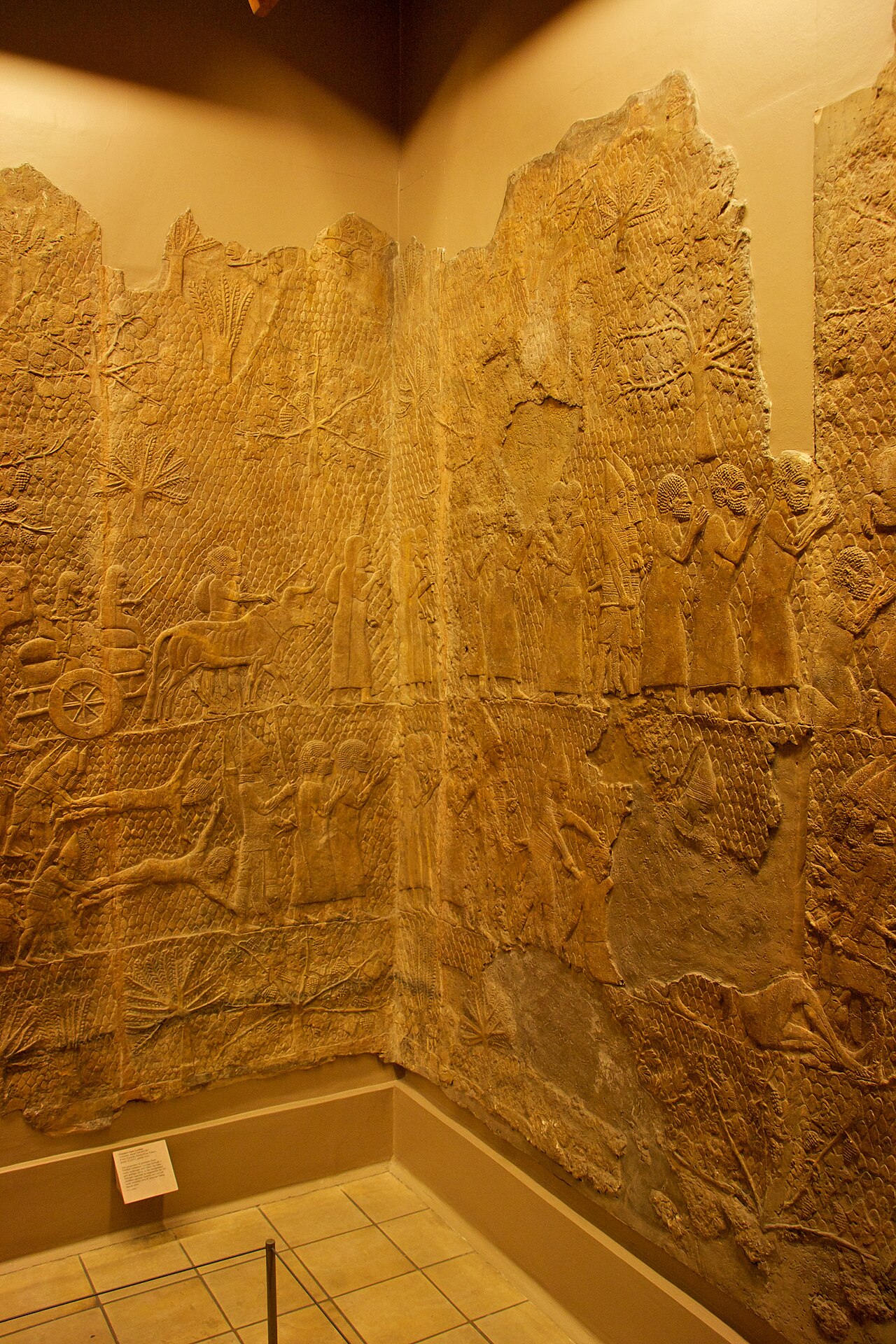
The Rassam Cylinder (700 BC) is the earliest edition of the annals; the Taylor Prism (British Museum, 691 BC), the Oriental Institute Prism (Chicago, 689 BC) and the Jerusalem Prism (Israel Museum) are later editions with the same account. Their manufacture dates are not the date of the campaign. The Lachish reliefs come from Room XXXVI of Sennacherib's Southwest Palace at Nineveh (British Museum). A clay seal impression of "Hezekiah [son of] Ahaz king of Judah" was found in the Ophel excavations (published 2015). The Siloam tunnel inscription describes the meeting of two teams of diggers and names no king (ISA-C6: catalogue checks open).
Isaiah's own oracles of the 700s promised that Assyria, God's rod, would be broken in God's land (10:24–27; 14:24–27; 31:8) and that Jerusalem would be spared (29:5–8; 31:5). Chapters 36–37 narrate that fulfillment.
Jewish tradition remembered the deliverance as a Passover night (the Talmud dates it to Passover, b. Sanhedrin 95b, reported) and celebrated Hezekiah as a model king; the Psalms of Zion's deliverance (46, 48, 76) were linked with 701 by some interpreters.
The New Testament does not refer to the events of 701.
Modern historians reconstruct the campaign from all the sources; many popular works present the prisms as "proof of the Bible" or as "refuting" it. The evidence does neither: it confirms the setting, the destruction, the tribute and Jerusalem's survival, and it is silent about the angel.
What the evidence shows
- Sennacherib's annals claim 46 walled cities and 200,150 people.Source: Sennacherib's annals: Rassam Cylinder (700 BC), Taylor Prism (691 BC, British Museum), Oriental Institute Prism (689 BC), Jerusalem Prism (Israel Museum); translations in RINAP 3 (A. K. Grayson and J. Novotny, 2012)
- The annals claim that Hezekiah was shut up in Jerusalem but not that Jerusalem was taken.Source: Sennacherib's annals: Rassam Cylinder (700 BC), Taylor Prism (691 BC, British Museum), Oriental Institute Prism (689 BC), Jerusalem Prism (Israel Museum); translations in RINAP 3 (A. K. Grayson and J. Novotny, 2012); Israel Museum, "The Assyrian Campaign in Judah as Told in the Sennacherib Prism" (2025–26) ↗
- Lachish was besieged and destroyed in 701 BC.Source: D. Ussishkin, The Conquest of Lachish by Sennacherib (1982) and open-access studies of the Lachish reliefs
- Kings and the annals agree on 30 talents of gold. The silver figures differ (300 / 800).
- Isaiah 36–37 was copied from 2 Kings 18–19. Majority view; some argue the reverse.
- Sennacherib campaigned against Judah a second time about 688 BC. No Assyrian record; most scholars reject it.
- The angel of the LORD struck the Assyrian army.
Continue the journey
Journey of a PassageIsaiah 36:1–3 and 2 Kings 18:13–18: Two versions of 701 BC: what Isaiah leaves out"In the fourteenth year of king Hezekiah… Sennacherib king of Assyria came up against all the defenced cities of Judah, and took them." 2 Kings 18:13 has the same sentence, but then 2 Kings 18:14–16 adds Hezekiah's message to Lachish ("I have offended"), his tribute of 300 talents of silver and 30 of gold, and the stripping of the temple doors.More from this lesson
On the map
Location securely identified Probable identification Proposed or debated location Biblical route (roads schematic) Scholarly proposal
- Sennacherib's campaign, 701 BC (schematic). Schematic, following the order of the annals: Phoenicia, the Philistine coast (Ekron), Judah's cities (Lachish), and the blockade of Jerusalem, which was not taken.
Investigations
Optional deep dives: the ancient sources, the physical evidence, and every interpretation side by side, including unconventional ones, each labeled for what it is.
Sennacherib, Hezekiah and the Siege of LachishCampaign: documented · Lachish siege: documented · Jerusalem not taken: documented · Cause of withdrawal: unknown
What do Assyrian records and archaeology say about 701 BC?
Sennacherib's annals claim he took 46 walled cities of Judah, shut Hezekiah in Jerusalem "like a bird in a cage," and received tribute. His palace reliefs show the siege of Lachish; excavations at Lachish found the siege ramp and destruction. Neither text nor relief claims Jerusalem fell. Why Sennacherib withdrew is not explained by Assyrian sources.
Open the full investigation →Why this matters to the rest of Scripture
- The Kings account (A and B).
- The Chronicler's account.
- Isaiah 1:7–9; 22:1–14Isaiah on the devastated land and the city's revelry.
- Lament over the Shephelah towns, Lachish among them.