How Isaiah Came to Us
From the prophet son of Amoz to the Great Isaiah Scroll, the Greek, the Masoretes and the printed Bible
"Bind up the testimony, seal the law among my disciples" (8:16). "Now go, write it before them in a table, and note it in a book, that it may be for the time to come for ever and ever" (30:8). The book itself speaks of writing and of disciples.
"For he did that which pleased the LORD… as Esay the prophet, who was great and faithful in his vision, had commanded him. In his time the sun went backward… He saw by an excellent spirit what should come to pass at the last, and he comforted them that mourned in Sion" (Sirach 48:22–24, c. 180 BC).
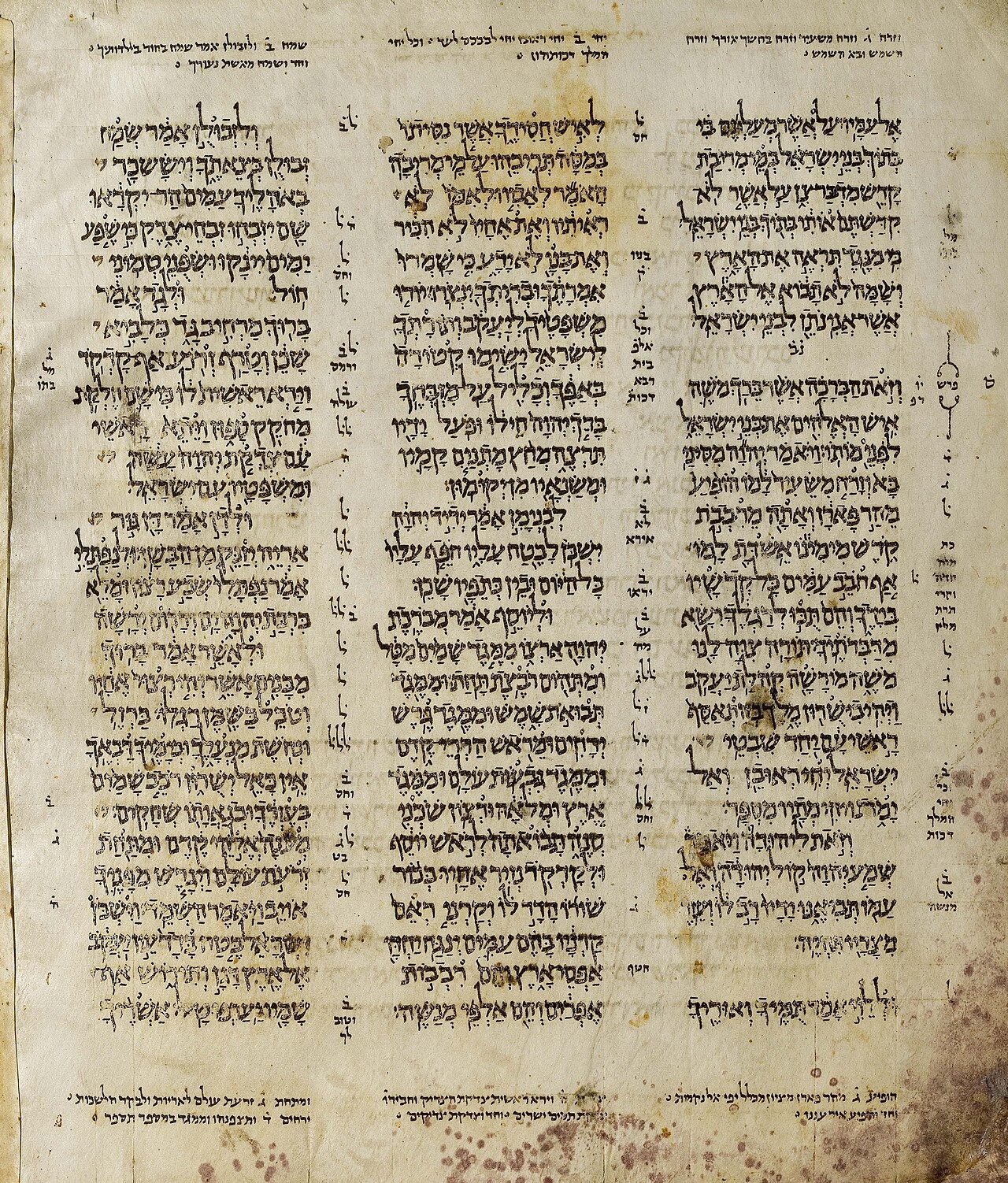
No autograph of Isaiah survives. What survives are copies: the Great Isaiah Scroll, about 125 BC; fragments from Qumran caves 1, 4 and 5 and from Wadi Murabba'at; the Greek, Latin, Syriac and Aramaic translations; and the medieval Masoretic codices of Aleppo (c. 930) and Leningrad (1008).
Then and Later
Isaiah through time
- c. 740–700 BCIsaiah son of Amoz Prophesies in Jerusalem under Uzziah, Jotham, Ahaz and Hezekiah (1:1; 6:1).Isaiah 6 →
- 734–701 BCAssyrian crisis The Syro-Ephraimite war, the fall of Samaria, Sennacherib's campaign; stories of 36–39 shared with 2 Kings 18–20.Isaiah's Assyria →
- 7th–6th c. BCDisciples and editors "Seal the law among my disciples" (8:16); most scholars think the collection grew and was edited in this period.
- c. 550–530 BCExile and Cyrus Chapters 40–55 address exiles in Babylon and name Cyrus (most scholars date them here).From Babylon to Cyrus →
- late 6th–5th c. BCRestoration Chapters 56–66 address the returned community (most scholars).Isaiah 56 →
- c. 180 BCBen Sira Praises Isaiah, who "comforted them that mourned in Sion" (Sirach 48:24): the whole book known as Isaiah's.
- 2nd c. BCGreek translation Old Greek Isaiah, a free and interpretive Jewish translation.
- c. 125 BCGreat Isaiah Scroll 1QIsa-a: 54 columns, all 66 chapters.The Great Isaiah Scroll →
- 1st c. BC – 1st c. ADQumran copies and commentaries 1QIsa-b and Cave 4 copies; Isaiah pesharim (4Q161–165, 3Q4).
- 1st c. ADNew Testament Isaiah quoted throughout; Luke 4 shows a synagogue reading.Jesus and Isaiah →
- 2nd c. ADNew Greek versions Aquila, Symmachus and Theodotion revise the Greek toward the Hebrew.
- c. AD 400Jerome's Latin Isaiah translated from the Hebrew (Vulgate).
- c. 930 and 1008Aleppo and Leningrad Codices The Masoretic text with vowels, accents and notes.
- 1611King James Version "The Book of the Prophet Isaiah" in English.
- 1947–2010Discovery and edition Cave 1 found in 1947; 1QIsa-a published 1950; the critical edition of the Cave 1 Isaiah scrolls, DJD XXXII, 2010.
A. Prophetic voice and historical setting
Isaiah son of Amoz is the only named prophet in the book. Its heading dates his vision to four kings of Judah (1:1), and the narratives place him at the courts of Ahaz (7) and Hezekiah (36–39). He had disciples (8:16) and children with symbolic names (7:3; 8:3). The book distinguishes several stages that are easily blurred: a prophetic event (a vision, an oracle spoken in public), an oral report, a first written record (8:1, 16; 30:8), a collection of such records, later rewriting and expansion, and the manuscripts that preserve the result. The dates in 1:1 belong to the prophet; they do not date every passage in the book.
B. Composition: several explanations, fairly represented
Traditional Jewish and Christian readers attributed the whole book to the 8th-century prophet, and many still do, understanding chapters 40–66 as long-range prophecy, including the naming of Cyrus (44:28; 45:1). Most modern historians, since J. C. Döderlein (1775) and J. G. Eichhorn, and in its classic three-part form since B. Duhm (1892), date chapters 40–55 to the end of the Babylonian exile and 56–66 to the restoration, and find later material within 1–39 as well (13–14, 24–27, 34–35). Their arguments come from the historical horizon (Jerusalem in ruins, Babylon about to fall, Cyrus named as a contemporary), changes of audience and tone, vocabulary and style, and the absence of Isaiah's name after chapter 39. Recent scholarship stresses the book's unity of themes (the Holy One of Israel, Zion, the remnant, the servant, the nations) and often describes a long editorial process rather than three separate books. See "One Isaiah or Several?" The Great Isaiah Scroll shows a continuous 66-chapter book by about 125 BC, with no break between 39 and 40 beyond a normal section gap; it does not decide who wrote each chapter.
C. The collection and its architecture
Readers commonly divide the book into 1–12 (Judah and Jerusalem; Immanuel), 13–23 (oracles on the nations), 24–27 (the "Isaiah Apocalypse"), 28–35 (woes, Zion and the Assyrian crisis), 36–39 (Hezekiah narratives), 40–55 (comfort, Cyrus, the servant) and 56–66 (restoration). These are useful literary groupings, not seven scrolls that once circulated separately. Chapters 36–39 closely parallel 2 Kings 18:13–20:19; scholars debate which came first, and the relationship is literary, not a physical transfer between manuscripts. Themes run across the whole: the Holy One of Israel, Zion, the remnant, the highway, light, the nations, new exodus and new creation.
D. The Great Isaiah Scroll
1QIsa-a was among the first seven scrolls found in Cave 1 near Qumran in 1947 (accounts of the discovery vary in detail). It is made of 17 sheets of leather sewn together, about 7.3 m long, with 54 columns of text, and contains all 66 chapters with a few small gaps from damage (reported). Palaeography dates it to about 125 BC. It is a working copy: its scribes corrected and added between the lines and in the margins, it uses fuller spelling than the Masoretic Text, and it has hundreds of small differences and some significant ones (for example 53:11 "light"; 19:18 "city of the sun"; 63:3 a shorter verse). It is now in the Shrine of the Book at the Israel Museum. An ancient copy is not Isaiah's autograph, and its readings are weighed one by one: sometimes it preserves a better reading, sometimes it shows a copying slip, and often it agrees with the Masoretic Text in substance. Readings of the Great Isaiah Scroll (1QIsa-a) and the other Qumran copies are described here in the site's own words, from Martin Abegg's published transcription (ETCBC/CACCHT Dead Sea Scrolls dataset). The transcription's text is not reproduced; single words are cited as facts about the manuscript. Checking every reading against the photographs and the critical edition (DJD XXXII) is still open, and an older copy is not assumed to have the better reading: each reading is weighed on its own.
E. Other Hebrew witnesses
1QIsa-b (1Q8), also from Cave 1, is fragmentary but closer to the Masoretic Text in wording and spelling. Cave 4 yielded some eighteen fragmentary copies (4Q55–69b, including 4QIsa-a to 4QIsa-r), Cave 5 one (5Q3), and Wadi Murabba'at one (Mur 3). Qumran also produced commentaries on Isaiah (pesharim, 4Q161–165 and 3Q4), which are interpretations, not copies. A fragment's silence proves nothing: a word missing from a damaged copy is evidence only if the surviving portion shows it was absent. The site's descriptions of these copies come from a published transcription; checking each against the photographs and DJD (ISA-C4) is still open.
F. Greek and other translations
Greek Isaiah, translated by Jews probably in Egypt in the 2nd century BC, is free and interpretive: it renders 'almah as parthenos (7:14), reads 9:6 as "the Angel of great counsel," makes the servant explicitly "Jacob… Israel" in 42:1, and reads "sight to the blind" in 61:1. Later Greek versions (Aquila, Symmachus, Theodotion, 2nd century AD) revised toward the Hebrew. The Aramaic Targum of Isaiah ("Targum Jonathan"), shaped over centuries, paraphrases and interprets (for example, "my servant the messiah" in 52:13). The Syriac Peshitta, Jerome's Latin Vulgate (from Hebrew, c. 400), the Coptic and other versions followed. There is no single unbroken chain from one pristine text: there are several streams, each with its own history. The library's Greek is Giguet's 1872 French translation of a printed Greek text, used for navigation only; a critical check needs Ziegler's Göttingen edition (ISA-C3).
G. Jewish and Christian reception
Isaiah is the first of the Latter Prophets in most Jewish and Christian Bibles, though the Talmud lists the order Jeremiah, Ezekiel, Isaiah (b. Bava Batra 14b, reported). More synagogue prophetic readings (haftarot) come from Isaiah than from any other book, including all seven "haftarot of consolation" after the Ninth of Av. Qumran read Isaiah of its own community; the rabbis read it of Israel, the nations and the messiah in many ways; the New Testament quotes it for John the Baptist, Jesus' birth, ministry, death and the mission to the nations (see "Jesus and Isaiah" and "Isaiah 53 in the New Testament"). Christian writers called Isaiah "the fifth evangelist." Theological meanings matter to readers, and the site presents them; they do not replace the history of the text.
H. The limits of our knowledge
We do not have Isaiah's autograph. We cannot securely date every oracle or know how many hands wrote the book. We cannot independently verify every speech, miracle or theological claim it reports, though key events, such as Sennacherib's campaign of 701 BC and the fall of Babylon in 539 BC, are well attested outside the Bible. We cannot treat all Qumran manuscripts as one text: they differ. We cannot derive one undisputed meaning of the servant passages. And the site's own work is incomplete: the scroll readings, the Greek and the Hebrew still need checking against the critical editions (ISA-C2–C5). These are open questions, and the site states them as open.
Why editions of Isaiah differ
Readers meet differences for several reasons: a manuscript variant (53:11 "light"; 19:18 "sun/destruction"); a vowel reading of the same consonants (61:8 "burnt offering/injustice"; 65:1 "called/calling"); a written/read (ketiv/qere) pair (49:5; 63:9); a translation choice (7:14 parthenos; 61:1 "sight to the blind"); different verse numbering (9:1; 64:1); and modern decisions about which reading to print. A footnote saying "Dead Sea Scrolls read…" may describe one manuscript out of several. The site labels each kind of difference on its passage pages.
Open checks (C)
ISA-C2 Masoretic wording against BHQ/BHS; ISA-C3 Greek against Ziegler's Göttingen Isaiah; ISA-C4 every Qumran reading against the photographs and DJD XXXII and XV; ISA-C5 source level of the key passages (7:14, 14:12, 19:18, 28:16, 40:3, 53:9–11, 61:1, 65:20, 66:24); ISA-C6 artifact dates; IS-D03 the transcription licence and permission. Until they close, the volume is built, not research-certified.
What the evidence shows
- The Great Isaiah Scroll contains all 66 chapters of Isaiah. With small gaps from damage.
- The Great Isaiah Scroll dates to about 125 BC. Palaeographic date; reported radiocarbon tests broadly consistent.
- Ben Sira (c. 180 BC) knew chapters 40–66 as Isaiah's. Sirach 48:24 alludes to 40:1 and 61:2–3.
- Chapters 40–66 were written by Isaiah son of Amoz.
- The Great Isaiah Scroll proves that one author wrote all 66 chapters. It proves the book was one scroll by 125 BC, not who wrote it.
- The older Qumran copy always has the original reading. Readings are weighed one by one.
- More haftarot come from Isaiah than from any other prophet. C check against a haftarah list.
Continue the journey
Journey of a PassageIsaiah 53:11: "He shall see light": the word missing from the Masoretic Text"He shall see of the travail of his soul, and shall be satisfied" (KJV, from the Masoretic Text, which has no object for "see").More from this lesson
Why this matters to the rest of Scripture
- Isaiah 8:16; 30:8Sealing the testimony; writing for the time to come.
- Ben Sira's praise of Isaiah.
- The parallel to Isaiah 36–39.
- A scroll of Isaiah in the synagogue.