Isaiah 63: Who Is This That Cometh from Edom?
The warrior stained from the winepress, the memory of the exodus, and a people's lament
"Who is this that cometh from Edom, with dyed garments from Bozrah? this that is glorious in his apparel, travelling in the greatness of his strength? I that speak in righteousness, mighty to save. Wherefore art thou red in thine apparel, and thy garments like him that treadeth in the winefat? I have trodden the winepress alone; and of the people there was none with me: for I will tread them in mine anger, and trample them in my fury; and their blood shall be sprinkled upon my garments, and I will stain all my raiment" (63:1–3).
"For the day of vengeance is in mine heart, and the year of my redeemed is come. And I looked, and there was none to help; and I wondered that there was none to uphold: therefore mine own arm brought salvation unto me; and my fury, it upheld me. And I will tread down the people in mine anger, and make them drunk in my fury, and I will bring down their strength to the earth" (vv. 4–6).
"I will mention the lovingkindnesses of the LORD… In all their affliction he was afflicted, and the angel of his presence saved them: in his love and in his pity he redeemed them; and he bare them, and carried them all the days of old. But they rebelled, and vexed his holy Spirit… Then he remembered the days of old, Moses, and his people, saying, Where is he that brought them up out of the sea with the shepherd of his flock?" (vv. 7–11).
"Look down from heaven, and behold from the habitation of thy holiness and of thy glory… Doubtless thou art our father, though Abraham be ignorant of us, and Israel acknowledge us not: thou, O LORD, art our father, our redeemer; thy name is from everlasting. O LORD, why hast thou made us to err from thy ways, and hardened our heart from thy fear?… The people of thy holiness have possessed it but a little while: our adversaries have trodden down thy sanctuary" (vv. 15–18).
| Verses | What it says | What to notice |
|---|---|---|
| 63:1 | Who comes from Edom, garments crimson from Bozrah, splendid, marching in strength? "I, speaking in righteousness, mighty to save" | Wordplay: Edom / adom ("red"); Bozrah / batsir ("grape harvest"). |
| 63:2 | Why is your clothing red, like one treading in the winepress? | The vintage: grapes trodden by foot in a rock-cut press. |
| 63:3 | I trod the press alone; no one from the peoples with me; I trampled them; their juice spattered my garments | Netsach, "juice" (literally "their strength" or "lifeblood"). 1QIsa-a: "of my people" and a shorter verse. |
| 63:4 | A day of vengeance in my heart; my year of redemption has come | The pair of 61:2 and 34:8. |
| 63:5 | I looked: no helper, no one to uphold; my own arm saved, my wrath upheld me | Repeats 59:16. |
| 63:6 | I trampled peoples in my anger, made them drunk with my wrath, poured their lifeblood on the ground | Some Hebrew manuscripts and the Targum read "I shattered them" for "I made them drunk" (reported). |
| 63:7–9 | I will recount the LORD's acts of covenant love (chasdei); he became their savior; in all their distress he was distressed; the angel of his presence saved them | Ketiv "not" / qere "to him" (lo/lo) in v. 9: see below. |
| 63:10 | But they rebelled and grieved his holy spirit; he became their enemy | "Holy spirit" (ruach qodsho): only here, v. 11 and Psalm 51:11 in the Hebrew Bible. |
| 63:11–14 | He remembered the days of old: Moses, the shepherd, the sea divided, the deep, rest given by the LORD's spirit | The exodus as the ground of the appeal. |
| 63:15–16 | Look from heaven: where are your zeal and compassion? You are our father, though Abraham does not know us; our Redeemer from of old | "Our father": rare in the Hebrew Bible for God (compare 64:8; Deuteronomy 32:6). |
| 63:17–19a | Why do you make us stray and harden our hearts? Return for your servants' sake; our enemies trampled your sanctuary; we have become like those you never ruled | Hebrew 63:19 continues with "Oh that you would rend the heavens" (English 64:1). |
Edom and Bozrah
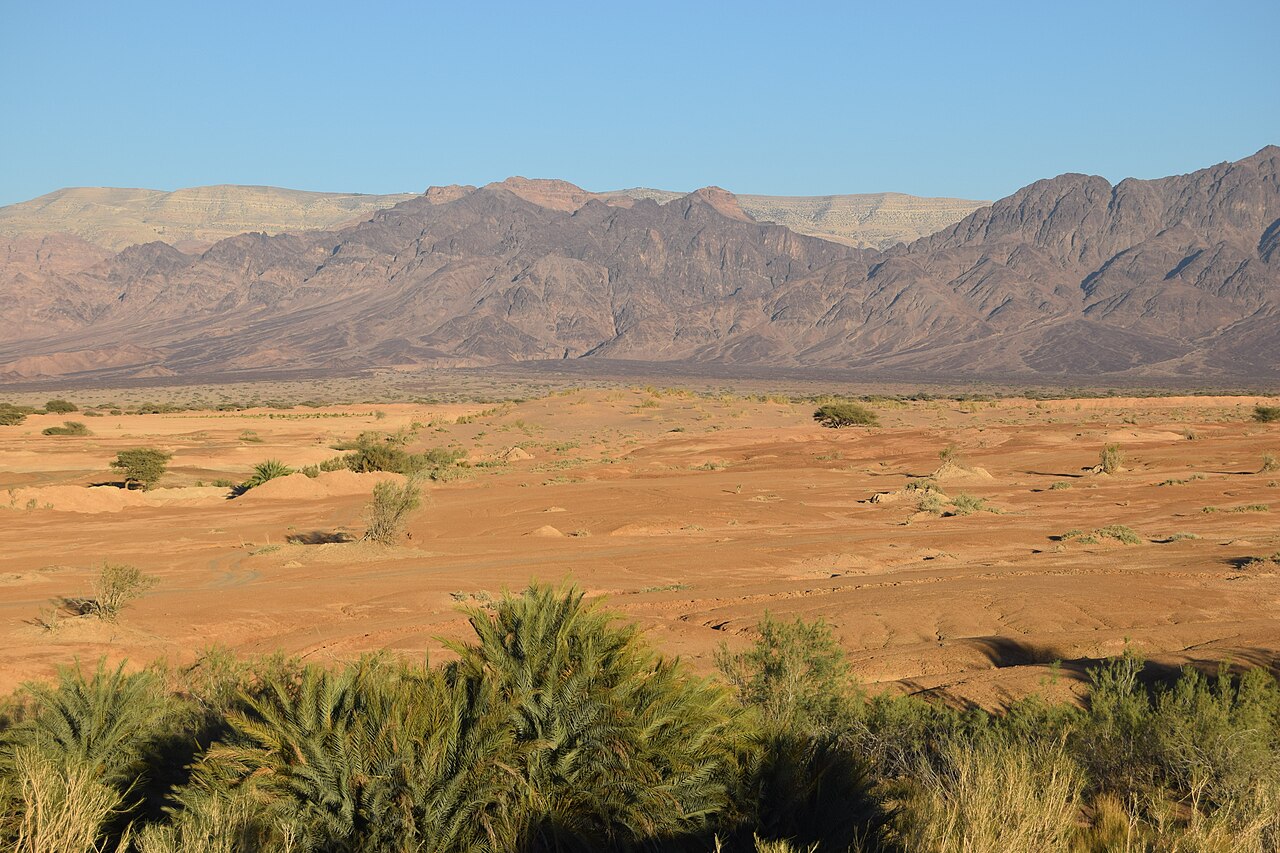
Edom, the land southeast of the Dead Sea, was Judah's neighbor and rival. Bozrah (modern Buseirah, Jordan) was its capital in the Iron Age; Crystal-M. Bennett's excavations (1971–1980) uncovered a large administrative and palace complex there (reported). After Jerusalem fell in 587 BC, Edom was remembered as having joined its enemies (Psalm 137:7; Obadiah 10–14; Lamentations 4:21–22), and Edomites moved into the southern Judean hills, the later Idumea. Isaiah 34 and 63 make Edom the symbol of the hostile nations. Whether 63:1–6 refers to a particular event is unknown; the poem is a vision, and Edom stands for more than itself.
The winepress
Rock-cut winepresses with a treading floor and a collecting vat are common in the hill country of Judah and Samaria. Treaders sang (Jeremiah 25:30; 48:33) and their clothing was stained red. The image of judgment as a winepress appears also in Lamentations 1:15 and Joel 3:13.
Honest reading of a violent text
The poem pictures God's victory over the nations as a slaughter and his clothes stained with their blood. Several things can be said without softening it. In the poem's setting, it is the cry of a defeated and humiliated people for God to act against their oppressors ("the year of my redeemed"), not a call for human violence: the warrior acts "alone," because no one else could or would. It belongs to a tradition of divine-warrior poetry in Israel and its neighbors (compare Deuteronomy 32:41–43; Psalm 68; the Ugaritic goddess Anat wading in the blood of warriors, reported). And its later readers have used it both as a symbol of God's justice and, at times, as license for human vengeance. The site names all three facts and leaves the moral question open (ISA-C9).
| Feature | Isaiah 63:1–6 | Revelation 19:11–16 (with 14:17–20) |
|---|---|---|
| Who | The LORD ("I that speak in righteousness, mighty to save") | A rider on a white horse, "Faithful and True," "The Word of God," "King of kings" (identified with Christ) |
| Alone or with others | "Of the peoples there was none with me" | "The armies which were in heaven followed him" (19:14) |
| Blood and garment | Garments spattered after the treading | "Clothed with a vesture dipped in blood" before the battle is described; whose blood is debated (his own, compare 5:9; or his enemies'). Some manuscripts read "sprinkled," perhaps from Isaiah 63:3 (reported) |
| The winepress | "I have trodden the winepress alone" | "He treadeth the winepress of the fierceness and wrath of Almighty God" (19:15); in 14:19–20 an angel's winepress outside the city flows with blood to the horses' bridles |
| Weapon | His arm and his fury | A sharp sword from his mouth (19:15, 21) |
| Place | From Edom and Bozrah | No place named; "without the city" in 14:20 |
| Purpose | "The day of vengeance… the year of my redeemed" | Judgment of the beast, the false prophet and the kings of the earth |
Where the texts differ
Revelation borrows Isaiah's images (the stained garment, the winepress, the lone conqueror's wrath) but changes them. The figure is named and given titles; his armies follow; his weapon is a sword from his mouth, which many interpreters take as his word; and his garment is bloody before the battle. Revelation never says "as it is written" here, and it does not claim that Isaiah 63 was a prediction of its scene; that identification belongs to later readers. Christian interpreters from Origen onward also read Isaiah 63 of Christ's passion ("I have trodden the winepress alone"), which inspired the medieval image of Christ treading the mystic winepress; and the Battle Hymn of the Republic (1861) turned the image toward the American Civil War. These are three different uses of one poem.
In all their affliction (63:9)
The written Hebrew text (ketiv) of 63:9 reads "in all their distress he was not distressed (lo), and the angel of his presence saved them"; the Masoretes' read text (qere) has lo, "to him": "in all their distress, he was distressed." The Great Isaiah Scroll spells "not." The library's Greek divides the words differently: "not an envoy nor an angel, but he himself saved them." The KJV follows the read text. Jewish and Christian theology both drew on this verse for the idea that God shares his people's suffering; the textual question shows how much rests on one letter (described from a transcription).
What the evidence shows
- Isaiah 63:1 plays on Edom/adom ("red") and Bozrah/batsir ("vintage").
- Bozrah (Buseirah) was Edom's Iron Age capital. Reported from the excavations; C check.
- 1QIsa-a has a shorter text of 63:3. Described from a transcription; 1QIsa-b has the full text.
- Revelation 19:13–15 alludes to Isaiah 63:1–3.
- Isaiah 63:1–6 predicts the scene of Revelation 19. A later Christian identification; the texts differ in figure, setting and detail.
- Isaiah 63:1–6 refers to a datable campaign against Edom.
Continue the journey
Journey of a PassageIsaiah 63:1–6: "Who is this that cometh from Edom?": the warrior in the winepress and Revelation 19"Who is this that cometh from Edom, with dyed garments from Bozrah?… Wherefore art thou red in thine apparel, and thy garments like him that treadeth in the winefat?More from this lesson
Echoes Across Civilizations
Optional: how other ancient peoples told similar stories. Open one to compare, then come back to the lesson.
The God who marches out to battleCanaanite (Ugarit) · Assyrian · Israelite
Did other ancient peoples sing of a god who comes from his mountain in storm, shaking the earth, with heaven fighting for his people?
- Canaanite (Ugarit): Baal the storm god Shared literary world
- Assyrian: Royal inscriptions of the storm god Adad Resemblance only
- Israelite: "YHWH of Teman" Possible historical contact
Also covered: A battle in the sky?, clearly labeled as a modern theory.
Compare side by side →Why this matters to the rest of Scripture
- The sword over Edom; Bozrah.
- Obadiah 10–15; Psalm 137:7Edom on the day of Jerusalem.
- Revelation 19:11–16; 14:17–20The rider and the winepress.
- The sea and the shepherd of the flock.