Isaiah 27: Leviathan the Crooked Serpent
The dragon slain, a vineyard guarded, and the great trumpet for the exiles
"In that day the Lord with his sore and great and strong sword shall punish leviathan the piercing serpent, even leviathan that crooked serpent; and he shall slay the dragon that is in the sea" (27:1).
"In that day sing ye unto her, A vineyard of red wine. I the Lord do keep it; I will water it every moment: lest any hurt it, I will keep it night and day. Fury is not in me… Or let him take hold of my strength, that he may make peace with me; and he shall make peace with me. He shall cause them that come of Jacob to take root: Israel shall blossom and bud, and fill the face of the world with fruit" (vv. 2–6).
"And it shall come to pass in that day, that the great trumpet shall be blown, and they shall come which were ready to perish in the land of Assyria, and the outcasts in the land of Egypt, and shall worship the Lord in the holy mount at Jerusalem" (v. 13).
| Verses | What it says | What to notice |
|---|---|---|
| 27:1 | God's sword punishes Leviathan the fleeing serpent, Leviathan the twisting serpent, and kills the dragon (tannin) in the sea | Three titles nearly identical to Ugaritic Lotan's. |
| 27:2–5 | A pleasant vineyard; the LORD keeps it; no wrath; briers and thorns may fight or make peace | Reverses the vineyard song of 5:1–7. |
| 27:6 | Jacob takes root; Israel blossoms and fills the world with fruit | Compare Hosea 14:5–7. |
| 27:7–9 | Israel struck less than its enemies; exile was measured; guilt atoned when altar stones are chalk and Asherim fall | Quoted in Romans 11:27 (with 59:20–21). |
| 27:10–11 | The fortified city desolate; calves graze; women burn its dry branches; a people without understanding | The unnamed city again. |
| 27:12–13 | Threshing from the Euphrates to the Wadi of Egypt; Israel gathered one by one; the great shofar calls the exiles from Assyria and Egypt | Matthew 24:31; the Jewish daily prayer. |
Leviathan at Ugarit
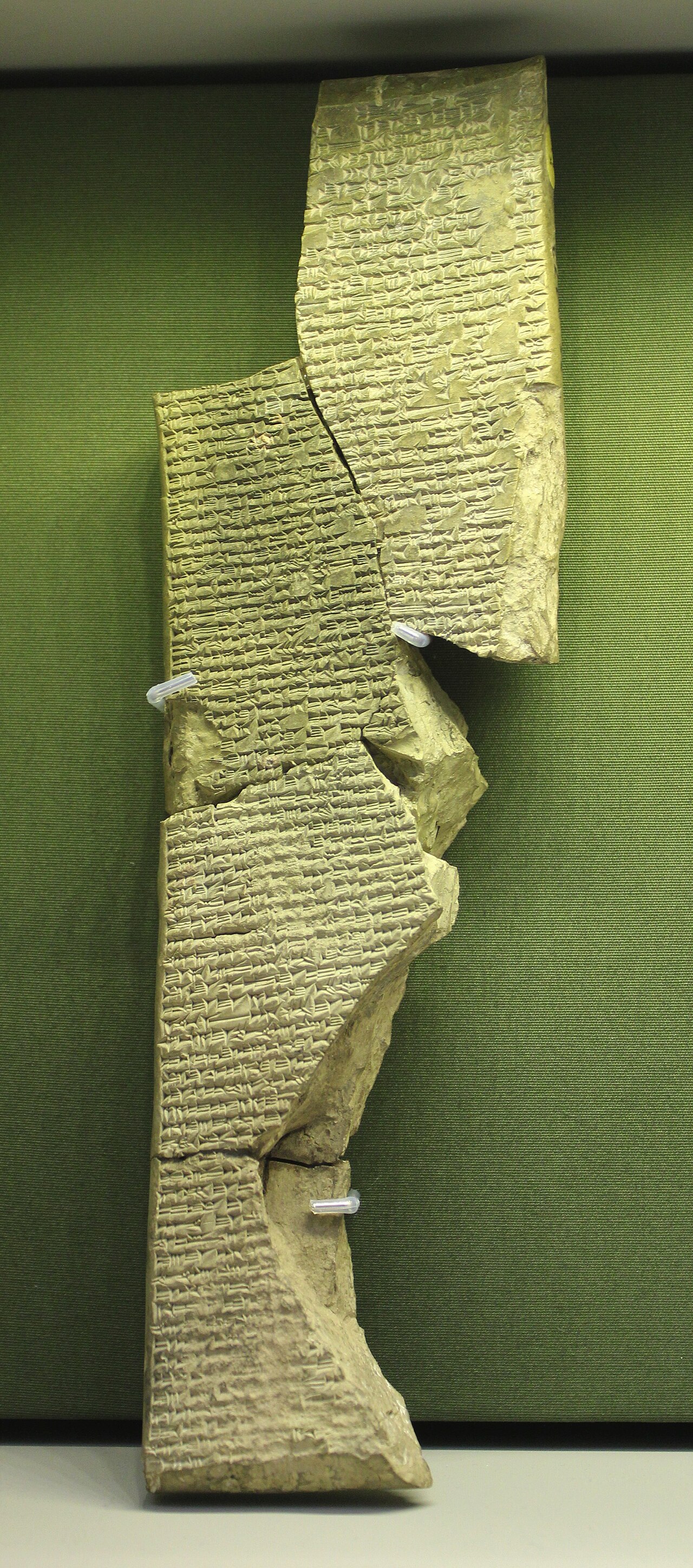
A tablet of the Baal cycle from Ugarit (14th–13th century BC) has Death say to Baal: "When you struck Lotan (Litan) the fleeing serpent, finished off the twisting serpent, the mighty one with seven heads…" (KTU 1.5 I 1–3). The Ugaritic "fleeing serpent" (btn brh) and "twisting serpent" (btn 'qltn) match Isaiah's nachash bariach and nachash 'aqallaton word for word. Job 26:13 also speaks of the "fleeing serpent" (KJV "crooked"); Psalm 74:13–14 of God crushing Leviathan's heads; Job 41 and Psalm 104:26 of Leviathan as a sea creature God made. Isaiah 27:1 uses the inherited language of a cosmic monster for God's final victory; it does not describe a zoological animal. Revelation 12:3, 9 and 20:2 call Satan "the great dragon… that old serpent."
Romans 11:27
Paul's conclusion that "all Israel shall be saved" quotes Isaiah 59:20–21 and adds the Greek of 27:9: "when I shall take away their sins." The library's Greek reads 27:9 "I will take away his sins" (Giguet: "je lui remettrai ses péchés"); the Hebrew speaks of removing Jacob's guilt by destroying the altars. A later quotation joining two Isaiah texts.
The great shofar
"The great trumpet (shofar gadol) shall be blown" (27:13). The tenth blessing of the Jewish daily Amidah prays: "Sound the great shofar for our freedom… and gather us together from the four corners of the earth." In Matthew 24:31 Jesus says the Son of man "shall send his angels with a great sound of a trumpet, and they shall gather together his elect from the four winds" (Matthew's report); 1 Corinthians 15:52 and 1 Thessalonians 4:16 also speak of the last trumpet. Each draws on the image of the shofar that gathers exiles.
Which vineyard?
The Masoretic Text reads kerem chemed, "a pleasant vineyard"; some Hebrew manuscripts, the KJV ("a vineyard of red wine") and the Vulgate (vinea meri, "a vineyard of pure wine") reflect kerem chemer. The library's Greek has "a beautiful vineyard." A one-letter difference (ד/ר again).
In its setting, 27:1 announces God's victory over the forces of chaos and the empires they stand for (perhaps Assyria, Babylon and Egypt, the "fleeing," "twisting" and "sea" monsters, as some suggest); 27:12–13 promises the return of exiles from Mesopotamia and Egypt.
Later Jewish tradition made Leviathan's flesh part of the feast for the righteous in the world to come (b. Bava Batra 74b–75a; 2 Baruch 29:4; 1 Enoch 60:7–9, reported).
Revelation's dragon and serpent (12:3, 9; 20:2) and its beast from the sea (13:1) draw on this imagery. Romans 11:27 quotes 27:9. Matthew 24:31 echoes the great trumpet.
Some modern readers have tried to identify Leviathan with a dinosaur or a crocodile; Job 41's description may draw on the crocodile, but Isaiah 27:1 is cosmic-mythic language and the site does not treat it as a zoological record.
What the evidence shows
- Isaiah 27:1's "fleeing serpent" and "twisting serpent" match the Ugaritic description of Lotan. KTU 1.5 I 1–3; reported.
- Romans 11:27 includes the Greek of Isaiah 27:9.
- Leviathan in Isaiah 27 is a real animal species. The text uses mythic language for cosmic evil.
- The Jewish Amidah's "great shofar" draws on Isaiah 27:13.
Continue the journey
Journey of a PassageIsaiah 27:1: Leviathan, the fleeing serpent and the twisting serpent"The Lord with his sore and great and strong sword shall punish leviathan the piercing serpent, even leviathan that crooked serpent; and he shall slay the dragon that is in the sea." The Hebrew witnesses agree (1QIsa-a; 4QIsa-b partly).More from this lesson
Investigations
Optional deep dives: the ancient sources, the physical evidence, and every interpretation side by side, including unconventional ones, each labeled for what it is.
Behemoth and LeviathanBehemoth: hippopotamus (majority view) · Leviathan: disputed · Dinosaurs: not supported
What creatures do Job 40–41 describe?
Behemoth is most often identified as the hippopotamus; Leviathan as the crocodile, a whale, or the mythic sea-serpent known from Ugarit as Lotan. Later Jewish tradition made them primeval monsters. Some modern readers identify them as dinosaurs; the description as a whole and its ancient context do not support certainty.
Open the full investigation →Echoes Across Civilizations
Optional: how other ancient peoples told similar stories. Open one to compare, then come back to the lesson.
Taming the sea and its monstersUgaritic (Canaanite) · Babylonian · Egyptian
Did other ancient peoples picture a god defeating or restraining the sea and a many-headed sea-serpent?
- Ugaritic (Canaanite): The Baal Cycle Shared literary world
- Babylonian: Enuma Elish Shared literary world
- Egyptian: Apophis, the chaos serpent Resemblance only
Why this matters to the rest of Scripture
- Psalm 74:13–14; Job 26:12–13; 41Leviathan and the sea monsters.
- The first vineyard song.
- Revelation 12:3, 9; 20:2The dragon, that old serpent.
- Matthew 24:31; 1 Thessalonians 4:16The great trumpet.