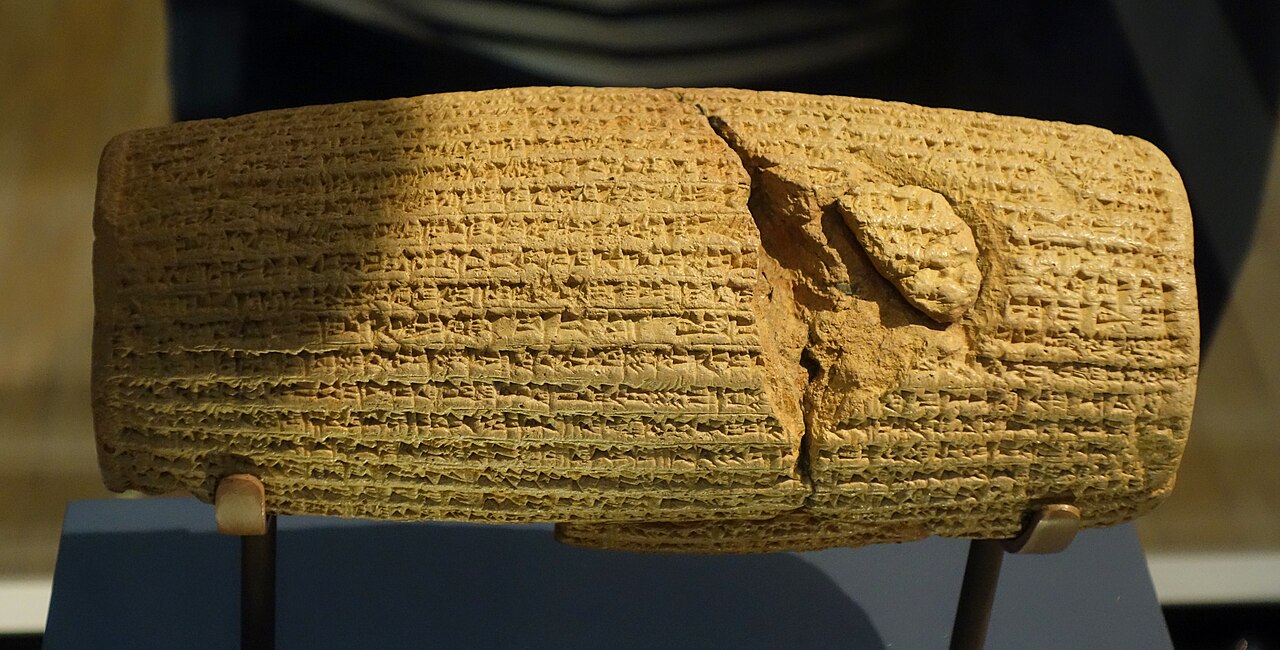
Cyrus, chosen by Marduk, returns the gods of cities beyond the Tigris to their shrines and gathers their peoples; asks that the gods pray for him and his son Cambyses.
The statue itself (Vatican, Museo Gregoriano Egizio)
An Egyptian priest-official records that Cambyses restored the temple of Neith at Sais at his request, and that Darius sent him back from Elam to restore the "house of life" (scribal school).
Similar
A native official at the Persian court obtains royal support for his people's temple
Sent home by Darius with a commission
Different
Egyptian cult; personal biography
Egyptian (Persian rule) · Egypt
Darius' collection of Egyptian law (Demotic Chronicle, verso)
Possible historical contact
Composed
Event c. 519–503 BC; papyrus 3rd c. BC
Earliest surviving copy
Papyrus, Bibliothèque nationale de France
Darius orders the satrap to assemble the wise men of Egypt and write down the law of Egypt, in Aramaic and Demotic.
Similar
Imperial interest in local law (compare Ezra 7:25–26)
Different
Reported in a much later papyrus
Lycian / Persian · Anatolia
Letoon trilingual inscription (Xanthos)
Resemblance only
Composed
337 BC
Earliest surviving copy
The stele (Fethiye Museum)
A local cult is founded with the satrap's approval and its regulations recorded in Lycian, Greek and Aramaic.
Similar
Local cult regulated under Persian authority
Different
Late Persian period; local initiative
Full investigations
The Cyrus Cylinder →Does the Cyrus Cylinder record the decree to rebuild Jerusalem's temple?
Back to the story
Cyrus, the Proclamation and the Vessels →In the first year of Cyrus, "that the word of the LORD by the mouth of Jeremiah might be fulfilled," the Persian king proclaims that the house of the God of heaven be rebuilt in Jerusalem. Families rise to go; neighbors give silver, gold and animals; and Cyrus hands the temple vessels Nebuchadnezzar had taken to Sheshbazzar, "the prince of Judah." Ezra opens under a foreign emperor, not a restored king of David's line.
The Memorandum, the Finished Temple and the Passover →Darius has the archives searched, and a scroll is found at Ecbatana: Cyrus' memorandum ordering the house rebuilt, sixty cubits high and wide, paid for by the crown, with the vessels returned. Darius orders his officials not to interfere, to fund the work and the sacrifices from the region's tribute, and to pray for the king. The temple is finished in his sixth year (515 BC). It is dedicated with joy, and the returned exiles, with all who had separated themselves from the uncleanness of the nations, keep the Passover.
Ezra the Priest and Scribe →"After these things" (some fifty-seven years later on the usual dating), Ezra, a priest descended from Aaron and "a ready scribe in the law of Moses," comes from Babylon in the seventh year of Artaxerxes. The king's Aramaic letter lets any Israelite go with him, sends silver and gold, exempts temple staff from tax, and gives Ezra authority to appoint judges and to teach the law of his God, with penalties for those who will not obey. Ezra breaks into thanks in the first person.
Investigation: The Persian Empire, Yehud and the Second Temple →Ezra's story is set inside the largest empire the world had yet seen. This investigation gathers the outside evidence: the Cyrus Cylinder, the chronology of the Persian kings, the province of Yehud and its stamped jars and coins, the Jewish community at Elephantine with its own temple, the Aramaic of the imperial chancery, and the question of Persian religious influence. Each item is shown with what it establishes and what it does not.
A Persian Commission and a Midnight Survey →In Nisan the king notices Nehemiah's sad face. Nehemiah, "very sore afraid," asks to be sent to rebuild the city of his fathers' tombs. He receives letters for the governors Beyond-the-River and for Asaph, keeper of the king's park, for timber, and an escort of officers and horsemen. Sanballat the Horonite and Tobiah the Ammonite servant are grieved. Nehemiah inspects the walls by night and calls the leaders to build; Geshem the Arab joins the mockery.
Isaiah 45: To His Anointed, to Cyrus →"Thus saith the Lord to his anointed, to Cyrus, whose right hand I have holden": God will open gates before him and give him hidden treasures, "though thou hast not known me," for Israel's sake and so that all may know "I am the Lord, and there is none else" (45:1–6). "I form the light, and create darkness: I make peace, and create evil" (v. 7). Let the heavens rain righteousness; woe to clay that argues with its potter; Cyrus will rebuild the city and free the exiles without payment (vv. 8–13). Nations will come and confess: "God is in thee… Verily thou art a God that hidest thyself" (vv. 14–17). God created the earth to be lived in, not as chaos; "Look unto me, and be ye saved, all the ends of the earth… unto me every knee shall bow, every tongue shall swear" (vv. 18–25).
Investigation: From Babylon to Cyrus →Isaiah 40–48 speaks to Judeans in Babylon, announces Babylon's fall, and twice names Cyrus of Persia as the LORD's shepherd and anointed. The Babylonian sources (the Nabonidus Chronicle, the Cyrus Cylinder, the Verse Account of Nabonidus) and Greek historians describe how Cyrus actually took Babylon in 539 BC. This investigation sets the events in order, compares what Isaiah says with what the sources say, and lays out the four main ways of explaining a prophecy that names a king: long-range prediction, composition in the 540s, later editorial insertion of the name, and literary unity.