Cyrus, the Proclamation and the Vessels
"The LORD stirred up the spirit of Cyrus king of Persia"
"Now in the first year of Cyrus king of Persia, that the word of the LORD by the mouth of Jeremiah might be fulfilled, the LORD stirred up the spirit of Cyrus king of Persia, that he made a proclamation throughout all his kingdom, and put it also in writing."
"Thus saith Cyrus king of Persia, The LORD God of heaven hath given me all the kingdoms of the earth; and he hath charged me to build him an house at Jerusalem, which is in Judah. Who is there among you of all his people? his God be with him, and let him go up to Jerusalem." Those who remain are to help with silver, gold, goods and animals, besides freewill offerings for the house of God.
The heads of the families of Judah and Benjamin, the priests and the Levites, "with all them whose spirit God had raised," rise up to go. Their neighbors strengthen their hands with vessels of silver and gold, goods, beasts and precious things.
Cyrus brings out the vessels of the house of the LORD that Nebuchadnezzar had put in the house of his gods. Mithredath the treasurer counts them out to "Sheshbazzar, the prince of Judah": thirty chargers of gold, a thousand chargers of silver, twenty-nine knives, thirty basins of gold, four hundred and ten silver basins of a second sort, a thousand other vessels. "All the vessels of gold and of silver were five thousand and four hundred. All these did Sheshbazzar bring up."
A return that was voluntary and partial
The proclamation invites; it does not order a mass migration. "Who is there among you… let him go up." Those who stay are asked to give. Ezra never says that all the exiles returned, and Babylonian records (the Al-Yahudu tablets) show Judeans still farming in Babylonia generations later. The return was a movement of some, not a reversal of the whole exile.
The same words end Chronicles
Ezra 1:1–3 repeats, almost word for word, the last two verses of 2 Chronicles. In Christian Bibles the repetition joins the two books; in most Jewish Bibles Chronicles comes last, so the Hebrew Bible ends with "let him go up." The overlap shows a deliberate literary link. It does not by itself prove one author wrote Chronicles and Ezra–Nehemiah, a question scholars still debate.
Two versions of the decree
Ezra gives Cyrus' decree twice. Here it is a Hebrew proclamation, spoken in the language of Israel's faith ("the LORD God of heaven"), inviting return and gifts. In Ezra 6:3–5 it is an Aramaic memorandum found in the archive at Ecbatana, dealing with the building's dimensions, its funding from the royal treasury, and the return of the vessels. Different documents, different purposes: see the passage page.
Jeremiah, Isaiah and Daniel
Ezra ties the decree to Jeremiah's seventy years (Jeremiah 25:11–12; 29:10). Isaiah 44:28–45:1 names Cyrus as the LORD's "shepherd" and "anointed." Daniel 9 prays over the same seventy years. Readers of faith see prophecy fulfilled; many critical scholars date Isaiah 40–55 to the exile itself, when Cyrus' rise was under way. The site gives both readings.
Who was Sheshbazzar?
Sheshbazzar is called "the prince (nasi') of Judah" here and "governor" in Ezra 5:14, where he is also said to have laid the temple's foundation, a deed Ezra 3 and Zechariah 4:9 give to Zerubbabel. Some identify the two men; others think Sheshbazzar was an earlier leader (perhaps Shenazzar, a son of Jehoiachin, 1 Chronicles 3:18); others see two traditions about the first return. The question is open: see the investigation.
The Case for the Biblical Account
Scripture's account
In 539/538 BC Cyrus authorizes the rebuilding of the temple in Jerusalem, allows the exiles to return, and restores the temple vessels to Sheshbazzar (Ezra 1).
What evidence would we expect?
Persian policy favoring the restoration of temples and deported peoples; Babylonian or Persian records of the period; evidence of a Judean community in Babylonia and of renewed settlement in Judah.
The discoveries
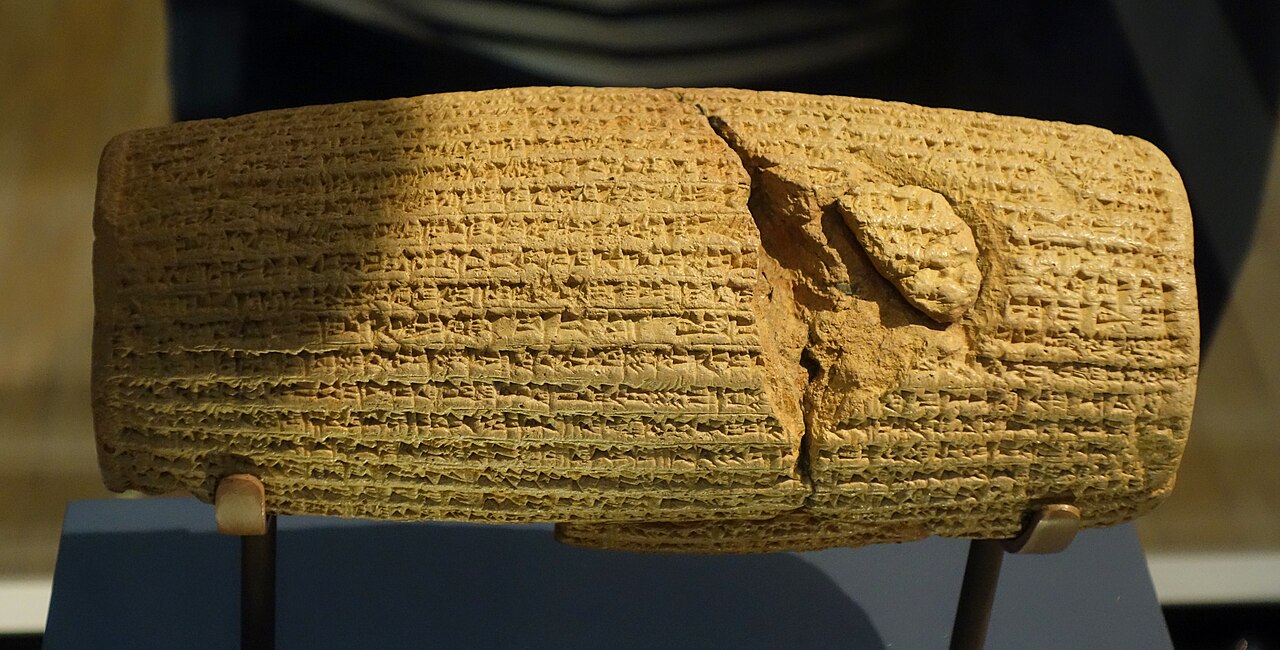
The Cyrus Cylinder (British Museum 1880,0617.1941) describes Cyrus returning gods to their sanctuaries and gathering their peoples to their settlements, in Babylonia and lands east of the Tigris. The Al-Yahudu tablets show Judeans in Babylonia. Persian-period Yehud is attested by stamped jar handles and coins.
Testing the discoveries
The Cylinder is Babylonian royal propaganda written in the voice of Marduk's chosen king. It does not mention Jews, Judah or Jerusalem, and it is not the decree quoted in Ezra. It shows a policy; it does not record this edict.
The strongest reconstruction
A decree permitting Judeans to rebuild their temple fits Cyrus' known policy and the language of Persian court documents; it is known only from the Bible.
What remains possible
Whether the Hebrew proclamation of Ezra 1 is a translation, a paraphrase, or a literary presentation of a Persian document; the identity of Sheshbazzar; how many returned in the first wave.
The vessel count
- Items listed in Ezra 1:9–10
- 30 + 1,000 + 29 + 30 + 410 + 1,000 = 2,499
- Total in Ezra 1:11 (Hebrew, library Greek, Vulgate, KJV)
- 5,400
- 1 Esdras 2:13–14 (KJV Apocrypha)
- 1,000 gold cups, 1,000 silver, 29 censers, 30 gold vials, 2,410 silver, 1,000 others; total 5,469 (the items add up)
- 1 Esdras 2:14 (library Greek, Giguet's French)
- Total 5,860; items differ
The listed items do not add up to the stated total. Possible explanations: the list names only the main categories; numbers were damaged in copying (Hebrew numerals are easily confused); or the total comes from a different record than the itemization. 1 Esdras gives a list that does add up, which may be an older reading or a later correction. The site shows the figures as they stand and does not "repair" them.
What the evidence shows
- Cyrus II took Babylon in 539 BC.Source: British Museum, Cyrus Cylinder, object 1880,0617.1941 ↗
- The Cyrus Cylinder describes returning gods and peoples to their homes.Source: British Museum, Cyrus Cylinder, object 1880,0617.1941 ↗
- The Cyrus Cylinder is the decree of Ezra 1 or mentions Jerusalem.Source: British Museum, Cyrus Cylinder, object 1880,0617.1941 ↗
- Cyrus issued a decree permitting the Jerusalem temple to be rebuilt. Consistent with Persian policy; attested only in Ezra and Chronicles.
- The vessel list in 1:9–10 adds up to the total in 1:11. 2,499 vs 5,400 in every library text.
- Sheshbazzar and Zerubbabel were the same man.
- "The LORD stirred up the spirit of Cyrus."
Then and Later
Cyrus, then and later
- c. 550–540 BCIsaiah 44–45 Cyrus named as the LORD's shepherd and anointed.
- 539 BCBabylon falls Cyrus' Cylinder presents him as Marduk's chosen restorer.The Cyrus Cylinder →
- 538 BC (traditional)The decree Ezra 1; 2 Chronicles 36:22–23.
- 1st c. ADJosephus Antiquities 11.1–7 says Cyrus read Isaiah's prophecy about himself; a later tradition, not a contemporary source.
- 1971 onwardModern symbol The Cylinder is promoted as a "first charter of human rights," a modern reading its own text does not support.
Continue the journey
Journey of a Passage2 Chronicles 36:22–23 and Ezra 1:1–3: Cyrus' proclamation, twiceThe last verses of Chronicles and the first verses of Ezra are nearly identical.More from this lesson
On the map
Location securely identified Probable identification Proposed or debated location Biblical route (roads schematic) Scholarly proposal
- The return from Babylon (schematic). Conceptual only. Ezra names the start (Babylon) and the end (Jerusalem and the towns of Judah) but not the route, which likely followed the Euphrates north and then turned south through Syria. Dates and the size of each wave are uncertain.
Investigations
Optional deep dives: the ancient sources, the physical evidence, and every interpretation side by side, including unconventional ones, each labeled for what it is.
The Cyrus CylinderCylinder: documented · Policy of restoration: documented · Mention of Jerusalem: none
Does the Cyrus Cylinder record the decree to rebuild Jerusalem's temple?
The Cyrus Cylinder, a clay cylinder found at Babylon in 1879 (British Museum 1880,0617.1941), is a Babylonian building inscription in Cyrus' name after he took Babylon in 539 BC. It presents Cyrus as chosen by Marduk, and says he returned gods to their sanctuaries and gathered their former inhabitants. It names cities east of the Tigris, not Judah or Jerusalem. It shows a policy consistent with the biblical decree; it is not that decree.
Open the full investigation →Who Was Sheshbazzar?Identity: unresolved · Outside evidence: none for either name in this role
Was Sheshbazzar, "the prince of Judah," the same man as Zerubbabel?
Sheshbazzar receives the temple vessels from Cyrus, is appointed governor and is said to have laid the temple's foundation. Ezra 3 and Zechariah give the foundation to Zerubbabel. Sheshbazzar then disappears from the story. Three main answers have been proposed; none is proven.
Open the full investigation →Echoes Across Civilizations
Optional: how other ancient peoples told similar stories. Open one to compare, then come back to the lesson.
Kings who restored templesBabylonian (Persian king) · Egyptian · Egyptian (Persian rule) · Lycian / Persian
Did other rulers of the Persian empire restore local temples and peoples, as Cyrus and Darius do in Ezra?
- Babylonian (Persian king): The Cyrus Cylinder Possible historical contact
- Egyptian: Statue of Udjahorresnet Possible historical contact
- Egyptian (Persian rule): Darius' collection of Egyptian law (Demotic Chronicle, verso) Possible historical contact
- Lycian / Persian: Letoon trilingual inscription (Xanthos) Resemblance only
Why this matters to the rest of Scripture
- The same proclamation closes Chronicles.
- Jeremiah 25:11–12; 29:10Seventy years.
- "That saith of Cyrus, He is my shepherd."
- The Aramaic memorandum of the same decree.
- The vessels taken in 586 BC.
- Belshazzar drinks from the temple vessels.
- "When the LORD turned again the captivity of Zion."
Sources to explore
- British Museum, Cyrus Cylinder, object 1880,0617.1941 ↗
- USCCB, Introduction to Ezra ↗
- J. C. Reeves, "ʿEzrā, Book of," Encyclopaedia Iranica ↗
Overviews are a starting point. Each links onward to the primary sources and specialist studies behind it.