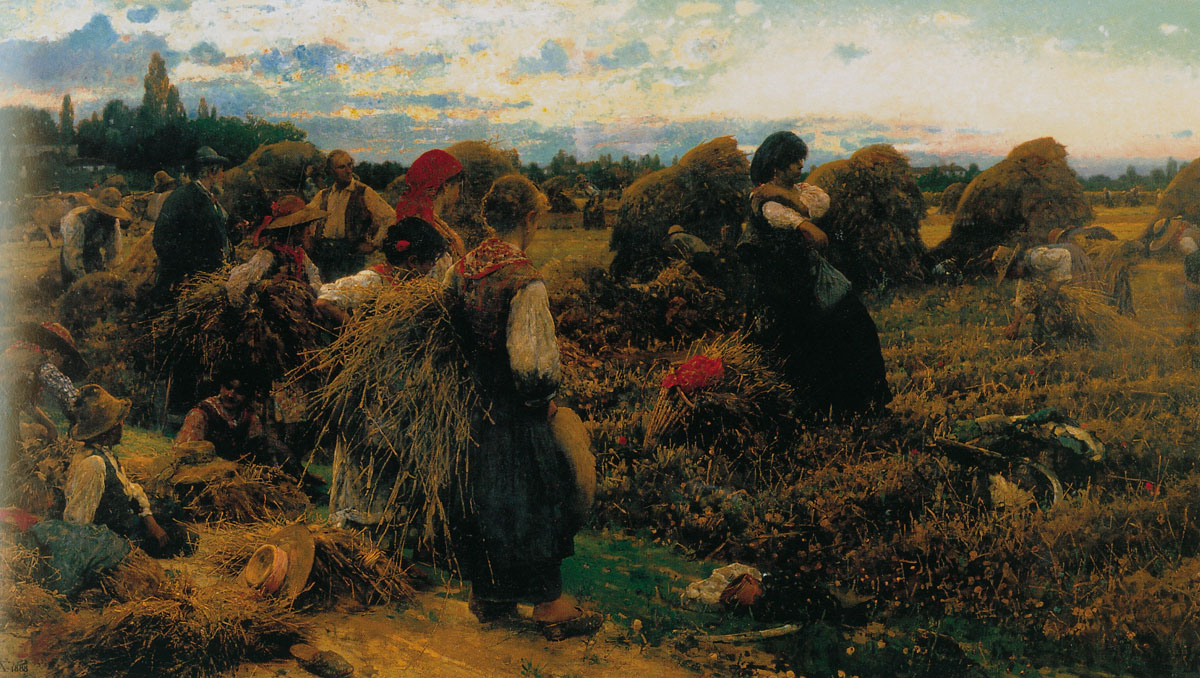
Mixed Marriages and Ezra's Prayer
"O my God, I am ashamed and blush to lift up my face to thee"
"The people of Israel, and the priests, and the Levites, have not separated themselves from the people of the lands, doing according to their abominations, even of the Canaanites, the Hittites, the Perizzites, the Jebusites, the Ammonites, the Moabites, the Egyptians, and the Amorites. For they have taken of their daughters for themselves, and for their sons: so that the holy seed have mingled themselves with the people of those lands: yea, the hand of the princes and rulers hath been chief in this trespass."
"And when I heard this thing, I rent my garment and my mantle, and plucked off the hair of my head and of my beard, and sat down astonied." Those who "trembled at the words of the God of Israel" gather around him until the evening sacrifice.
"O my God, I am ashamed and blush to lift up my face to thee, my God: for our iniquities are increased over our head, and our trespass is grown up unto the heavens." Since the days of their fathers, he confesses, they have been delivered to kings, sword, captivity and plunder.
"And now for a little space grace hath been shewed from the LORD our God, to leave us a remnant to escape, and to give us a nail in his holy place… For we were bondmen; yet our God hath not forsaken us in our bondage, but hath extended mercy unto us in the sight of the kings of Persia, to give us a reviving… and to give us a wall in Judah and in Jerusalem."
He recalls the commandment given "by thy servants the prophets": the land is unclean with the uncleanness of its peoples; "give not your daughters unto their sons, neither take their daughters unto your sons." "O LORD God of Israel, thou art righteous: for we remain yet escaped, as it is this day: behold, we are before thee in our trespasses: for we cannot stand before thee because of this."
Old names for new neighbors
The list combines the nations of Canaan from Deuteronomy 7:1 (Canaanites, Hittites, Perizzites, Jebusites, Amorites) with the peoples excluded from the assembly in Deuteronomy 23:3–8 (Ammonites, Moabites, Egyptians). By the 5th century BC there were no Hittites, Perizzites or Jebusites as living peoples. The old names describe the neighbors in the language of the Torah: they define a religious boundary, not an ethnic survey. Ammonites, Moabites and Egyptians did exist. The KJV text of 1 Esdras 8:69 has "Edomites" instead of Ammonites and Amorites; the library's Greek (Giguet) has "Moserites" for Egyptians (from Hebrew Mitsri).
"The holy seed"
Zera' haqqodesh comes from Isaiah 6:13 ("the holy seed shall be the substance thereof"). Applied to the community, it pictures Israel as holy by descent, as priests were holy by descent. Scholars debate how far this moves toward an ethnic definition of the people, and how far the concern is covenant faithfulness and worship ("doing according to their abominations"). Ancient categories of people, lineage and religion do not match modern ideas of race, and the site does not use racial language for them.
A peg in his holy place
The "nail" (yated, a tent peg) in 9:8 is a small, firm hold: a temporary foothold that grace has given. Isaiah 22:23 uses the image of a peg in a sure place; Zechariah 10:4 of the peg that comes out of Judah.
"By thy servants the prophets"
The commandment Ezra quotes (9:11–12) combines phrases from Leviticus 18:24–30, Deuteronomy 7:3 and 23:6, and others. It is not a quotation from any one prophetic book: Ezra treats the Torah as delivered through prophets, beginning with Moses.
Other voices in Scripture
| Passage | Stance |
|---|---|
| Exodus 34:11–16; Deuteronomy 7:1–4 | No marriages with the nations of Canaan, "for they will turn away thy son" |
| Deuteronomy 23:3–8 | Ammonites and Moabites excluded from the assembly; Edomites and Egyptians admitted in the third generation |
| Genesis 41:45; Exodus 2:21; Numbers 12:1 | Joseph marries an Egyptian; Moses a Midianite and a Cushite |
| Joshua 6:25; Ruth 1–4 | Rahab of Jericho and Ruth the Moabite join Israel; Ruth becomes David's great-grandmother |
| 1 Kings 11:1–8 | Solomon's foreign wives turn his heart (cited in Nehemiah 13:26) |
| Isaiah 56:3–8 | Foreigners who join themselves to the LORD will be brought to his holy mountain |
| Malachi 2:10–16 | Judah has married "the daughter of a strange god"; "he hateth putting away" |
Ezra 9–10 stands within this conversation, not apart from it. Ruth and Isaiah 56 show outsiders welcomed when they commit to Israel's God; Ezra 9 sees intermarriage with "the peoples of the lands" as a threat to a fragile community's faithfulness. Readers have weighed these voices differently for over two thousand years.
Why this crisis?
- Covenant and worship: marriages with those "doing according to their abominations" endangered the community's faithfulness, as in Solomon's case (the text's own explanation).
- Survival of a small community: a province of perhaps a few tens of thousands, surrounded by larger neighbors, could be absorbed within generations.
- Land and inheritance: marriages with local families could transfer land to outsiders (a social-historical proposal).
- Power: "the princes and rulers" led the way; marriage alliances with local elites may have been political (a social-historical proposal).
- Identity after exile: returnees defined themselves as the true Israel, sometimes against those who had stayed (a social-historical proposal, which some scholars find ethically troubling).
These proposals are not mutually exclusive, and none is proven from the text alone. Missing throughout are the voices of the women and their families.
What the evidence shows
- Ezra 9:1 uses the Torah's lists of nations, some of which no longer existed.
- Ezra 9:11–12 is a composite of Torah passages.
- The crisis was primarily about modern ideas of race.
- Social and economic motives lay behind the reform.
- "Grace hath been shewed from the LORD our God, to leave us a remnant."
Continue the journey
Journey of a PassageEzra 9:1–2; 1 Esdras 8:69–70: The peoples of the lands and "the holy seed"Ezra's list of peoples combines Deuteronomy 7:1 and 23:3–8.More from this lesson
Echoes Across Civilizations
Optional: how other ancient peoples told similar stories. Open one to compare, then come back to the lesson.
Outsiders in the family lineIsraelite (later) · Jewish (Second Temple and rabbinic) · Greek
How did Israel's Scriptures and its neighbors treat foreign women who joined a people?
- Israelite (later): Ezra and Nehemiah Possible historical contact
- Jewish (Second Temple and rabbinic): Conversion traditions Possible historical contact
- Greek: Citizenship laws Resemblance only
Why this matters to the rest of Scripture
- The nations of Canaan.
- Who may enter the assembly.
- "Thy people shall be my people."
- "Mine house shall be called an house of prayer for all people."
- "The holy seed."
- Another great prayer of confession.
- Daniel's confession.
- Marriage and faithfulness.
- "Thou shalt love him as thyself": the stranger in Israel.