Haggai, Zechariah and an Imperial Inquiry
"We are the servants of the God of heaven and earth"
"Then the prophets, Haggai the prophet, and Zechariah the son of Iddo, prophesied unto the Jews that were in Judah and Jerusalem in the name of the God of Israel, even unto them. Then rose up Zerubbabel the son of Shealtiel, and Jeshua the son of Jozadak, and began to build the house of God which is at Jerusalem: and with them were the prophets of God helping them."
"At the same time came to them Tatnai, governor on this side the river, and Shetharboznai, and their companions, and said thus unto them, Who hath commanded you to build this house?" They ask for the builders' names. "But the eye of their God was upon the elders of the Jews, that they could not cause them to cease, till the matter came to Darius."
Their letter reports: "We went into the province of Judea, to the house of the great God, which is builded with great stones, and timber is laid in the walls, and this work goeth fast on." The elders answered: "We are the servants of the God of heaven and earth, and build the house that was builded these many years ago, which a great king of Israel builded and set up. But after that our fathers had provoked the God of heaven unto wrath, he gave them into the hand of Nebuchadnezzar."
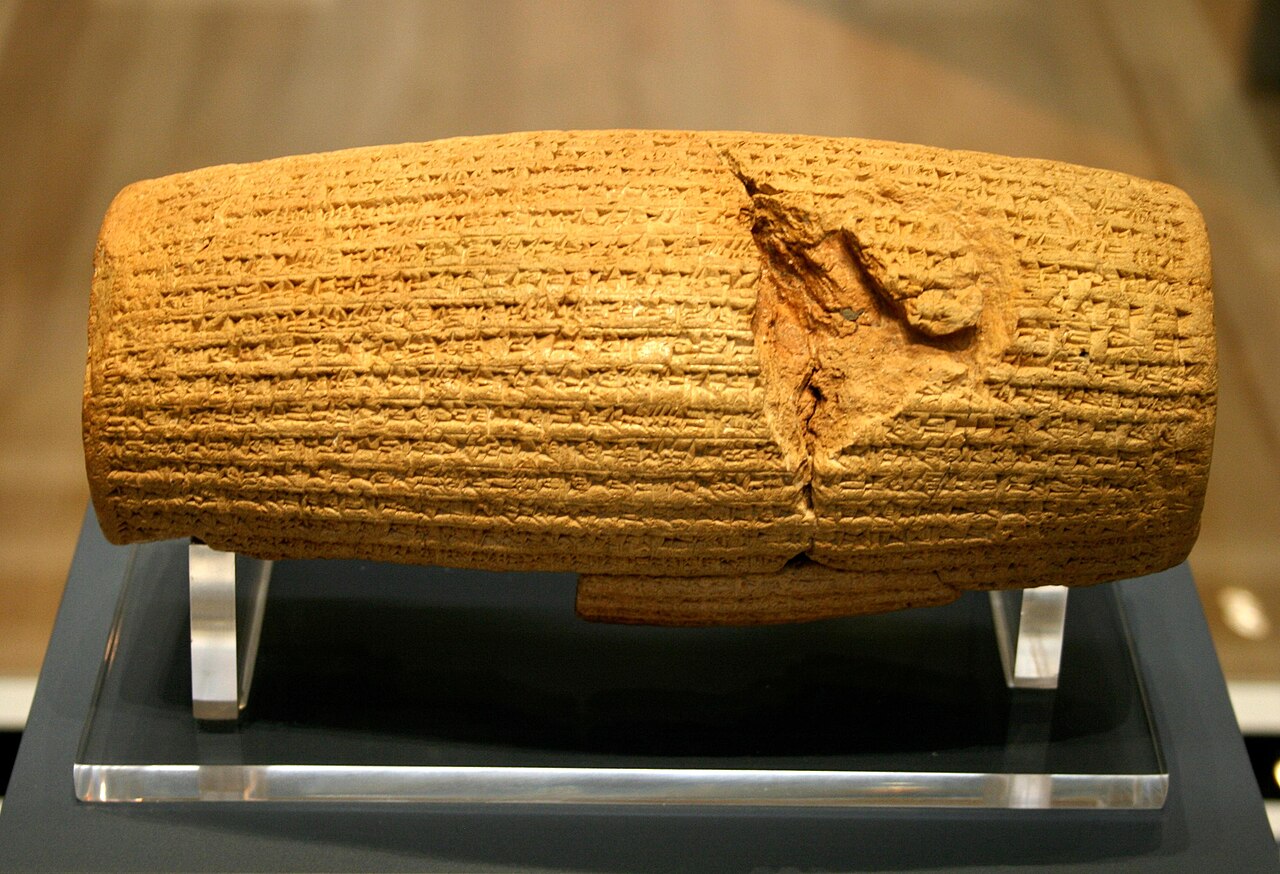
"But in the first year of Cyrus the king of Babylon the same king Cyrus made a decree to build this house of God." Cyrus gave the vessels to Sheshbazzar, "whom he had made governor," who "laid the foundation of the house of God which is in Jerusalem: and since that time even until now hath it been in building, and yet it is not finished." "Now therefore, if it seem good to the king, let there be search made in the king's treasure house."
Haggai and Zechariah
Haggai's dated oracles fall between the first day of the sixth month and the twenty-fourth day of the ninth month of Darius' second year (520 BC). He rebukes the people for living in "cieled houses" while the LORD's house lies waste (Haggai 1:4), and promises that "the glory of this latter house shall be greater than of the former" (2:9). Zechariah's visions (Zechariah 1–8) begin in the same year; he promises that "the hands of Zerubbabel have laid the foundation of this house; his hands shall also finish it" (4:9). Ezra names both prophets but quotes neither.
Tattenai
A Babylonian legal document dated to Darius' twentieth year (502 BC) names Ta-at-tan-ni, governor (pahat) of Ebir-nari ("Across-the-River"), as a superior of Ushtanu, satrap of Babylon and Across-the-River. This is usually identified with Ezra's Tattenai; the tablet does not mention Jerusalem. It shows that a man of this name held this office under Darius I.
"Great stones, and timber laid in the walls"
Building walls of stone courses with timber beams (6:4: "three rows of great stones, and a row of new timber") is a known technique in the region, used in Solomon's courts (1 Kings 6:36; 7:12) and at Late Bronze and Iron Age sites, to strengthen masonry.
Sheshbazzar's foundation and Zerubbabel's
5:16 credits Sheshbazzar with laying the foundation; 3:10 and Zechariah 4:9 credit Zerubbabel. In the elders' answer to a Persian official, naming the governor appointed by Cyrus himself would make legal sense. Whether the two foundings are one event, two stages, or two traditions is not settled.
The archive request
Tattenai asks Darius to search "the king's treasure house, which is there at Babylon." The scroll is found instead at Ecbatana (6:2), Cyrus' summer capital in Media. Persian royal records were kept in several centers, and Elamite administrative tablets from Persepolis show an elaborate record system. The detail that the document turned up in an unexpected archive is the kind of detail an inventor would not need, but it is not proof.
4Q117 at 5:17
The 4Q117 fragments reportedly include 5:17, the end of Tattenai's letter, and continue into 6:1–5. The site marks the exact surviving letters as not yet collated with the published edition.
What the evidence shows
- Haggai dates his oracles to Darius' second year (520 BC). Haggai 1:1; 2:1, 10.
- A Tattenai was governor of Across-the-River under Darius I. Babylonian document of 502 BC (Ungnad; Olmstead).
- Tattenai's letter is preserved in a Persian archive. Known only from Ezra.
- Sheshbazzar laid the temple's foundation. Ezra 5:16 vs 3:10; Zechariah 4:9.
- "The eye of their God was upon the elders of the Jews."
Continue the journey
Journey of a PassageEzra 3:8–13; 5:1–2, 16; Haggai 1–2; Zechariah 4:9: When was the foundation laid?Ezra 3 places the foundation in the second year after the return under Zerubbabel and Jeshua; Ezra 5:16 credits Sheshbazzar; Haggai and Zechariah tie Zerubbabel's foundation to 520 BC.More from this lesson
On the map
Location securely identified Probable identification Proposed or debated location Biblical route (roads schematic) Scholarly proposal
- Letters between Yehud and the court (schematic). Schematic geography of the correspondence, not a courier route. Officials of Samaria and Across-the-River wrote to the king; an archive search began in Babylon and found Cyrus' memorandum at Ecbatana. The court moved between Susa, Babylon, Ecbatana and Persepolis (Persepolis lies beyond the map).
Investigations
Optional deep dives: the ancient sources, the physical evidence, and every interpretation side by side, including unconventional ones, each labeled for what it is.
Who Was Sheshbazzar?Identity: unresolved · Outside evidence: none for either name in this role
Was Sheshbazzar, "the prince of Judah," the same man as Zerubbabel?
Sheshbazzar receives the temple vessels from Cyrus, is appointed governor and is said to have laid the temple's foundation. Ezra 3 and Zechariah give the foundation to Zerubbabel. Sheshbazzar then disappears from the story. Three main answers have been proposed; none is proven.
Open the full investigation →Are Ezra's Persian Letters Authentic?Style: authentic Persian-period · Originals: none survive · Authenticity: disputed
Do the Aramaic letters and decrees in Ezra 4–7 reproduce real Persian documents?
Ezra quotes seven official documents in Aramaic. Their formulas, titles and vocabulary match genuine Achaemenid Aramaic letters from Egypt, the satrap Arshama's archive and Bactria. No original of any of them survives, and their theological language has led some scholars to think they were composed or reworked by Jewish writers. Opinion ranges from authentic archival copies to literary creations.
Open the full investigation →4Q117: Ezra among the Dead Sea ScrollsManuscript: authentic · Coverage: fragments of chs. 4–6 (reported) · Letters: not yet collated by the site
What does the one Qumran manuscript of Ezra preserve?
4Q117 (4QEzra) is the only identified copy of Ezra from Qumran: three small fragments of the Aramaic section, reportedly 4:2–6, 4:9–11 and 5:17–6:5, copied in the 1st century BC and published by Eugene Ulrich in DJD XVI (2000). It is the oldest surviving copy of Ezra. It does not preserve the whole book, and it says nothing about who wrote it.
Open the full investigation →Echoes Across Civilizations
Optional: how other ancient peoples told similar stories. Open one to compare, then come back to the lesson.
Letters of the Persian empireJewish (Egypt) · Persian
How do the Aramaic letters in Ezra compare with real letters of the Persian empire?
- Jewish (Egypt): Elephantine petition and memorandum Possible historical contact
- Persian: Letters of the satrap Arshama Possible historical contact
- Persian: Aramaic copy of the Behistun inscription Possible historical contact
Why this matters to the rest of Scripture
- The call to rebuild.
- "Not by might, nor by power, but by my spirit."
- Solomon, the "great king of Israel."
- Nebuchadnezzar burns the temple.
- Sheshbazzar receives the vessels.